





The Options Industry Conference took place May 5-7 in Palm Beach Gardens, Florida. Traders Magazine, a Markets Media Group publication, covered Day 1 and Day 2 of the event; we cover Day 3 here.
Institutional Innovation
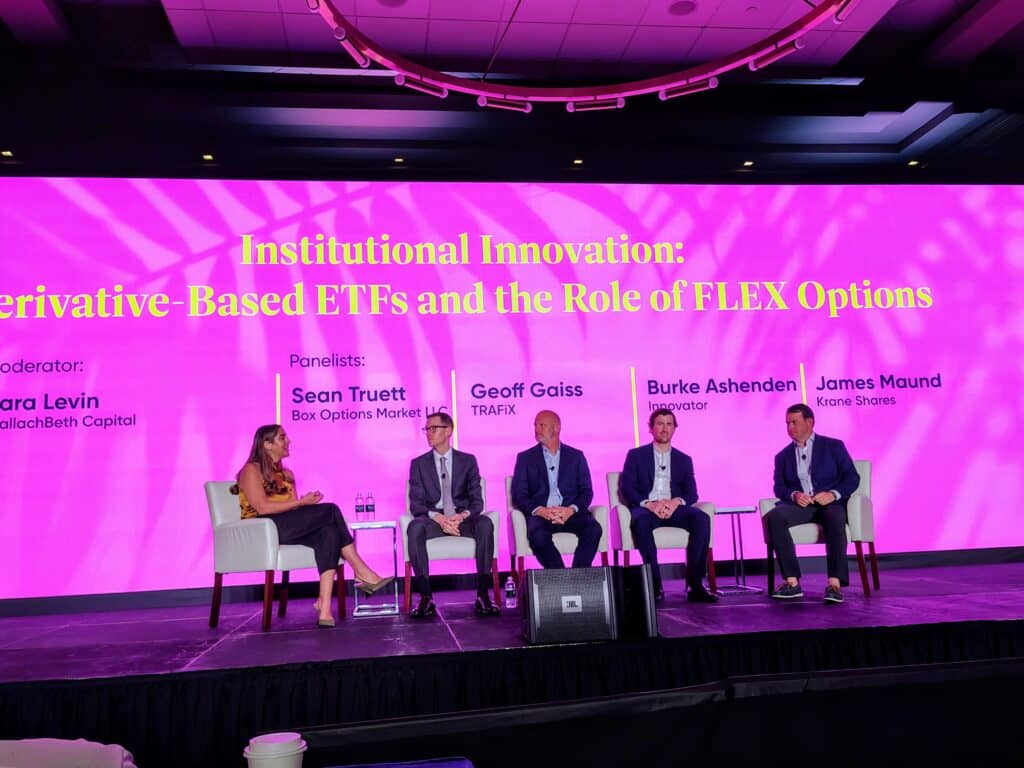
The institutional innovation panel Thursday morning at OIC was about how institutions are increasingly using derivative-based ETFs and FLEX options (customizable contracts that allow investors to tailor the strike price, exercise style, and expiration date) to achieve precise risk-return outcomes.
It was noted that a decade ago the buy side was generally uninterested in hearing about options strategies ago, and as recently as five to six years ago there was still low awareness and enthusiasm. But there has been strong growth in recent years, touched off by the breakdown of the traditional 60/40 portfolio in 2021-22, as infrastructure has developed and the strategies have proven themselves as a way to dampen volatility and generate income.
Defined outcome ETFs can offer liquidity, tax efficiency, and transparency in a scalable ETF wrapper. RIAs are the core users of the product but foundations, endowments and pensions are among institutions getting involved.
An advisor being able to communicate an outcome to a client is invaluable — institutions have been tough to break in with in this regard as they tend to think of ETFs as liquidity placeholders. A big unlock will be institutional acceptance of asymmetrical payoffs and alternative sources of income in a wrapper that’s transparent compared with hedge fund returns and private assets.
The panel noted that in the early 2020s, there were only about three market makers in defined outcome ETFs and FLEX options, and trading was “by appointment.” The products remain in the high touch realm but there are many more brokers involved and more trades are being crossed electronically.
The products can expand further with more education provided to both retail and institutional, as well as more automation and infrastructure optimization that will lighten the currently heavy operational load.
Moderator: Sara Levin, WallachBeth Capital
Panelists: Sean Truett, BOX Options Market; Geoff Gaiss, TRAFiX; Burke Ashenden, Innovator; James Maund, Krane Shares
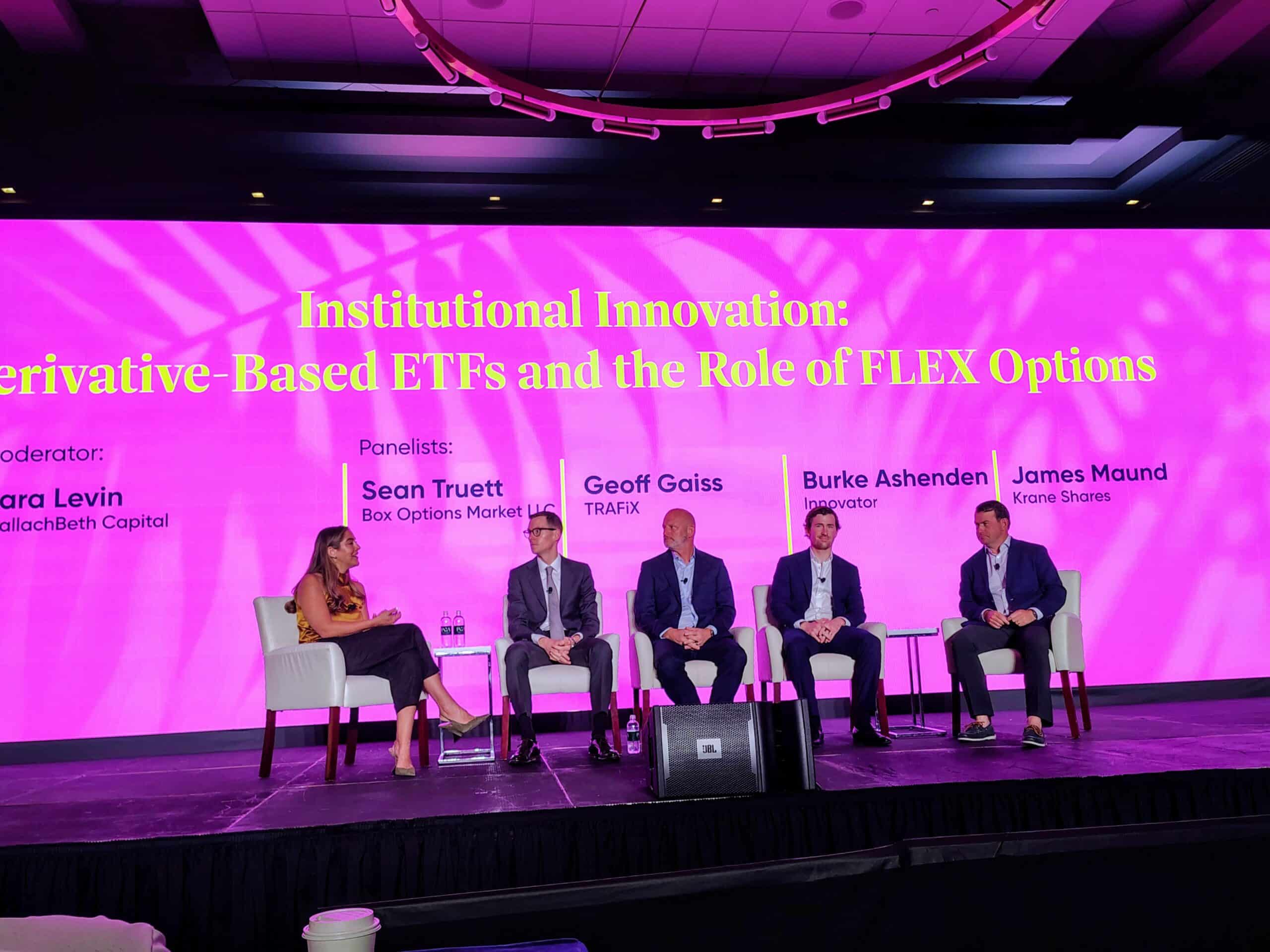
The Institutional Innovation panel at the Options Industry Conference
Event Contracts
The Event Contracts aka prediction markets panel was the last session of the three-day OIC, and strong interest in the topic earned it 60 minutes rather than 45 minutes for all other OIC panels.
Based on anecdotal observation, panel attendance on the last day of a conference is often down 50% or more, but this session had no drop-off from Tuesday or Wednesday.
The panel jumped right into regulation, or the lack thereof, for event contracts. It was noted that it must be made clear what’s a security and what’s a future, as the gray area between the SEC and the CFTC is impeding market development. Also, swap dealer registration rules need to be revisited, as the current framework and event contracts are centrally cleared.
The agricultural industry is in the ear of regulators, as they are a politically connected industry and they are asking tough questions about what new rules might mean for ag futures market.
Market operators are positioning themselves to offer prediction markets that relate to financial markets directly – there are no plans for sports or culture.
An opportunity, and a risk of prediction markets is long tail of products, which further out on the tail will offer limited price discovery and be more susceptible to market manipulation. Ultimately the onus will be on retail brokers to determine suitability for clients.
Data from prediction markets is becoming more accurate and valuable. To the question of whether they can serve institutional hedging needs, it was noted that the markets have evolved from a niche curiosity to a significant risk transfer mechanism, information from which can be valuable for investment firms.
Beyond that there were discussions on the jurisdictional question, and whether market participants can “pick their regulator” by calling their products either binary option swaps or security options. Tribal sovereignty is another consideration.
The event contract question may well end up with the Supreme Court.
The panel noted that legal certainty is a prerequisite for capital deployment – the worst outcome would be reactionary rulemaking that pushes event contracts offshore.
Moderator: Dawn Stump, Stump Strategic
Panelists: JJ Kinahan, Cboe Global Markets; Ryan Jachym, Goldman Sachs; Summer Mersinger, Blockchain Association; Thomas Plummer, Jump Trading

The Event Contracts panel at OIC.

NEWSLETTER SIGN UP
And receive exclusive articles on securities markets

🏆 The 2026 Global Markets Choice Awards are here! 🌍 Nominations are officially OPEN for the celebration of excellence in global capital markets trading & technology. Nominate below:
https://www.jotform.com/form/260086385121150

Delaware Life Insurance Company is becoming the first insurance carrier to offer an index that contains cryptocurrency, adding the BlackRock U.S. Equity Bitcoin Balanced Risk 12% Index to its fixed index annuity (FIA) portfolio.
As the digital assets industry pushes toward
Franklin Templeton is expanding its tokenized fund suite, signaling growing institutional demand for blockchain-based fund infrastructure and regulated investment products moving onchain. Read the full article below:
$50 billion in active ETF inflows helped fuel a record year for @BlackRock 's iShares business, as investors continue to lean into active strategies.
Related articles
-

QQI launches as investors are reassessing international markets amid shifting trade dynamics.
-

The timing follows CME's plans to list futures on the FutureSports NHL and MLB indexes.
-

Year-to-date net inflows are a record $1.96 trillion.
-
The European ETF industry is on pace to establish a new annual record for net inflows in 2026.
-

The two asset managers are likely to continue jockeying for first place.