






02.25.2026

Nasdaq said transforming markets and the financial systems is one of its strategic priorities through enabling equities trading for 23 hours each day between Monday and Friday, tokenization of equities and deployment of artificial intelligence.
The firm said at its investor day on 25 February 2026 in New York that these efforts will create powerful flywheels across its three divisions – capital access platforms; financial technology, and market services – and will expand connectivity, investor access and liquidity across the broader ecosystem.

Adena Friedman, Nasdaq
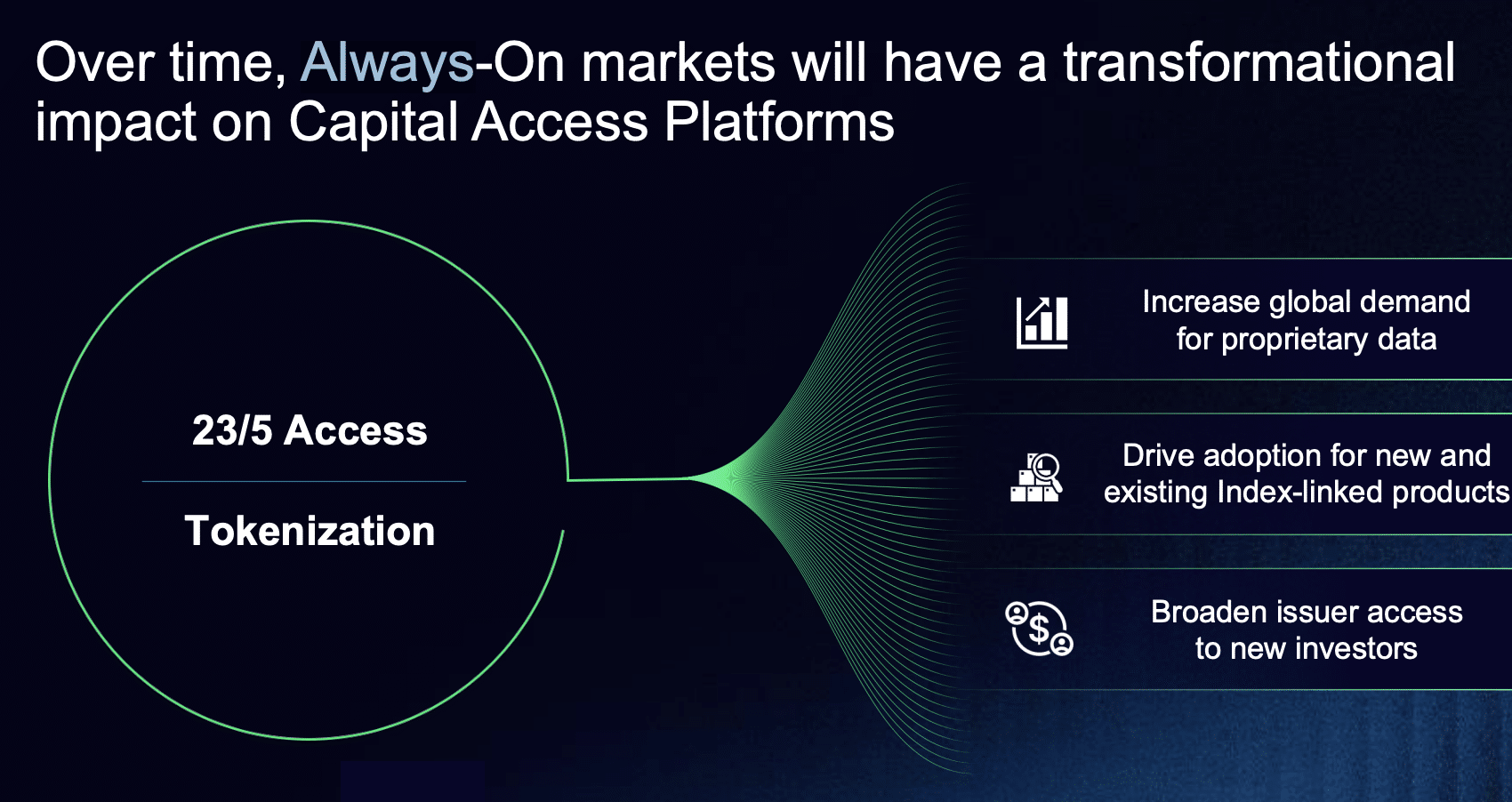
Adena Friedman, chair and chief executive of Nasdaq, said during the investor day: “23×5 is our first step with the tokenization of equities to create an always-on market infrastructure for the future.”
Friedman said Nasdaq started experimenting with blockchain in its markets nine years ago and began integrating digital asset capabilities into its market technology solutions.
“We have integrated blockchain and digital asset capabilities across our market technology solutions and we are now deploying that for our clients,” she added. “We are ready for the next steps in terms of tokenizing equities on our markets and other markets around the world.”
She argued that the always-on market will generate enormous flywheels across Nasdaq, open up access to new investors and drive resilience in market infrastructure for tokenized assets around the world. Iead to more institutional engagement, and create demand for Nasdaq’s financial technology solutions.
“That is a new flywheel that we are really, really excited to talk about,” added Friedman.
Source: Nasdaq
Nelson Griggs, president of Nasdaq, said at the investor day that Nasdaq has an opportunity to help issuers take advantage of tokenization to find new investor pools, particularly around retail on an international basis. He said: “We also think there’s a great opportunity to reduce some frictions in the marketplace that exist, primarily around the proxy process.”
Nasdaq has consistently defined three technologies that are transformative for the industry over time: cloud, AI and blockchain.
Cloud
The firm had just launched an AI team when Friedman became chief executive at the start of 2017. Friedman said Nasdaq started to accelerate its cloud efforts nine years ago and began bringing the technology into each client-facing solution and market, as well as its internal operations.
“We really started to scale that team and partner them with the business to create AI capabilities across our solutions and our markets,” she added. “We were able to accelerate that even further with the acquisition of Verafin.”
Nasdaq completed its acquisition of Verafin, which provides anti-financial crime management solutions through a cloud-based platform, in February 2021. As a result, Friedman said Nasdaq is fully scaled in cloud across its internal operations, client solutions and markets.
Brenda Hoffman, divisional chief technology officer at Nasdaq, said at the investor day that the firm has moved seven of its eight options books to its Fusion platform, which she describes as a modern, state-of-the-art technology built for markets. She added that clients like Fusion for its “best in class”performance metrics with 19 microsecond latency and the ability to process millions of messages per second. In addition, clients’ experience of connecting to Fusion and writing their algorithms remained the same, so they like the consistency and standardization of connecting Nasdaq markets.

Brenda Hoffman, Nasdaq
“We have one more options market to move this summer, and when we finish, that is going to mark a major milestone in our journey to have all of our markets running on the platform,” she added.
Nasdaq has also built an AWS cloud offering for Calypso, the technology that provides scalable capital market solutions for trading, risk and collateral management, and for AxiomSL which provides regulatory reporting. More than 80% of new clients in the last two years have chosen Nasdaq’s cloud platform, according to Hoffman.
Brad Peterson, chief information officer and chief technology officer at Nasdaq, claimed at the investor day that the firm’s move to the cloud means it is well prepared for AI. He said: “It turns out that both are prerequisites for unlocking the full value of AI.”
Don Beery, chief AI integration officer, agreed that Nasdaq’s early leadership in cloud is one reason that it is one of the leaders in AI. He said: “12 years of sustained investment in cloud computing, machine learning and AI means this team has built an engineering organization that is truly ahead of the industry. “
AI
Beery continued that Nasdaq has built a Gen AI platform which is secure, foundational and scalable. The platform allows users to register agents with an identity for authentication and authorization, see agent behavior, and use a kill switch to kill or roll back a unique agent or a fleet of agents.
Hoffman gave the example of Nasdaq using AI in its trade surveillance product. Last year the engineering team reimagined the product development life cycle with AI and suggested 12 agent types, with four now being deployed. As a result, there has been an approximately 20% reduction in the development cycle and higher productivity.
Griggs said Nasdaq’s CAP intelligence layer is its advantage in an AI world. He described the platform as a unified intelligence layer, which normalizes, links and enriches all of the firm’s data so it can be used across the entire product portfolio.

Nelson Griggs, Nasdaq
“We have embedded institutional-grade security, governance, entitlement and traceability so we make sure the data is properly used, both internally and externally by our clients,” said Griggs. He stressed that the platform is not a data lake, but a truly intelligent layer that provides AI-ready data.
“We are bringing more product to market more quickly, and the quality of that product continues to get better,” Griggs added. “We believe this is the foundation for us leading in an AI world.”
Angie Ruan, divisional chief technology officer, said during the investor day that the firm has data from 30,000 public and 80,000 private funds representing more than $90 trillion in institutional assets.
“The real power isn’t just the data itself,” added Ruan. “It’s how we integrate the data and our business together through the entire group and turn it into shared intelligence.”
Ruan gave the example of Nasdaq inventing a patent pending data transformation mechanism to help institutions analyse unstructured data in their investment decisions. Nasdaq uses its Gen AI platform to build an agent for each document to automatically transform unstructured, messy content into AI-ready data.

Angie Ruan, Nasdaq
“The results have been remarkable,” said Ruan. “We have seen 50% more relevant answers and 70% more token efficiency, which is the cost of AI compute efficiency.”
There has been “really strong” early adoption from the largest global asset managers, according to Ruan. She said: “In fact, they are reaching out to us as they believe embracing AI is an accelerator for their business.”
Peterson added that every Nasdaq product has AI opportunities in its roadmap. The group will also continue to advance its internal deployment of enterprise-grade AI capabilities to drive productivity.
In addition nearly all, 88% of Nasdaq’s clients have started to use AI inside their organizations, but only 7% have been able to generate AI capabilities at scale within their infrastructure, according to Friedman. Clients are being held back by a lack of confidence in securing the data and the outputs that AI creates, that they have not been able to generate a clear return on investment across every use case and the complexity of their own operations and technology.
Friedman argued that Nasdaq is an expert in secure, compliant and resilient infrastructure, and so is “incredibly well situated” to partner with clients to help them transform their business with AI.
“We have authoritative data, a cloud-native and resilient platform, a hyper focus on security and deep market expertise,” Friedman said. “We are built for speed and machine-to-machine capabilities.”
During the investor day, Nasdaq announced an AI productivity program with a run-rate expense efficiency target of $100m to be actioned by year-end 2027.
Financials
Nasdaq also added in a statement that it is raising its medium-term revenue outlook for the solutions business from 8-11% to 9-12% growth, reinforcing confidence in the company’s platform.

Sarah Youngwood, Nasdaq
The firm said the increase is driven by an elevated outlook for the capital access platforms division and sustained growth expectations for its financial technology division. The company is maintaining its medium‑term expense guidance at 5-8% and is reaffirming its 2026 expense outlook.
The company’s medium-term outlook includes:
– capital access platforms revenue growth of 6-10%, an increase from 5-8%
– financial technology revenue growth of 10-14%
– total solutions revenue growth of 9-12%, an increase from 8-11%
– maintains non-GAAP operating expense growth of 5-8%
The outlook reflects a three-to-five-year period and assumes a stable market backdrop. The company also reaffirmed its 2026 non-GAAP operating expense guidance with a range of $2.455bn to $2.535bn.
Sarah Youngwood, chief financial officer at Nasdaq, said in a statement: “Raising our medium-term outlook underscores our continued ability to grow organically.”

NEWSLETTER SIGN UP
And receive exclusive articles on securities markets

🏆 The 2026 Global Markets Choice Awards are here! 🌍 Nominations are officially OPEN for the celebration of excellence in global capital markets trading & technology. Nominate below:
https://www.jotform.com/form/260086385121150

Delaware Life Insurance Company is becoming the first insurance carrier to offer an index that contains cryptocurrency, adding the BlackRock U.S. Equity Bitcoin Balanced Risk 12% Index to its fixed index annuity (FIA) portfolio.
As the digital assets industry pushes toward
Franklin Templeton is expanding its tokenized fund suite, signaling growing institutional demand for blockchain-based fund infrastructure and regulated investment products moving onchain. Read the full article below:
$50 billion in active ETF inflows helped fuel a record year for @BlackRock 's iShares business, as investors continue to lean into active strategies.
Shanny Basar
Senior writer
A Senior Writer at Markets Media who became a financial journalist in 2000 after working in banking for over a decade....
More about this author