






03.24.2026

There have been increased requests for redemptions from private credit funds and Goldman Sachs expects these other continue through next year, but the bank argued that the institutional segment remains strong.
Alex Blostein, an analyst who covers U.S asset managers and other financial companies for Goldman Sachs research, and Vivek Bantwal, global co-head of private credit in Goldman Sachs Asset Management and co-chief executive officer of the Goldman Sachs BDC complex spoke on the bank’s Exchanges podcast on 19 and 20 March 2026. BDCs, or business development companies, are pools of capital that buy leveraged loans
Blostein said on the podcast that there is a lot of nuance to the private credit market but there are definitely some valid risks.
A series of asset managers have put limits on withdrawals from their private credit funds because of an increase in redemption requests from investors. These requests are a result of concerns about poor underwriting standards, funds having large exposures to software companies which may be in danger of being disrupted by artificial intelligence, the lack of monetization of AI and the increasingly challenging macroeconomic environment.
Blostein said the first issue is that private credit has grown at an annual 15% rate over the last several years and he estimated that the asset class is now more than $3.5 trillion, but there is a lack of transparency compared to public equities. The second issue is the software exposure and the third, which he described as “most acute” is liquidity with some retail products.
“I feel like we have seen pretty sizable withdrawals every day for the last month and there may be an effect on asset pricing if any of these funds have to sell assets to meet redemptions,” said Blostein.
On 24 March Bloomberg reported that Ares Management is limiting redemptions at its $10.7bn private credit fund.

Marc Rowan, Apollo
Alternatives manager Apollo, led by Marc Rowan, said in a filing with the U.S. Securities and Exchange Commission on 23 March 2026 that Apollo Debt Solutions BDC gross inflows were approximately $724m in new subscriptions in the first quarter of 2026. However, against a backdrop of rising redemption requests across the semi-liquid segment of the wealth market, the fund received shareholder requests to repurchase approximately 11.2% of outstanding shares as of December 31, 2025, based on preliminary information.
“Consistent with the fund’s designated liquidity objectives, ADS will honor redemption requests for 5% of shares outstanding, which we estimate to represent approximately $730m of gross outflows based on February 28, 2026 NAV per share,” said the filing. “Taken together, we expect net flows into ADS will be approximately flat for the first quarter of 2026.”
Apollo said in the filing that ADS’ commitment to first lien senior secured lending with its emphasis on downside protection and focus on large-cap corporate borrowers means the fund is well positioned for the current environment.
“With that said, we expect to see more performance dispersion among BDCs over the coming quarters,” added Apollo. “Since the start, we have made a series of decisions as to how we manage ADS that have put us in a place today to drive future performance as a result of – not despite – the current cycle.”
Blostein argued that the current redemption requests are coming from retail, with just under 20% of the total assets the direct lending space, as institutions do not have the same mechanism in the same way.
“Over 80% of the assets in these funds do not have the liquidation mechanism that could result in fire sales and a downward spiral in prices, which is what everybody is worried about,’ said Blostein. “I would put that issue as front and center to think about where liquidity could become a real problem.”
In the retail space, Goldman Sachs estimated that gross sales are currently running about 50% lower that in 2025 while there has been a meaningful pickup in redemptions. Blostein expects most funds to use their ability to cap redemptions at 5%.

Alex Blostein, Goldman Sachs
“That puts people in the queue, and it will take more than a year to resolve some of these outflow issues,” he added. “We broadly think that evergreen retail funds in private credit will remain in net outflows throughout 2026 and likely 2027 based on some of the experiences we’ve seen with other similar products.”
On the institutional side of the equation the outlook could be quite different, according to Blostein. As there is a lot of money chasing fewer deals, he argued that returns for the next couple of years could become more attractive with better terms and covenants, so any dry powder is likely to be deployed. In addition, he expects more institutional fundraising over the next two years as spreads become more compelling.
Software exposure
Software exposures are predominantly in the direct lending part of the private credit ecosystem, which is between a total $1.6 trillion and $1.7 trillion, according to Blostein. He estimated that software is approximately 25% in terms of the assets that have been allocated to this part of the market.
“All software is not created the same, and the challenge is going to be that some of the software companies will have terminal value questions,” said Blostein. “We won’t see that for several years, because today, these credits are performing just fine.”
He also argued that in terms of the underlying quality of the portfolio companies, there has not been a deterioration in accruals and there has not a significant increase in payment in kind dynamics across the space.
“I would say though, credit is credit,” he added. “It’s not equity so there is a significant amount of subordination that exists below these credits.”
Blostein said the loan-to-value ratio is at around 30 to 40% which means there is “significant amount of cushion beneath the loan.”
“In other words, almost 70% of the value of the company has to go away before you lose any capital as a loan provided to this ecosystem,” he said. “Because defaults have been zero, they have literally nowhere to go but up.”
He warned there will be a lot of dispersion, especially between retail and institutional capital, but expects the the ultimate loss rate will be “pretty manageable” at a systemic level
Bantwal said on the podcast last that there is no doubt hat AI is going to have a really big impact and disrupt a lot of software, so it is important to evaluate each company on a specific basis.
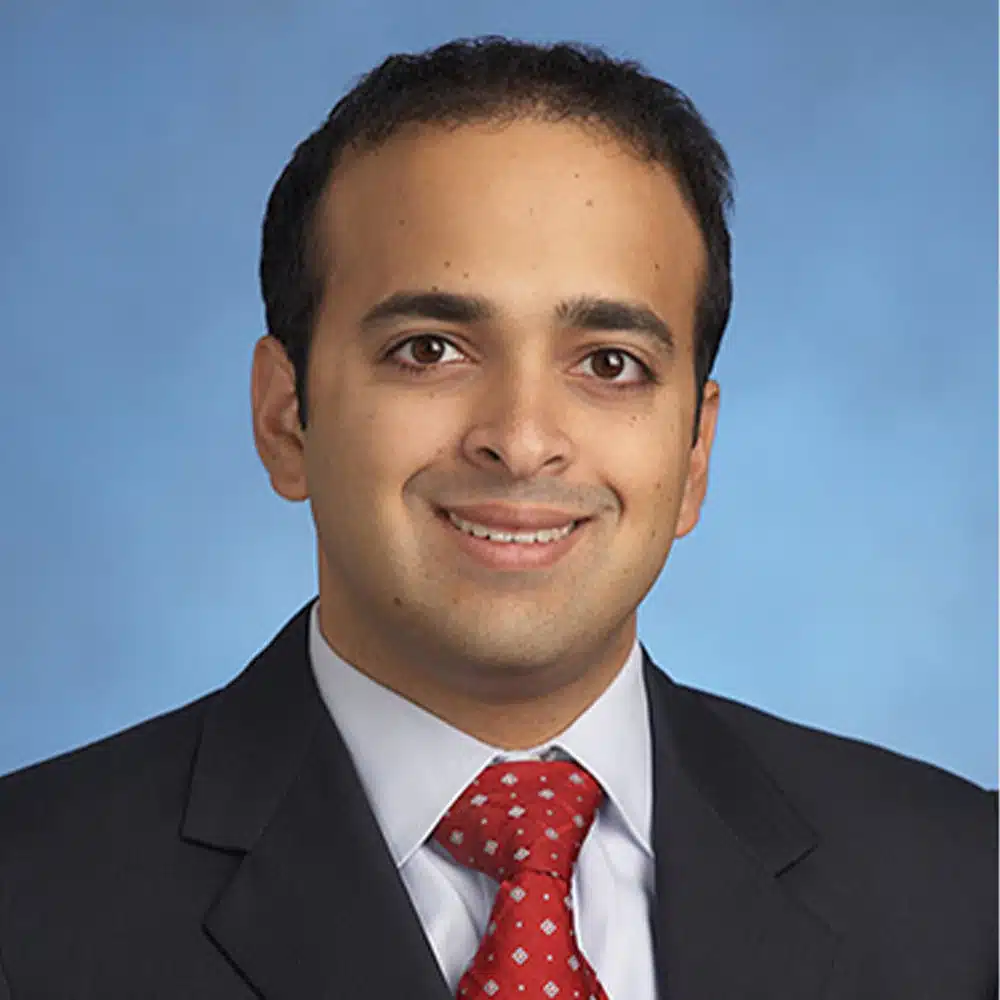
Vivek-Bantwal, Goldman Sachs
“We’ve been evaluating deals from an AI perspective, going back to 2023 when we turned down our first deal due to concerns around AI disruption,” Bantwal added.
The market is starting to appreciate that not all software is created equally, so companies are going to be impacted differently, and with some ending up as beneficiaries, according to Bantwal. He claimed that Goldman Sachs has a “very robust” screening framework ghat was developed with the bank’s internal engineers and outside consultants.
“Our general view is that if you have proprietary data, so you own the data and the customer, you’re going to be less disrupted than a company that doesn’t do those things,” he added.
In addition, Goldman Sachs is generally lending at about six times debt to EBITDA, and the loan-to-value on these companies at entry was generally 30% or less, so there is good coverage.
“One of the things that’s happening is that investors initially throw the baby out with the bath water, and then differentiation happens over time,” said Bantwal.
He believes that private credit businesses with largely institutional capital will be well positioned to invest through that cycle and get the better returns, as some of that flood of retail money leaves, and dispersion will create opportunities.
Liquidity
Goldman Sachs has had a strong view from the beginning of the evolution of private credit funds that the customer needs to understand that the illiquidity is part of the reason that returns are higher than in public credit, so the bank does not use the term semi-liquid, according to Bantwal.
“We think that if you’re allocating a portion of your portfolio where you don’t need access to that money, then we think that’s a really good reason to be in private credit because, over cycles, we have seen there is a risk premium,” said Bantwal.
He also argued that none of the handful of instances of fraud and default have happened in direct lending. In addition, the default rate in broadly syndicated loans is currently only about 1.3%.
“That means that for every company going wrong in private credit, there are 98.5 other companies that are paying their bills on time and where that is not an issue,” added Bantwal.
He believes the fundamentals of credit are currently quite strong, although conditions could get worse if there is a recession.

NEWSLETTER SIGN UP
And receive exclusive articles on securities markets

🏆 The 2026 Global Markets Choice Awards are here! 🌍 Nominations are officially OPEN for the celebration of excellence in global capital markets trading & technology. Nominate below:
https://www.jotform.com/form/260086385121150

Delaware Life Insurance Company is becoming the first insurance carrier to offer an index that contains cryptocurrency, adding the BlackRock U.S. Equity Bitcoin Balanced Risk 12% Index to its fixed index annuity (FIA) portfolio.
As the digital assets industry pushes toward
Franklin Templeton is expanding its tokenized fund suite, signaling growing institutional demand for blockchain-based fund infrastructure and regulated investment products moving onchain. Read the full article below:
$50 billion in active ETF inflows helped fuel a record year for @BlackRock 's iShares business, as investors continue to lean into active strategies.
Shanny Basar
Senior writer
A Senior Writer at Markets Media who became a financial journalist in 2000 after working in banking for over a decade....
More about this authorRelated articles
-

They will leverage capabilities across public and private markets in both equities and credit.
-

Pontes enables wholesale tokenised asset transactions to be settled in central bank money.
-

The French bank will pursue its cost reduction efforts including accelerating the deployment of AI.
-

Multi-bank network friction is becoming the bottleneck of business and corporate treasury.
-

Digital assets are new rails that can coexist with existing market infrastructures.