






03.27.2026
Vaults Emerge as ‘Core Building Block’ of Onchain Asset Management
03.27.2026
Matt Hougan, chief investment officer at Bitwise Asset Management, said at the Digital Asset Summit in New York on 26 March 2026 that all fund management will eventually be carried out through onchain vaults. Bitwise is a crypto fund manager with more than $15bn in client assets.
🚨 Bitwise CEO @Matt_Hougan on Digital Asset Management:
"Eventually all asset management will be done through vaults."
Bitwise currently custodies over 193,000,000 $XRP in its ETF Vault 🔥 pic.twitter.com/yZ77wNjCuf
— 🇬🇧 ChartNerd 📊 (@ChartNerdTA) March 26, 2026
Vaults are similiar to onchain investment funds that accept deposits of a single asset, such as a stablecoin, and deploy the asset in lending markets to generate yield, primarily across decentralised finance (DeFi). They can be described as a portfolio of lending positions that combine liquidity, strategy execution, and risk constraints in one transparent structure, rather than just replicating traditional financial products onchain.
Jonathan Galea, partner at law firm Cahill Gordon & Reindel (UK) LLP, said on LinkedIn that the model is interesting because each vault has a curator, who selects the lending markets and risk manages the exposure.
“The curator also tends to act as allocator, handling the day-to-day capital allocation within those parameters, though the two are technically distinct roles,” Galea added. “Crucially, neither carries custody over deposited assets, as the smart contract enforces the rules, and all allocations are visible onchain.”
Bitwise vault
In January this year Bitwise launched its first offering as the curator of a non-custodial vault powered by Morpho, an onchain platform that provides programmable and non-custodial infrastructure for lending and borrowing.
Dennis Bree, head of institutional sales at Morpho, told Markets Media that vaults are almost programmable mandates. Traditional institutional credit strategies might define eligible collateral, loan-to-value (LTV) ratios or concentration limits but these parameters can be executed automatically and transparently onchain. Morpho’s vault uses a set of smart contracts to programmatically invest funds on behalf of its clients with the aim of generating digital yield. At this point in time, Morpho vaults are native to, and only allocate to, Morpho markets.
The Bitwise strategy on Morpho’s vault currently targets an annual percentage yield of 6%, and the firm could expand into curating other lending strategies or real world asset exposures.
Innovations in asset management only come along every so often:
* 1770s: Closed-end mutual funds
* 1920s: Open-end mutual funds
* 1940s: Hedge funds
* 1970s: Money-market funds, index funds, SMAs
* 1990s: ETFs, target-date funds
* 2020: VaultsYou could quibble around the… https://t.co/4dEs9UqvLQ
— Matt Hougan (@Matt_Hougan) January 26, 2026
Paul Frambot, co-founder and chief executive of Morpho, said in a statement that its vaults are built for institutional use and enable professionally defined risk parameters to be expressed directly onchain. He added: “As major institutions like Bitwise recognise the value in diversified fixed-income strategies in digital assets, vaults are emerging as a core building block of onchain finance strategies.”
Jonathan Man, portfolio manager and head of multi-strategy solutions and DeFi strategies at Bitwise is responsible for the underlying strategy. As the curator of the vault, Bitwise also oversees the vault’s risk framework, including collateral requirements, exposure limits, and allocation parameters.
Man told Markets Media that Bitwise’s launch of a vault is a convergence of two things. He said: “The first is a much more constructive regulatory environment and the second is the explosive adoption of stablecoins.”
The GENIUS Act was passed by the U.S. administration in 2025 and set the first federal framework for stablecoins, but also restricted stablecoin issuers from paying yield. Stablecoins are being used for transactions, such as payments, but holders such as corporate treasuries will want to generate returns.

Jonathan Man, Bitwise
Most of the current stablecoin issuers are crypto-native firms but Bitwise expects the biggest growth factor will be general adoption. Man said: “We want to be part of that, and made that a priority for the firm. Being here early is important for us.”
Morpho’s platform provides different yield-generating and lending mechanisms, which are then evaluated by Bitwise, who allocate assets based on their risk appetite. Man said: “We have built in a lot of real-time risk monitoring and wrote an algorithm that encodes asset movements automatically.”
Off chain, in traditional finance, there are currently concerns about credit quality and possible defaults in the world of private credit. Man highlighted that he spent 17 years in traditional finance at CIBC Capital Markets which included CMBS, credit and fixed income derivatives trading, so he is familiar with credit issues. He argued that, as a curator, Bitwise tries to understand the risks associated with each opportunity that could go into the vault and would not sacrifice risk management just for higher yield.
“We are fiduciaries so we treat risk management very seriously and bring that to the vault business as well,” added Man.
Man continued that even though crypto assets are volatile, the lending markets have not suffered any bad debt, as there is always an automatic liquidation mechanism. Bitwise technology constantly monitors the health of the lending markets, and allocations will be decreased automatically if leverage increases. He said: “It runs fully automatically but we have alerting systems to wake up personnel around the world if necessary.”
Morpho’s onchain lending platform
Man said Bitwise chose Morpho as the firm is “one of the category definers.”
“Until Morpho came to market there really wasn’t the idea of a risk curator so they kind of created this whole category,” added Man. “We see them as one of the highest executing teams in DeFi and they also have a great track record from a security standpoint.

Dennis Bree, Morpho
Bree continued that Morpho invites invite banks and financial institutions to access onchain credit using their own risk parameters and strategies that align with their current investment mandates.
“You can think about us as a modular AWS for onchain credit,” Bree added. “We have transparent, programmable tools that allow institutions to understand the flow of funds and who owns those funds.”
In February this year Morpho was integrated into Taurus-PROTECT, a digital asset custody and servicing technology solution to enable banks, asset managers, and other financial institutions to access onchain lending strategies and develop yield products. Taurus’ integration will be made available to more than 40 financial institutions across four continents. Bree said that before this integration, institutions wanting to access DeFI had to move their assets out of their traditional custodian which created risk and operational complexity. Now, their assets do not have to leave a regulated environment.
Victor Busson, CMO at Taurus, said in a statement: “Custody technology providers are becoming the critical access layer between traditional finance institutions and onchain markets. Taurus’ integration with Morpho marks a structural shift – we allow institutions to engage at scale with Morpho onchain credit markets and develop innovative products on top of banking-grade financial infrastructure.”
Morpho has a “very strong” pipeline with traditional institutions, according to Bree.
FalconX’s private credit vault
In March 2025 digital asset prime broker FalconX said in a statement that it had launched the first institutional structured credit facility that was structured and tokenized onchain. The statement said: “This facility transforms institutional lending by packaging FalconX-originated loans into a structured product that investors can now access through a private credit vault.”
FalconX originates institutional loans, packages them into a structured product that institutional investors can access through a private credit vault launched by Pareto, a DeFi protocol specializing in onchain credit markets. M11 Credit, the credit investment arm of digital asset investment firm Maven 11, serves as the vault curator. The prime broker uses a multi-layered risk framework with real-time collateral monitoring, automated margin calls, and a cross-exchange liquidation engine designed to safeguard institutional credit.
Craig Birchall, head of lending, Americas at FalconX, told Markets Media that the vault is a bankruptcy remote entity which is essentially an over-collateralized pool of loans, for which there will be regular reporting.

Craig Birchall, FalconX
Birchall said different vaults will offer different yields and liquidity structures. He said: “From a risk management standpoint it is relatively safe.There are tried-and-tested partners, relatively straightforward liquidation methodologies and custodial frameworks.”
He said it was important to launch the private credit vault last year for the firm to scale its lending business and create financing partners and relationships.
“We thought we should be at the forefront of bringing the benefits of efficiency and transparency of tokenization and onchain markets to ourselves and to lenders,” added Birchall.
He described the vault as a “win-win for everyone.” FalconX needs funds to grow its financing business and can provide lenders with access to onchain yield.
Birchall highlighted the balancing act required in private credit where onchain money is able to be used 24/7 and lockups.
“We think we have found something that is nicely in the middle,” he said. “It’s not a quarterly lock up, but you also cannot redeem in five minutes, so we think that model has worked.”
In August last year DeFi firm Gauntlet launched a levered strategy for FalconX Credit Vault (CV) tokens in partnership with Pareto and powered by Morpho. The strategy uses FalconX CV tokens as collateral to borrow USDC stablecoin and purchase more CV tokens within strict risk parameters set by Gauntlet’s optimization engine. Gauntlet said in a statement that this collaboration further bridges traditional finance and decentralized finance and showcases how onchain real world assets can operate as composable building blocks for institutional portfolios.
Birchall said: “The lenders into the vault have found ways to leverage tokens that are representative of their investments into different strategies. It is interesting to see a secondary market related to our vault, which starts a flywheel.”
He continued that having first mover advantage is helpful and the firm has received a lot of interest in porting onto different chains or supporting different assets in a vault. For example, in December last year FalconX’s lending desk integrated Kamino, a decentralized fixed rate lending protocol on Solana, into its lending and structured product offerings.
“We have expanded our onchain presence in the last year,” said Birchall. “FalconX bridges the onchain and offchain worlds and we pride ourselves on marrying all those pools of liquidity to be able to service clients for their trading.”
FalconX is also looking at different strategies which it could bring into vaults onchain.
“We are always going to have a nexus to the digital asset ecosystem, but we also have to be cognizant of the types of risks that our lenders are expecting,” added Birchall.
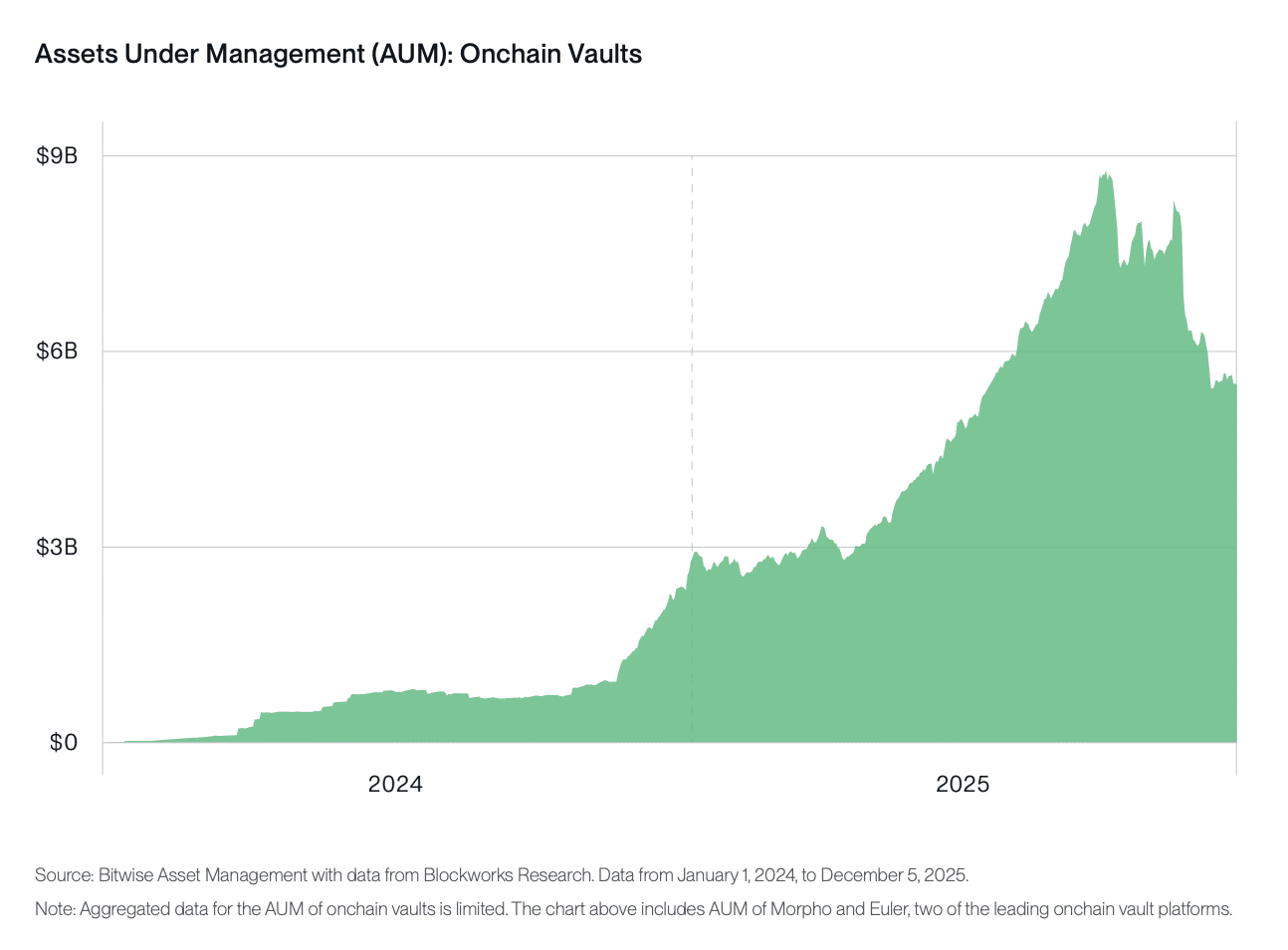
Source: Bitwise
Growth predictions
Man said Bitwise believes vaults will end up being like the equivalent of an ETF wrapper in this new digital world. He added: “As more people warm to this idea, they are going to see this is a fast growing area, and that the types of strategies that you can achieve in DeFIi are unique and compelling.”
Galea said his law firm is seeing “notable” interest from asset managers and financial institutions in vault structures. He added: “As more exotic implementations emerge, the legal questions will become more nuanced. An interesting year lies ahead for DeFi, with the U.S. CLARITY Act still working through the Senate and, hopefully, edging closer towards reality.”
Bitwise said in its 10 Crypto Predictions for 2026 that a wave of high-quality vault curators will enter the market in this year drawing billions of dollars of capital into the vaults they manage. Vaults emerged in a meaningful way in 2024, according to Bitwise, with assets rising from less than $0.1 bn to $2.3bn.
“Interest surged in 2025, with assets under management peaking at $8.8bn before the October 2025 volatility spike led to losses across poorly managed strategies,” said Bitwise. “Since then, the assets under management in vaults has retracted. But that won’t last for long.”

NEWSLETTER SIGN UP
And receive exclusive articles on securities markets

🏆 The 2026 Global Markets Choice Awards are here! 🌍 Nominations are officially OPEN for the celebration of excellence in global capital markets trading & technology. Nominate below:
https://www.jotform.com/form/260086385121150

Delaware Life Insurance Company is becoming the first insurance carrier to offer an index that contains cryptocurrency, adding the BlackRock U.S. Equity Bitcoin Balanced Risk 12% Index to its fixed index annuity (FIA) portfolio.
As the digital assets industry pushes toward
Franklin Templeton is expanding its tokenized fund suite, signaling growing institutional demand for blockchain-based fund infrastructure and regulated investment products moving onchain. Read the full article below:
$50 billion in active ETF inflows helped fuel a record year for @BlackRock 's iShares business, as investors continue to lean into active strategies.
Shanny Basar
Senior writer
A Senior Writer at Markets Media who became a financial journalist in 2000 after working in banking for over a decade....
More about this authorRelated articles
-

The manager will expand the reach of tokenized securities via Prometheum’s regulated broker-dealer.
-

The deal represents the first OTC derivative to reference a fully tokenized index on DLT.
-

DLX gives clients a front-to-back platform for integrating tokenized assets.
-

They will bring tokenized real-world assets to NUVA, the Animoca Brands-backed vault marketplace.
-

Legal and regulatory certainty is needed for adoption to scale.