






04.06.2026
U.S. May See Wave of New ETF Share Classes of Mutual Funds
04.06.2026
Dimensional Fund Advisors launched the first actively managed share class ETF in the U.S. on 20 March 2026. The US Micro Cap ETF is a share class of the firm’s first mutual fund, the US Micro Cap Portfolio, which launched in 1981 to systematically invest in the smallest U.S stocks. The fund has since delivered 1.44% of annualized outperformance over its benchmark since its first full month, according to Dimensional.

Gerard O’Reilly, Dimensional Fund Advisors
Gerard O’Reilly, co-chief executive and co-chief investment officer of Dimensional Fund Advisors, said in a statement: “Broader adoption of the share class structure can offer millions of American investors potential benefits of increased tax efficiency and cost savings from economies of scale.”
Financial services group BBH said in its 2026 Global ETF Investor Survey that the U.S. Securities and Exchange Commission’s approval of Dimensional adding ETF share classes broke a long-running market impasse. Previously, only Vanguard had been able to create ETF share classes from its mutual funds via a unique patent which lapsed in 2023, according to the report.
BBH added: “Its decision could trigger the creation of a wave of new ETF share classes of mutual funds.”
Source: BBH
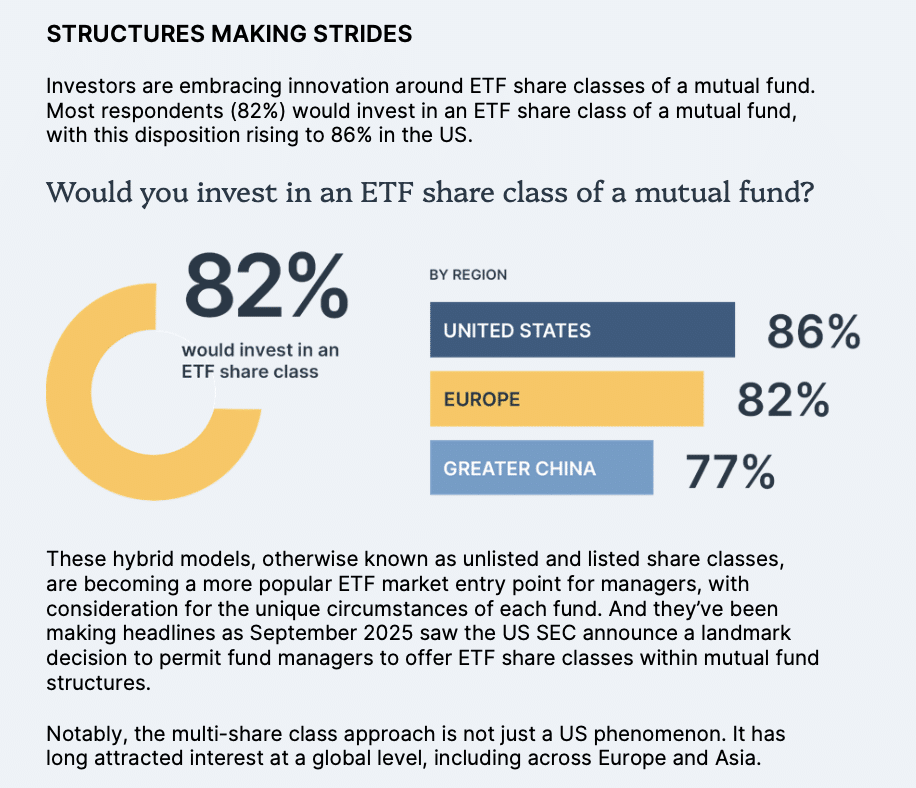
BBH’s survey found that over three quarters of respondents would invest in an ETF share class of a mutual fund.
Dimensional has been engaging the SEC on ETF share class exemptive relief since 2019 and filed its application in 2023. Rob Harvey, co-head of product specialists at Dimensional Fund Advisors, told Markets Media that the firm wanted to launch an active ETF share class to empower investors and give them more choice. He said the SEC’s concerns included fair treatment of investors in both the mutual fund and ETF share class in terms of fees and trading costs, and differences in transparency, as ETFs disclose their holdings on a daily basis.

Rob Harvey, Dimensional Fund Advisors
Mutual fund-class shareholders can gain from lower transaction costs and greater tax efficiency, while ETF-class shareholders may benefit from more efficient rebalancing using mutual fund cash flows and lower total portfolio transaction costs.
Harvey said Dimensional first launched the US Micro Cap ETF due to demand from advisors, and because the asset manager wanted to first add the share class to mutual fund strategies that did not already have a standalone ETF. He added: “We have more than 100 mutual funds, so we have a lot to do.”
ETF servicing
State Street was the service provider for Dimensional Fund Advisors’ approved ETF share class structure. Support includes custody, fund accounting, ETF basket creation, create / redeem order management, ETF settlement, transfer agency and reporting. The firm supports more than 3,000 ETFs and $8.1 trillion across 15 countries.
Jeff Sardinha, head of ETF solutions – Americas State Street, told Markets Media that Dimensional wanted one service provider to make the overall operating model work better. He said that when State Street launched the first ETF and supported the first operating model, it created technology that allowed ETFs to live side by side with mutual funds to provide a seamless operating model around the globe.

Jeff Sardinha, State Street
Sardinha added: “Being able to support both mutual funds and ETFs in the U.S. on a single platform from order taking to the transfer agency makes it easier to get the products up and running.”
He continued that the whole industry has been discussing the operational challenges of adding an ETF share class to a mutual fund since Dimensional made its filing. For example, mutual funds break down individual expenses while ETFs have just one si combined fee; and there are also differences in their accounting treatments.
One of the biggest challenges was exchange privileges, which allows shareholders of a mutual fund to exchange shares of their mutual funds for the equivalent value of ETF shares in the same fund on a non-taxable basis. In addition, ETFs also operate intra-day and subscription/redemption activity is completed by 4pm ET, while this is not the case with mutual funds.
“There are existing industry utilities and DTCC and its Fund/SERV offering did quite a bit of work with the industry to bring ETF share classes into this existing capability,” added Sardinha. “That was very helpful.”
For example, Fund/SERV is due to deliver technology later this year to automate and standardise exchange privileges which will connect the necessary intermediaries.
Active ETF growth
Global assets in actively managed ETFs climbed to a new record of $2.15 trillion at the end of February this year, according to ETFGI, an independent research and consultancy. Net inflows into active ETFs in the first two months of this year were also a record $167.6bn.
Two thirds, 66%, of investors prefer active management over passive in the next 12 months, according to the BBH survey. Nearly all the survey respondents, 94%, also believe active ETFs will reach $10 trillion in assets within 10 years, an expected annual growth rate of 20%.
Deborah Fuhr, managing partner and founder of ETFGI, said in the BBH report that the 20% growth rate for the active ETF market seems realistic, and may be an understatement following the SEC approval of ETF share classes.

Deborah Fuhr, ETFGI
“There’s strong investor demand in the US for mutual fund managers to convert their mutual funds, private funds, and SMAs, or offer strategies in the ETF wrapper,” she added. “We’ve already seen significant mutual fund to ETF conversions, and this could accelerate flows further – $10 trillion assets under management within the next seven years is possibly a conservative estimate.”
There are approximately 98 SEC filings for ETF share classes including new ETF issuers, according to Sardinha, with five or six prospectuses for products. Sardinha added there are firms that are looking at the ETF share class as an entry point. He said State Street is having many conversations about ETF share classes and he expects to see more firms to make filings with real products.
“A year from now, I don’t think 98 firms will have added an ETF share class but there will definitely be more than Dimensional,” added Sardinha.
Harvey said other firms will be able to use Dimensional’s approved filing as a template to launch ETF share classes. Although there have been a large number of applications, managers will still need to address the SEC’s concerns such as the disclosure of holdings and ETF fees versus mutual fund fees. He said: “They will have to do some soul searching.”
Dimensional is the largest active ETF provider in terms of assets with $286.3bn, reflecting 13.3% market share, according to ETFGI. JP Morgan Asset Management is second with $268.7bn and 12.5% market share, followed by BlackRock’s iShares with $128.5bn and 6% market share.
In October last year Dimensional Fund Advisors launched its first ETFs in the UK and Europe – the Global Core Equity UCITS ETF and the Global Targeted Value UCITS ETF.

NEWSLETTER SIGN UP
And receive exclusive articles on securities markets

🏆 The 2026 Global Markets Choice Awards are here! 🌍 Nominations are officially OPEN for the celebration of excellence in global capital markets trading & technology. Nominate below:
https://www.jotform.com/form/260086385121150

Delaware Life Insurance Company is becoming the first insurance carrier to offer an index that contains cryptocurrency, adding the BlackRock U.S. Equity Bitcoin Balanced Risk 12% Index to its fixed index annuity (FIA) portfolio.
As the digital assets industry pushes toward
Franklin Templeton is expanding its tokenized fund suite, signaling growing institutional demand for blockchain-based fund infrastructure and regulated investment products moving onchain. Read the full article below:
$50 billion in active ETF inflows helped fuel a record year for @BlackRock 's iShares business, as investors continue to lean into active strategies.
Shanny Basar
Senior writer
A Senior Writer at Markets Media who became a financial journalist in 2000 after working in banking for over a decade....
More about this authorRelated articles
-

The two asset managers are likely to continue jockeying for first place.
-

The ETF is backed by a $2.5bn investment from UC Investments.
-

The group of 21 firms includes Fidelity Investments, Goldman Sachs, Deutsche Bank, UBS & MUFG Bank.
-

This allows hedge funds to avoid potentially significant costs associated with implementation.
-

Nomura Asset Management International appointed Linda Galsim as Global Head of Product.