






04.15.2026

Six large financial institutions have agreed to publish data on the Pyth Network, while the data of equities listed on SIX Swiss Exchange and BME Exchange is being published on another data oracle, Chainlink.
On a blockchain, trust or verification from the user is not needed because data is stored on a decentralized ledger with global consensus. Oracles provide secure access from blockchains to off-chain data using smart contracts to connect to external data providers, especially for asset prices which are constantly changing.
On 6 April 2026 Pyth said in a statement that Euronext FX, Exchange Data International (EDI), Fidelity Investments, OTC Markets Group, SGX FX, and Tradeweb are publishing proprietary market data through the network. Mike Cahill, chief executive of Douro Labs and contributor to Pyth Network, told Markets Media: “These six contributors are voting on us to be the means to be ahead of the curve for transformational changes in financial markets.”
Pyth added that each firm represents a different type of financial institution, each brings data from a different corner of global markets and that this marks the first time that their proprietary data has been put onchain. Michael Zaladonis, global head of data products and analytics at Tradeweb, said in a statement that the firm is seeing growing demand for more timely and accessible exchange-traded fund data, so publishing onchain can extend the reach of high-quality, intraday valuations to a broader set of market participants.

Nicolas Jegou, Euronext
Nicolas Jégou, chief executive of Euronext FX, said in a statement: “Publishing this data through Pyth marks an important step toward a unified, transparent, and programmable market data standard for modern finance.”
These six institutions also marked the official launch of the Pyth Data Marketplace, which enables any institution to distribute proprietary datasets through Pyth’s global infrastructure of more than 100 blockchains and 700 applications while retaining full control over their data, attribution, and pricing.
Cahill used the analogy that the launch is similar to Amazon and the Amazon marketplace. He added that when Pyth launched five years ago, exchanges were “spooked” by what the firm was doing but the marketplace allows them to have a positive relationship with the firm. He argued that large exchanges realize they have to buy, build, or partner with somebody to become blockchain-aligned. Pyth can introduce them to potential new buyers of their data, intermediate the technology and offer them the ability to contribute some of their data into its core Pyth Pro product.
“I would like to see every major exchange on our marketplace,’ added Cahill. “I am very optimistic that will happen by the end of the third quarter.”

Matt Nurse, SIX
On 15 April 2026 SIX, the financial data and market infrastructure provider, said in a statement that equities data from its exchanges in Switzerland and Spain would be available onchain for the first time through Chainlink and its DataLink data publishing service. Equities listed on SIX Swiss Exchange and BME Exchange are valued at more than €2 trillion and data is available to over 2,600 applications in the Chainlink ecosystem across more than 75 public and private blockchains. As a result, equities data from the SIX exchanges can now be programmatically accessed within standardized smart contract environments at scale.
Matthew Nurse, head market data, SIX, said in a statement: “This enables digital asset applications to access trusted market data through proven, secure infrastructure, fostering trust and innovation across global financial ecosystems.”
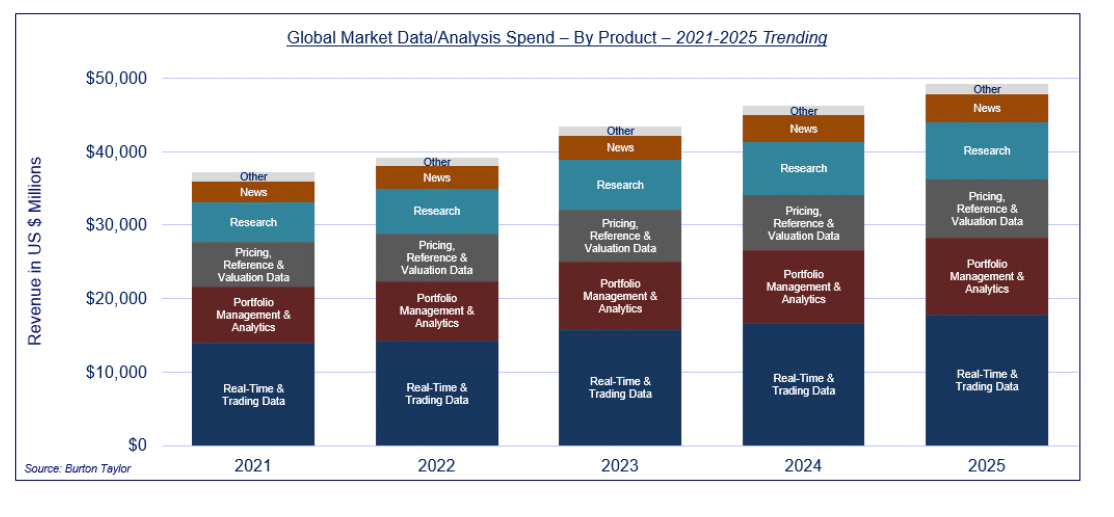
Source: Burton-Taylor International Consulting, part of TP ICAP
24/7 markets
One of the reasons that traditional financials want to put data onchain is the move to 24/7 markets as real-world assets are tokenized. Cahill said: “We have seen tremendous demand from our client base to get more into 24/7.”
For example, in March 2026 Pyth launched the 24/7 Oil Index, which it said was the first continuously updating crude oil composite index. The Pyth 24/7 Oil Index aggregates both onchain and offchain data from exchanges, institutions, and professional trading firms to produce a real-time price that never stops updating. In comparison, traditional oil price feeds come from one exchange and are only updated during their trading hours, which do not include weekends.
In contrast Hyperliquid, a decentralized trading-focused blockchain, can be used over the weekends and saw well over $1 billion in daily WTI oil perpetual futures volume during recent volatility spikes when there were U.S. and Israel attacks on Iran. OxResearch, a newsletter from Blockworks, highlighted that Hyperliquid’s weekend pricing was an accurate predictor of where traditional markets would reopen. Cahill said Hyperliquid asked Pyth to build the index due to demand from clients.
“We used to be a one-way street where we brought offchain data onto blockchains,” added Cahill. “Now, if you don’t get the onchain data as well, you don’t have a complete picture – which is a big thing.”
At the end of this month, Pyth will start to roll out additional single asset 24/7 indices according to Cahill that will eventually cover equities, more commodities and cross-asset class baskets.

Michael Cahill, Pyth
Cahill continued that Pyth is getting a lot of interest from banks to take onchain data feeds for their trading desks in a way that they can consume very easily.
“Being able to show the set of things that occurred offchain and onchain to a bank for risk management is really important,“ he added. “In the second quarter I am hopeful that we will be able to announce a couple of Tier One bank partnerships.”
Prediction markets
Last year Pyth Network partnered with Kalshi to publish its prediction market information across more than 100 blockchains. In April this year prediction market Polymarket said in a statement it had integrated Pyth Pro as its data source for a new suite of traditional asset contracts, starting with gold, silver, and major equity index ETFs.
Pyth Pro was launched last year and allows banks, brokers, and trading firms to access institutional-grade data across every asset class and geography, directly from more than 125 of the world’s leading market participants through a single, unified price layer.
Polymarket samples Pyth Pro data every second and publishes it as a live chart, the “price to beat,” giving traders continuous visibility into where the market stands relative to their position. Mustafa Aljadery, product lead at Polymarket, said in a statement that millions of dollars can hinge on a single price point, and that demands absolute confidence in the source of truth.
“Prediction markets offer markets on everything, so you have to get data from everywhere for everything, and this data has been siloed for a long time,” said Cahill.
In addition, Pyth can connect Polymarket’s data to market makers, and provide the data in a way that makes it easy for them to trade.
“We will keep expanding, understanding where the pain points are and leaning in, because we think that prediction markets are never going away,” added Cahill. “The genie is out of the bottle.”
In March this year Pyth also launched Pyth Pro for AI Agents to give any AI agent access to more than 3,000 institutional-grade price feeds across crypto, equities, FX, metals, and commodities.

NEWSLETTER SIGN UP
And receive exclusive articles on securities markets

🏆 The 2026 Global Markets Choice Awards are here! 🌍 Nominations are officially OPEN for the celebration of excellence in global capital markets trading & technology. Nominate below:
https://www.jotform.com/form/260086385121150

Delaware Life Insurance Company is becoming the first insurance carrier to offer an index that contains cryptocurrency, adding the BlackRock U.S. Equity Bitcoin Balanced Risk 12% Index to its fixed index annuity (FIA) portfolio.
As the digital assets industry pushes toward
Franklin Templeton is expanding its tokenized fund suite, signaling growing institutional demand for blockchain-based fund infrastructure and regulated investment products moving onchain. Read the full article below:
$50 billion in active ETF inflows helped fuel a record year for @BlackRock 's iShares business, as investors continue to lean into active strategies.
Shanny Basar
Senior writer
A Senior Writer at Markets Media who became a financial journalist in 2000 after working in banking for over a decade....
More about this authorRelated articles
-

The future of financial services will require greater interoperability, trust, and collaboration.
-

This is the first cross-chain repo flow separating the venue from the networks where cash & collateral settle.
-

A CSD will use a public blockchain to mirror securities ownership records for the first time.
-

Banks can easily manage smart contracts on both their own ledgers for tokenized deposits and the Swift ledger.
-

London Stock Exchange Group also intends to bring other services into the Canton Network.