






05.12.2026

The use of exchange-traded funds by institutional asset owners has grown at a faster rate than the general market, and nearly half expect to increase their ETF allocations over the next 24 months,
Brendan Powers, director of product development research at research provider Cerulli Associates, told Markets Media: “We’ve seen institutional asset owners double their use of ETFs over the last five years. They are starting from a smaller base relative to wealth management, but I think the driver is evolving use cases.”
Cerulli Associates and fund manager Invesco published a report on the use of ETFs by institutional asset owners in April this year. The survey, Inside Institutional ETF Adoption – How asset owners are broadening use cases, covered 31 institutional decision makers in North America with at least $1bn in assets under management and was carried out in the fourth quarter of 2025 and the first quarter of this year.
The research found that ETF assets under management of institutional asset owners, which includes public and corporate defined benefit plans, endowments, foundations, insurance general accounts, and health and hospital systems, reached approximately $337bn in 2025. Their holdings grew at a 14.4% compound annual growth rate between 2020 and 2025, outpacing the 5% rate of the broader U.S. institutional market over the same period.
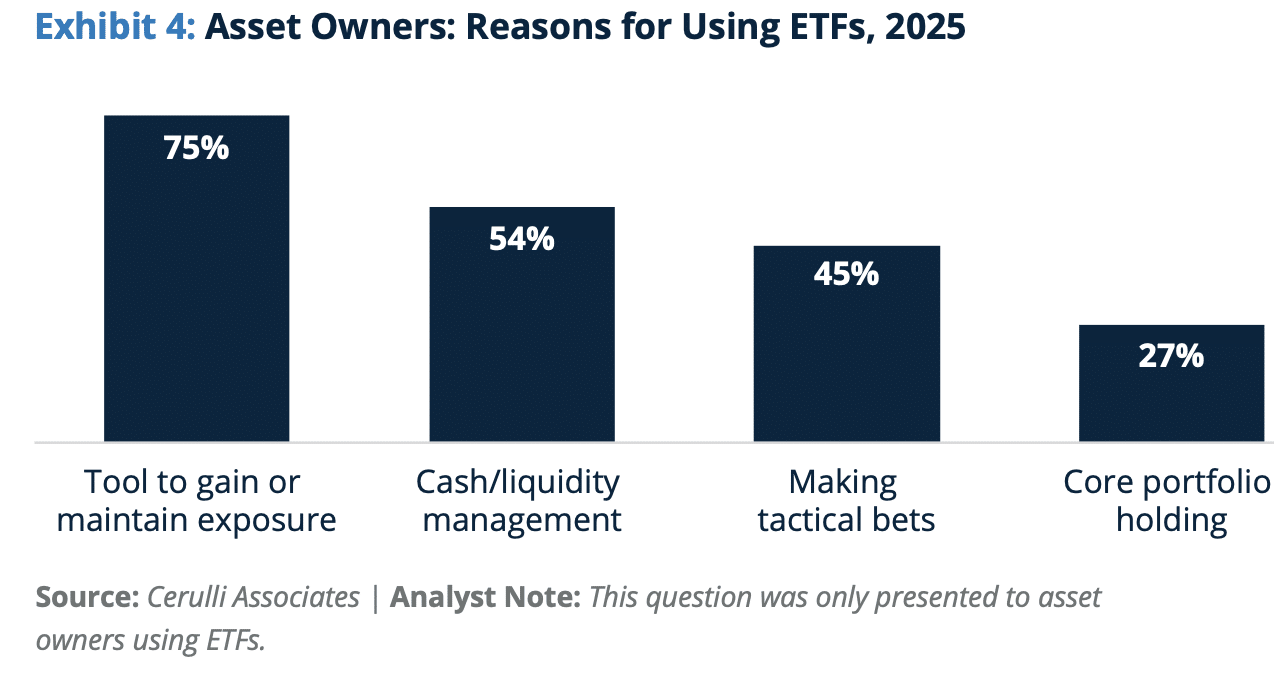
Nearly half of the respondents expect to increase their ETF allocations over the next 24 months, while 16% of non-users also plan to begin using ETFs over that time. Primary factors for increased adoption of ETFs as core portfolio tools include improved liquidity, operational efficiency, an expanded menu of ETFs across asset classes, longer performance track records, the ability to deploy capital quickly in one diverse product and lower fees, according to the survey. In addition, ETFs make it easier to gain exposure to areas of the market that were historically difficult to access such as digital assets, bank loans and emerging markets.

Garrett Glawe, head of asset owner & consultant ETF specialists at Invesco, told Markets Media that the largest ETF users have historically been public pension plans, and they made up 17 of the top 25 users in the survey. Many of the large, sophisticated public pension plans internally manage funds and have the capabilities to trade stocks and bonds, so they can also easily trade ETFs.
Glawe said ETFs are also becoming a vehicle of choice for endowments and foundations, who are increasing their use at a faster rate than public plans, as smaller asset owners want to obtain their public market exposure more efficiently. He added: “They are building ETF portfolios for public market exposure, to spend more time in private markets where there are possibly more alpha opportunities.”
Active ETFs
Active ETFs gathered 31.2% of total ETF net flows during 2025, despite making up just 10.9% of total ETF assets, according to Cerulli. A recent study of asset managers offering ETFs by Cerulli found that 87% are developing transparent active ETFs.
The majority of assets are in index tracking strategies but there is an evolution towards the use of actively managed ETFs and more active use of products such as market-cap weighted or equal-weighted core equity ETFs, according to Powers. In particular, there is increased interest in active fixed-income ETFs as funds approach their three- and five-year track records. For example CalPERS, the California Public Employees Retirement System, has seeded an active high-yield ETF managed by JPMorgan.
“The growth in ETF assets was an ‘aha’ moment for us, as well as the interest in active management,” he added.
Powers stressed that it is still “very early innings” on the active management side. He gave the example of one asset owner who was searching for a high-yield bond fund manager and another looking for a small-cap equities manager.

“Both of them went through their typical search process and happened upon strategies they liked that were available in ETFs,” he said. “They both ended up using the active ETFs.”
The chief investment officer at a $1bn-$5bn foundation said in the survey that when they inherited the portfolio three and a half years ago, it was 100% active management and it had performed “very poorly.” The CIO said: “We fired almost all the U.S. public equity managers, and the thinking was let’s go 50% passive, 50% active…[With index tracking ETFs] you have daily liquidity and you’re paying probably like five basis points or something. It’s basically free.”
Glawe argued that ETFs are blurring the lines between active and passive. For example, asset owners can use Invesco’s equal weight factor ETFs in active ways to hedge against concentration in their public U.S. equity allocations. He said Texas Permanent School Fund and State of Wisconsin Investment Board have both put more $1bn into Invesco’s Equal Weight S&P 500 ETF to provide some balance to their portfolios.
Municipal Employees Retirement System of Michigan (MERS) is a long-term client of Invesco and the asset manager built three multi-factor ETFs for the scheme about five years ago, which now have an aggregate total of almost $2bn in assets. MERS now uses 40 to 50 ETFs and half of their total portfolio, inclusive of private market exposure, is invested in ETFs according to Glawe.
“Depending on MERS’ views of how they think factors will perform relative to beta, they can make adjustments at a click of a button rather than having to buy and sell individual securities,” added Glawe. “They are a very cutting-edge power user of using ETFs in very thoughtful ways and are blazing a trail.”
Glawe does not expect many other asset owners to reach the level of MERS, but he believes they are helping others to gain some comfort in using ETFs.
Co-manufacturing ETFs
The “power users” of ETFs have also co-manufactured desired exposures directly with ETF issuers. The report said any ETF issuers are willing to co-manufacture strategies, assuming institutional asset owners can provide the seed capital to do it, which is often hundreds of millions or potentially billions in assets.
For example, in late 2024 Finnish pension insurer Varma and Invesco partnered to create the Invesco MSCI North America Climate ETF (KLMN). It is the largest ETF launch by assets at $2.4bn, according to the report.
Glawe said: “This democratizes access to these new strategies. When we launch these new ETFs, they are available to everybody else trade at exactly the same price as the asset owner.
The only firms with more than $10bn in institutional asset owner ETF assets, as measured by year-end 2025 13F data, were BlackRock ($43.5bn), Vanguard ($37.7bn), State Street Investment Management ($19.7bn), and Invesco ($10.5bn) according to the survey.
•

NEWSLETTER SIGN UP
And receive exclusive articles on securities markets

🏆 The 2026 Global Markets Choice Awards are here! 🌍 Nominations are officially OPEN for the celebration of excellence in global capital markets trading & technology. Nominate below:
https://www.jotform.com/form/260086385121150

Delaware Life Insurance Company is becoming the first insurance carrier to offer an index that contains cryptocurrency, adding the BlackRock U.S. Equity Bitcoin Balanced Risk 12% Index to its fixed index annuity (FIA) portfolio.
As the digital assets industry pushes toward
Franklin Templeton is expanding its tokenized fund suite, signaling growing institutional demand for blockchain-based fund infrastructure and regulated investment products moving onchain. Read the full article below:
$50 billion in active ETF inflows helped fuel a record year for @BlackRock 's iShares business, as investors continue to lean into active strategies.
Shanny Basar
Senior writer
A Senior Writer at Markets Media who became a financial journalist in 2000 after working in banking for over a decade....
More about this authorRelated articles
-

Vanguard, Wellington Management completed their first tokenized collateral trades on Nasdaq Calypso & Canton.
-

The U.S asset manager intends to use HashKey's multi-jurisdictional platform over time.
-

The platform provides a periodic auction process to provide investors with greater liquidity flexibility.
-

AI agents decouple costs from assets under management.
-

So far this year 1,212 active ETFs have been launched by 269 providers.