






07.30.2026
ICE Fills Execution Gap in Fixed Income with MarketAxess
07.30.2026
Jeff Sprecher, chair and chief executive of Intercontinental Exchange, said the group had been late to execution in fixed income and so focussed on building the data, network, and infrastructure that makes these markets function more efficiently and transparently.
ICE said in a statement on 30 July 2026 that it is acquiring MarketAxess Holdings, the electronic trading platform for institutional fixed income markets, which will bring the execution layer to that foundation.

Jeff Sprecher, ICE
On the second quarter results on 30 July 2026, Sprecher said: “ We saw what MarketAxess and others were doing in the execution space, and we decided to build around what those players were doing. We looked for daylight where others weren’t moving.”
Sprecher argued that ICE has become one of the largest providers of fixed income pricing, reference data, and indices, providing daily evaluated pricing on over three million securities. This is critical in fixed income due to the number of instruments and the number that trade infrequently.
The ICE Global Network connects the financial community to data and analytics, and ICE indices have attracted nearly $1 trillion in exchange-trade fund assets. In clearing, Sprecher said ICE Clear Credit is the leading credit default swap (CDS) clearinghouse.
In execution ICE Bonds serves the trading desks of the largest wealth management firms in the U.S., including firms like Charles Schwab, Fidelity and Merrill Lynch, across municipal bonds, corporates, treasuries, and agencies.
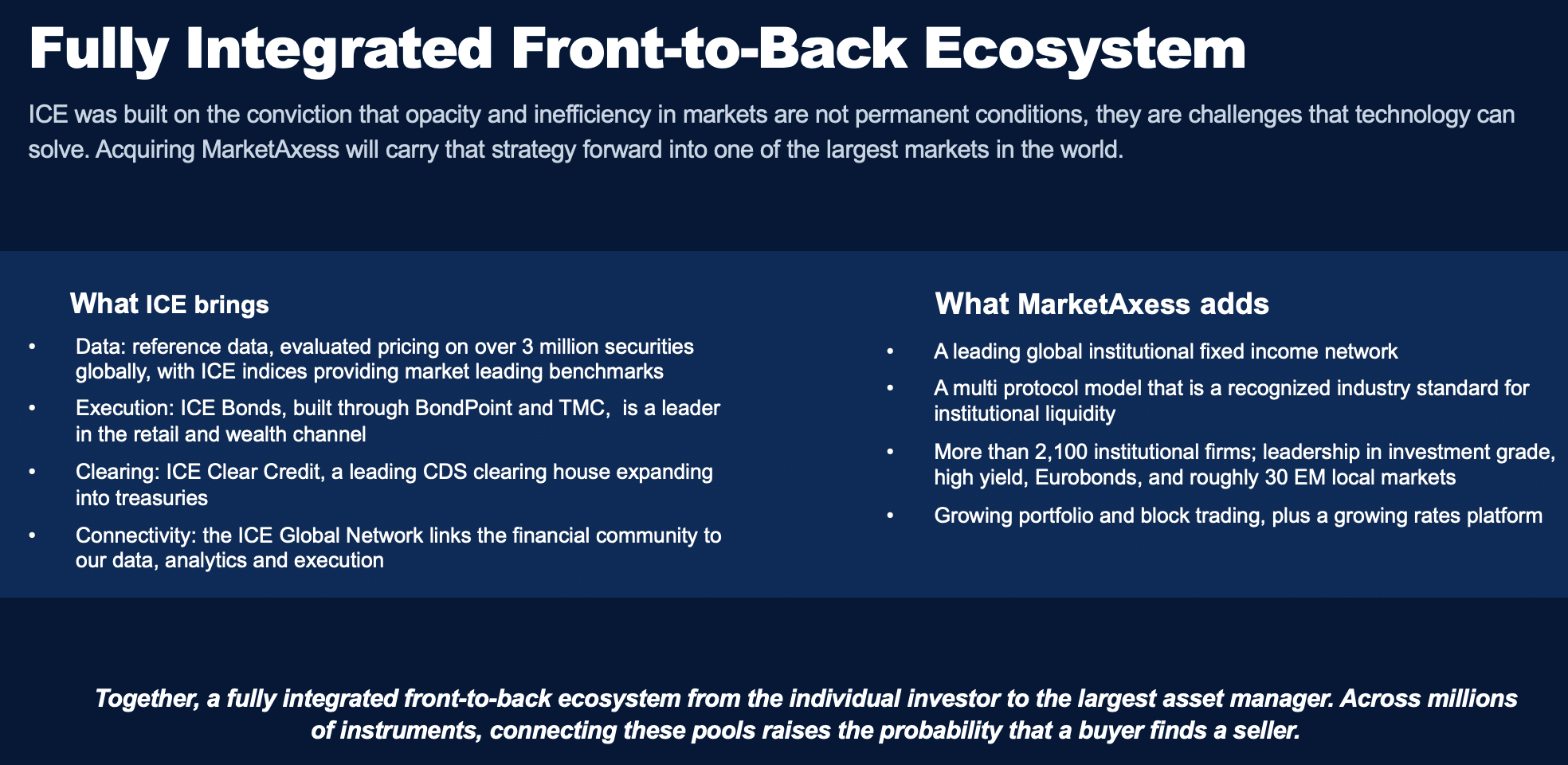
“Having built strong distribution in the retail and wealth channel, we now see a clear opportunity to extend our reach into the institutional segment, where MarketAxess has a leading presence by bringing these liquidity pools together,” said Sprecher. “The logic is simple: we are building a global fixed income network.”
The purchase of MarketAxess will extend ICE’s track record of growth into global fixed income, according to Sprecher. He argued that ICE has followed a consistent strategy of bringing transparency, efficiency, and standardization to markets, and of digitizing the analog.
“Each market that we have taken on has grown more open and more electronic as a result,” Sprecher added. “Our acquisition of MarketAxess will continue this strategy in one of the largest markets in the world.”
He gave the examples of succeeding with this strategy in energy, in credit default swaps, and in mortgage technology, and claimed that acquiring MarketAxess is the natural next step in that journey.
“MarketsAxess has tough competition and and many of their competitors have been able to work in a larger ecosystem with a broader pool of products that appeals to many of the major institutions and dealers,” said Sprecher. “I think we can help bring that back in line.”
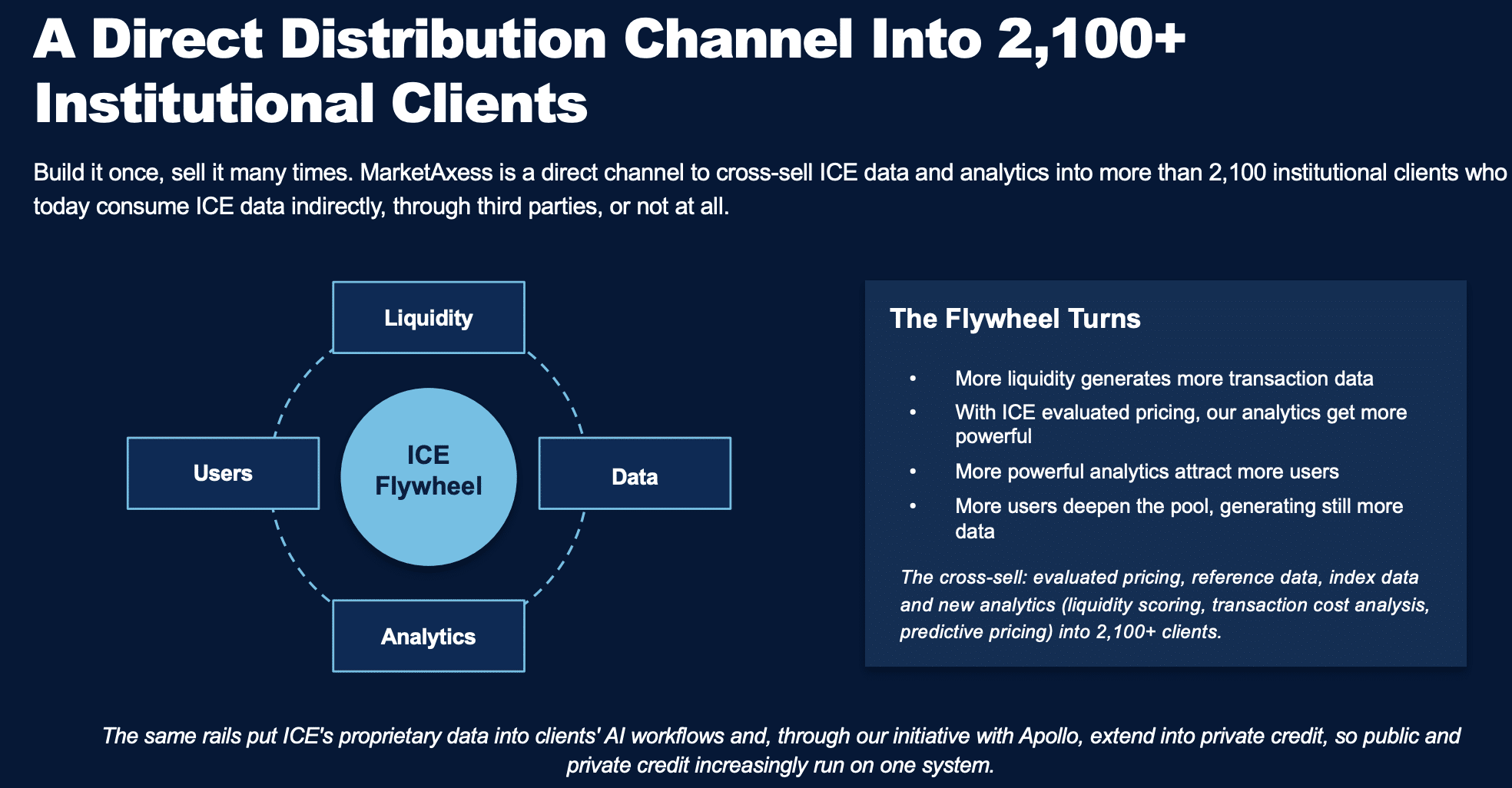
MarketAxess connects approximately 2,100 institutional investors and broker-dealers across more than 90 countries, enabling electronic trading in corporate bonds, municipal bonds, emerging market debt, Eurobonds, U.S. Treasuries, and other fixed income instruments, using protocols that are recognized standards for institutional credit liquidity. Sprecher argued that by connecting the full spectrum of liquidity from retail to institutions, trading will become cheaper and more efficient for clients and the combined network will turn into a compounding data and distribution engine.
Putting MarketAxess and ICE Bonds together creates a fully integrated front-to-back ecosystem spanning the fixed income market, said Sprecher. Retail and wealth flow, long separated from institutional flow, will be able to connect into a deep institutional pool, and institutions will gain access to the diversified order flow that retail and wealth channels bring.
“The single greatest challenge to any investor is finding the other side for a true representation of fair value,” said Sprecher. “Connecting these two pools should dramatically increase the probability that a buyer finds a seller, and this price discovery will benefit every market participant and create real economies of scale.”

Ben Jackson, ICE
On 9 June 2024 the firm launched Ice Compass, an AI-powered pre-trade analytics platform for fixed income. Ben Jackson, president of ICE, said on the call that Compass solves a real problem for the buy side in fixed income because investors have always traded at an informational disadvantage. Jackson said that every time an investor shows interest in a bond, that signal is picked up by potential counterparties and used to shape the price quoted back to them. He argued that AI is making ICE’s data more valuable, not less.
“Before a trade, Compass gives an asset manager an estimate of the bid or ask they can expect from each potential counterparty and ranks those counterparties on how competitive they are likely to be, customized to that specific client,” added Jackson. “It runs on pricing and transaction data that only we have, and T Rowe Price has signed on as our anchor client.”
In addition MarketAxess’ treasury rates trading platform will be connected to ICE’s newly approved Treasury clearinghouse.
Source: ICE
Private credit
Sprecher said the fixed income network that ICE is designing will use the same rails to connect private credit clients via the group’s initiative with alternatives manager, Apollo Global Management. On 27 July 2026 ICE said in a statement it was launching a new classification service that creates unique, persistent identifiers (IDs) for private credit instruments for the first time.
ICE IDs are a key part of ICE Private Credit Intelligence, an industry-wide initiative started by ICE and Apollo to build the foundational data infrastructure for the private credit market. ICE IDs will span the investment lifecycle from origination through to the final payoff date and closure of each instrument, including through potential credit events. As an anchor partner, Apollo now applies ICE IDs to its originated credit assets.
“Public and private credit will increasingly be accessible on one platform,” added Sprecher. “ICE has spent its history turning fragmented analog markets into connected electronic networks, then growing and compounding these networks.”
Chris Edmonds, president of fixed income and data services at ICE, said on the call that MarketAxess will have the ability to provide a distribution channel for private credit.

Chris Edmonds, ICE
“We are talking about a common set of rails,” added Edmonds. “We are putting standards in place on the data and distribution side in order for everyone to have an opportunity to participate in the private credit market as it continues to grow.”
Warren Gardiner, chief financial officer at ICE, said on the call that the transaction is a product of a deliberate, long-term view about where fixed income markets are going, and the role ICE is “uniquely” positioned to play in that evolution.
The transaction is expected to be accretive to adjusted earnings per share in the first full year following close, which is expected in the first half of 2027.
Gardiner said: “Critically, our balance sheet strength allows us to finance this acquisition entirely in cash while maintaining our plans for returning capital to shareholders.”
The deal will be financed through a combination of newly issued bonds, a term loan, and commercial paper, while maintaining a strong investment grade credit rating. ICE will acquire all outstanding shares of MarketAxess for $167 per share, a 33% premium to MarketAxess’s closing price as of July 29, 2026. This represents an equity value of approximately $6bn and a total enterprise value of approximately $5.7bn. The transaction has been unanimously approved by the boards of both companies.
“The transaction value we announced and intend to underwrite is supported by MarketAxess’s recent mid-single-digit growth trajectory,” said Gardiner. “However, we believe that ICE’s platform, our data, our network, our client relationships, and our track record of deepening engagement over time can accelerate that growth trajectory.”
Source: ICE
Second quarter results
Gardiner described the second quarter as “exceptional” because the platform continued to produce record recurring revenue and strong earnings despite a moderation in episodic volatility.
Second quarter adjusted earnings per share were $1.90, a second quarter record and the second best quarter in ICE’s history. Net revenues were $2.7bn, up 5% from a year ago, and adjusted operating income was $1.6bn.
In exchanges, net revenue was $1.5bn, compounding on top of double-digit growth in both 2025 and 2024.

Warren Gardiner, ICE
Gardiner said: “Our rates business once again delivered exceptional performance, growing 24% versus the year-ago period, as investors and institutions continue to expand and actively manage their duration exposure.”
Total futures and options open interest was up 20% year-over-year and NYSE transaction revenue was a record, up 15% from a year ago.
Jackson said financials had an “exceptional” quarter, driven by European and U.K. rates as the European Central Bank raised rates for the first time since 2023, and the expectations for rates across major economies repriced sharply higher.
In June, open interest in ICE’s rates franchise reached a record of 53 million contracts, up over 50% year-over-year, and Euribor options open interest set a new all-time high, passing a record that stood since 2010.
“The total value of the positions that customers hold across our three main European and UK rates contracts reached $62.3 trillion in mid-June,” said Jackson. “That is roughly triple where it stood three years ago, and it now exceeds the comparable market tied to U.S. dollar rates for the first time.”

NEWSLETTER SIGN UP
And receive exclusive articles on securities markets

🏆 The 2026 Global Markets Choice Awards are here! 🌍 Nominations are officially OPEN for the celebration of excellence in global capital markets trading & technology. Nominate below:
https://www.jotform.com/form/260086385121150

Delaware Life Insurance Company is becoming the first insurance carrier to offer an index that contains cryptocurrency, adding the BlackRock U.S. Equity Bitcoin Balanced Risk 12% Index to its fixed index annuity (FIA) portfolio.
As the digital assets industry pushes toward
Franklin Templeton is expanding its tokenized fund suite, signaling growing institutional demand for blockchain-based fund infrastructure and regulated investment products moving onchain. Read the full article below:
$50 billion in active ETF inflows helped fuel a record year for @BlackRock 's iShares business, as investors continue to lean into active strategies.
Shanny Basar
Senior writer
A Senior Writer at Markets Media who became a financial journalist in 2000 after working in banking for over a decade....
More about this authorRelated articles
-

The DIGIT pilot is expected to take place by Q1 2027.
-

This extends regulated tokenised funds beyond cash management into actively managed fixed income.
-

Hana Bank's issue is the first digital bond listing on SGX.
-

Corporate bond trading is shifting toward more electronic and automated execution.
-

The firm is working with S&P Global Market Intelligence to help modernise critical workflows.