






07.31.2026

Craig Donohue, chief executive of Cboe Global Markets, said the group will focus on growth opportunities including event and prediction market contracts, products tied to company-specific performance metrics and continued investment in global clearing.
On the second quarter results call on 31 July 2026, Donohue said that over the past year Cboe has delivered on its strategy of sharpening its portfolio, simplifying its structure, and building a stronger foundation for its core businesses. He said the group must now take the next step and shift focus to growth opportunities based on the strength of its derivatives franchise.

Craig Donohue, Cboe Global Markets
“Repositioning has aligned us more directly with the most powerful secular trends in our industry: the continued dominance of the U.S. equity marketplace, the growing role of retail investors globally and the secular rise in options trading,” he added.
Donohue became the chief executive in May 2025, taking over from Fredric Tomczyk, who has returned to the board.
“As we look to extend our traditional options business, we are building something that we believe will define the next chapter of growth at Cboe – a suite of solutions in the event and prediction market space,” Donohue said.
In June this year Cboe launched the first products in Cboe Predicts, its new prediction markets suite, with the aim of introducing retail traders to the options market. Mini S&P 500 Index (SPX) prediction market contracts allows traders to express a view on where the index may close by taking a “yes” position or a “no” position. Under Cboe’s new proprietary and patent-pending framework, customers can also participate in contracts that deliver three potential payout outcomes: a $0 payout, a partial payout within a defined “payout zone,” or a full $100 payout.
Donohue said: “The feedback reinforces something we have long believed – there is demand for simple outcome-based ways to engage with markets that have traditionally felt out of reach for many investors.”
Over time, Donohue expects many of these retail traders to progress into more sophisticated strategies such as options spread trading. Rob Hocking, global head of derivatives at Cboe, said on the call that the firm has been encouraged by the level of engagement with mini SPX prediction market contracts in the early days following their launch. There are three market makers providing liquidity in the product, and he said spreads continue to narrow as liquidity grows.
“We’ve also been working very closely with Schwab as an anchor tenant, and we are extremely excited that they will begin offering these contracts on their platform to clients very soon,” added Hocking.
In July Cboe also filed with the U.S. Securities and Exchange Commission to list contracts tied to company-specific performance metrics which Donohue said are a “compelling”opportunity with use cases for both retail and institutions. The initial focus is on 23 of the most actively traded U.S. companies with launch slated for September this year, pending regulatory approval.
“What sets this product apart from competitors is the structure,” said Donohue. “We firmly believe these are securities products that should be overseen by the SEC and built within a framework of transparency and investor protection that Cboe has helped shape for more than 50 years.”
Hocking added that the company-specific key performance indicator (KPI) contracts provide the ability to trade more granularly and manage the individual components that drive a company’s stock value. For example, Nvidia’s data centre revenue or Microsoft’s cloud-based revenue. The suite could be expanded to economic indicators, such as CPI.

Rob Hocking, Cboe
Hocking anticipates adoption of the KPI contracts will follow a similar path to the development of zero days to expiry (0DTE) options. At the beginning, the market will be weighted towards retail investors but institutions will then become more involved given the correlation between KPIs and stock valuations. Hocking said: “We believe they will help institutions better manage risk across single name portfolios.”
Cboe believes it has a differentiator due to its intermediated model and partnerships with a number of retail broker platforms including Robinhood and Schwab, who have millions of customers. Hocking added: “The encouraging thing is the demand coming from these platforms.’
Clearing
Another enabler for expanding the derivatives franchise is continued investment in global clearing. CBOE has filed with the SEC for temporary registration as a covered clearing agency, with full registration targeted at the end of an 18-month period. If approved, this will allow Cboe to move quickly to introduce new products such as the KPI contracts and tokenized products with a vertically integrated stack of trading and clearing.
With the CFTC, Cboe has became subject to the enhanced prudential standards that apply to systemically important clearinghouses. These two changes support Cboe’s treatment as a qualifying central counterparty under the U.S. bank capital rules, which Donohue said reduces capital requirements for clearing members.
“Our clearing efforts are designed to be complementary to our longstanding partnership with OCC,” added Donohue. “We remain fully committed to the existing market structure and the OCC clearing model for existing equity options.”
In addition, DataVantage will continue to bring new products to market to meet customers’ data and access needs.
Source: Cboe
Retail trading
In June this year Cboe saw a “notable” increase in retail volume following the repeal of the pattern day trader rule by U.S regulators. The rule set limits on how smaller accounts could trade without triggering additional restrictions.
“Its removal has eliminated a friction point, making it easier for smaller retail accounts to trade products like 0DTE options more frequently,” said Donohue. “The impact of the repeal was immediate.”
For example, trading volume of 0DTE SPX options increased 11% month-over-month in June. Estimated retail share of that volume rose to 57% in June, versus 53% in April and May, according to Donohue. He expects the impact of the repeal across Cboe’s retail broker-dealer partners will be a tailwind for volumes and retail investors in the months ahead.
In December this year Cboe also plans to expand cash equities trading to 23×5, pending industry readiness, with an eye towards 24×7 over time. Against that backdrop, Cboe supports the SEC reviewing market structure and its proposed withdrawal of Rule 611of Regulation NMS, also known as the trade-through rule. The regulation prevents trading venues from executing an order at a price that is worse than the best publicly displayed price on any other competing exchange.

Paul Atkins, SEC
Paul Atkins, chairman of the SEC said in a statement in June that although the central aim of Rule 611 was to incentivize displayed liquidity, trading activity has increasingly occurred off-exchange over the last two decades. Atkins said: “I am concerned that what the Rule rather incentivized was a proliferation of new trading venues, which in turn fragmented liquidity and created an increasingly complex, costly, and opaque marketplace for order execution.”
Donohue argued that Cboe is the only exchange group that operates both registered lit exchanges and an alternative trading system (ATS), so the firm is uniquely positioned to be a leader in combining the best elements of the various market models that equity market participants demand.
Financials
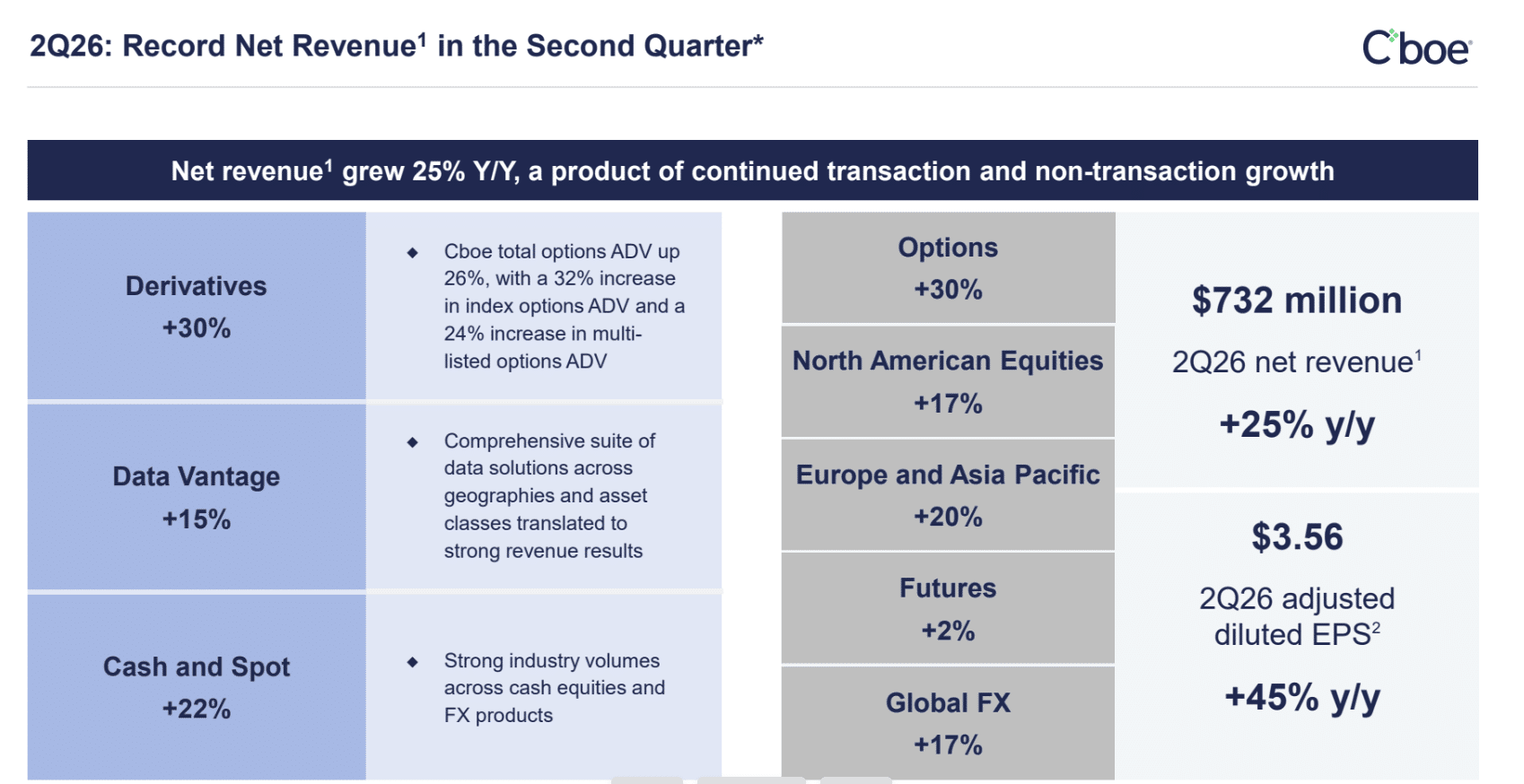
Cboe reported record net revenue for the second quarter of $731.6m, up 25% from a year ago.

Jill Griebenow, Cboe Global Markets
Jill Griebenow, chief financial officer of Cboe, said on the results call that there was double-digit net revenue growth in all categories, led by Cboe’s derivatives business.
Derivatives set a quarterly record, growing net revenue 30% from the same period last year to $413m, with strength across its proprietary index options and multi-list products.
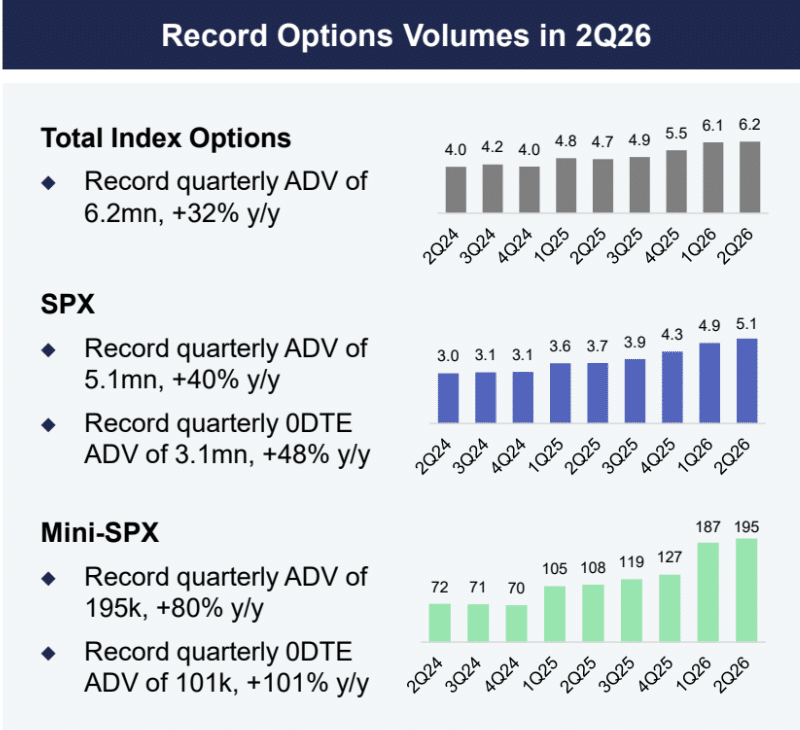
Index options set another quarterly record with average daily volume (ADV) increasing 32% year -over-year to 6.2 million contracts. There were product-specific ADV records during the quarter including for SPX options, SPX 0DTE options, mini SPX options, and contracts traded during global trading hours.
“The revenue per contract for our options business rose 6% year-over-year,” Griebenow added. “This was a result of a continued shift towards index options, coupled with a 3% increase in the index options rate per contract.”
Cash and spot markets net revenue rose 22%, including record revenue in North American equity segment, and the Data Vantage business grew 15% on a year-over-year basis.
Source: Cboe
The group has increased its 2026 organic total net revenue growth target to “mid to high teens” from “low double-digit to mid teens.” Cboe Data Vantage’s organic net revenue growth target was also increased to “low teens” from the previous “low double-digit” guidance.
“We continue to maintain significant balance sheet flexibility, with adjusted cash of $2.3bn and a leverage ratio of 0.7x,” said Griebenow. “That strong financial position gives us the capacity to pursue organic or inorganic growth opportunities while continuing to return capital to shareholders through dividends and opportunistic share repurchases.”

NEWSLETTER SIGN UP
And receive exclusive articles on securities markets

🏆 The 2026 Global Markets Choice Awards are here! 🌍 Nominations are officially OPEN for the celebration of excellence in global capital markets trading & technology. Nominate below:
https://www.jotform.com/form/260086385121150

Delaware Life Insurance Company is becoming the first insurance carrier to offer an index that contains cryptocurrency, adding the BlackRock U.S. Equity Bitcoin Balanced Risk 12% Index to its fixed index annuity (FIA) portfolio.
As the digital assets industry pushes toward
Franklin Templeton is expanding its tokenized fund suite, signaling growing institutional demand for blockchain-based fund infrastructure and regulated investment products moving onchain. Read the full article below:
$50 billion in active ETF inflows helped fuel a record year for @BlackRock 's iShares business, as investors continue to lean into active strategies.
Shanny Basar
Senior writer
A Senior Writer at Markets Media who became a financial journalist in 2000 after working in banking for over a decade....
More about this authorRelated articles
-

Booij decided not to extend his mandate from 1 January 2027.
-

Customer priority, pro-rata exchange provides additional ways to source liquidity.
-

Fully autonomous institutional listed equity derivatives trade marks milestone in AI-powered trading.
-

Clearing members and their clients realized margin offsets reaching 60% of the total FX initial margin.
-

Hyperliquid Policy Center said CME’s lawsuit is an attempt to halt innovation in U.S. futures markets.