






08.07.2026

Pictet Asset Management has reached $5bn in assets under management in its artificial intelligence-driven strategies (including its long/short strategies) and in July this year the firm launched its first range of European AI enhanced equity index active ETFs.
David Wright, head of quantitative investments at Pictet Asset Management, told Markets Media that the fund manager is running $4bn of assets across approximately 10 different accounts for its enhanced index AI strategies. The original version of the strategy was trained to be a developed world strategist, so is based on MSCI World, which Pictet launched as a UCITS mutual fund.

David Wright, Pictet Asset Management
“Once we started talking about introducing an ETF format, we also trained versions of the model for Europe and the US,” added Wright. “We have also tested emerging markets, which is an additional fund that we will launch as an ETF this year.”
On 1 July 2026 Pictet Asset Management launched its first range of four European AI enhanced equity index active ETFs. The enhanced equity index strategies are designed to outperform their benchmark indices by around 1% a year, net of fees, while tracking the index closely, with a targeted tracking error of up to 2% and a beta of 1.0.
The firm said the launch follows the success of Pictet – Quest AI-Driven Global Equities, a Luxembourg-domiciled UCITS fund introduced in March 2024 which has raised more than $3bn and returned 50% in US dollar terms since inception to the end of May 2026. Its benchmark, the MSCI World Index, has returned 45.9% over the same period according to Pictet.
“The new ETFs have the same long only enhanced index approach as the ETFs and other wrappers since launching two and a half years ago,” Wright added. “We have not added people to the team over that time, so it is efficient and we can pass savings onto investors.”
Wright’s team has developed Pictet Asset Management’s AI-driven quant model which he said has been six to seven years in the making. He added: “This has been in production way before AI became sexy and is not a large language model or using generative AI.”
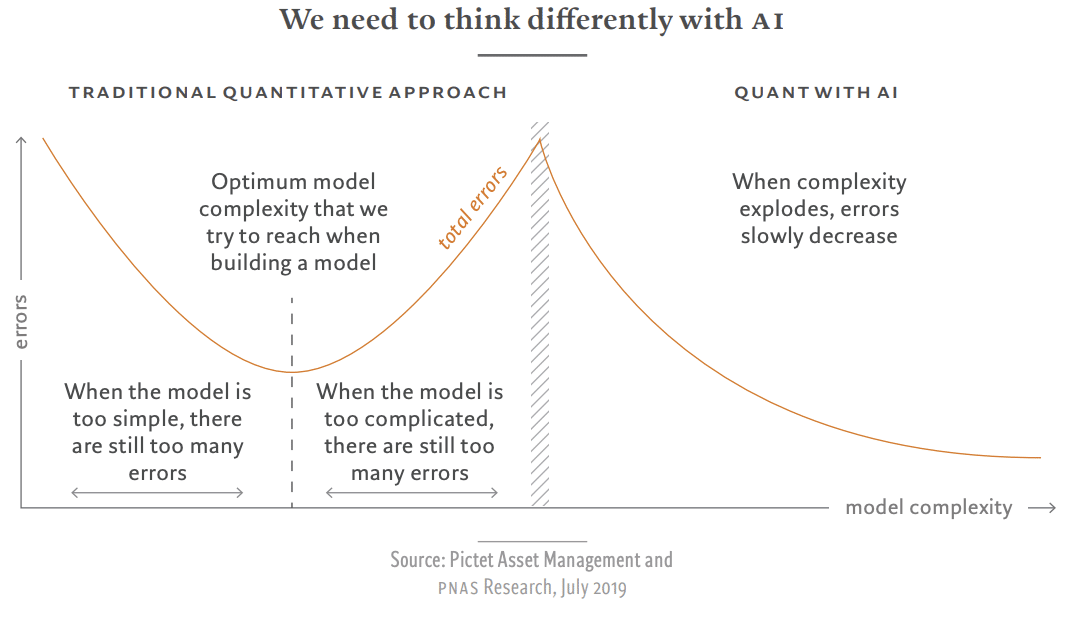
Pictet trained its model on historical data with a focus on finding where machine learning would be most effective. The research concluded that machine learning is the most effective way to forecast the relative returns of a large universe of stocks over the next month as there are many different drivers of the short-term relative performance of stock prices that are hard for humans to understand. Wright argued that this increased complexity means that traditional quant models built using traditional factors like momentum, value, or quality, do not do a great job of explaining short-term performance.
“As the time horizon became shorter, the additional benefit of using machine learning became greater.” Wright added. “Around 50% of the active return over and above the benchmarks comes from the use of machine learning, which cannot be captured with traditional models.”
In a paper Wright wrote that the most profound impact of Al might be in quantitative investing, where it enables the creation of sophisticated machine learning models that capture complex, non-linear relationships in data that traditional models cannot see. He gave the example of the relationship between a stock’s return and its exposure to the “value” factor (such as the price-to-book ratio). A linear model would assume that each unit decrease in the price-to-book ratio, indicating a “cheaper” stock, leads to a fixed increase in expected return. Wright said: “However, AI-driven non-linear models go beyond these simple assumptions.”
Source: Pictet
Although the process is data-driven, systematic and automated, Wright stressed that it has human supervision and guardrails at each step. Portfolio managers define the data and the signals used to train the model every three months using 15 years of data. Once that model is trained, it produces forecasts for the next one month for each stock. Managers then use those forecasts to help build a diversified portfolio that fits the parameters of running an enhanced index strategy.
Pictet aims for the model to be as all-weather as possible and Wright said it is independent of market direction, and also independent of the dominant style so it does not have a momentum, value or a quality tilt.
“We have a strong belief in the quality of our model, and we have made it regime agnostic and factor neutral,” Wright said. “We think the strategy offers something over and above a lot of other capabilities to clients, and it is attractively priced.”
He claimed that Pictet has been able to demonstrate to clients that the active return is there and is uncorrelated with traditional factors and other managers. Wright added: “We can demonstrate where the performance is coming from which has given people a lot of comfort.”
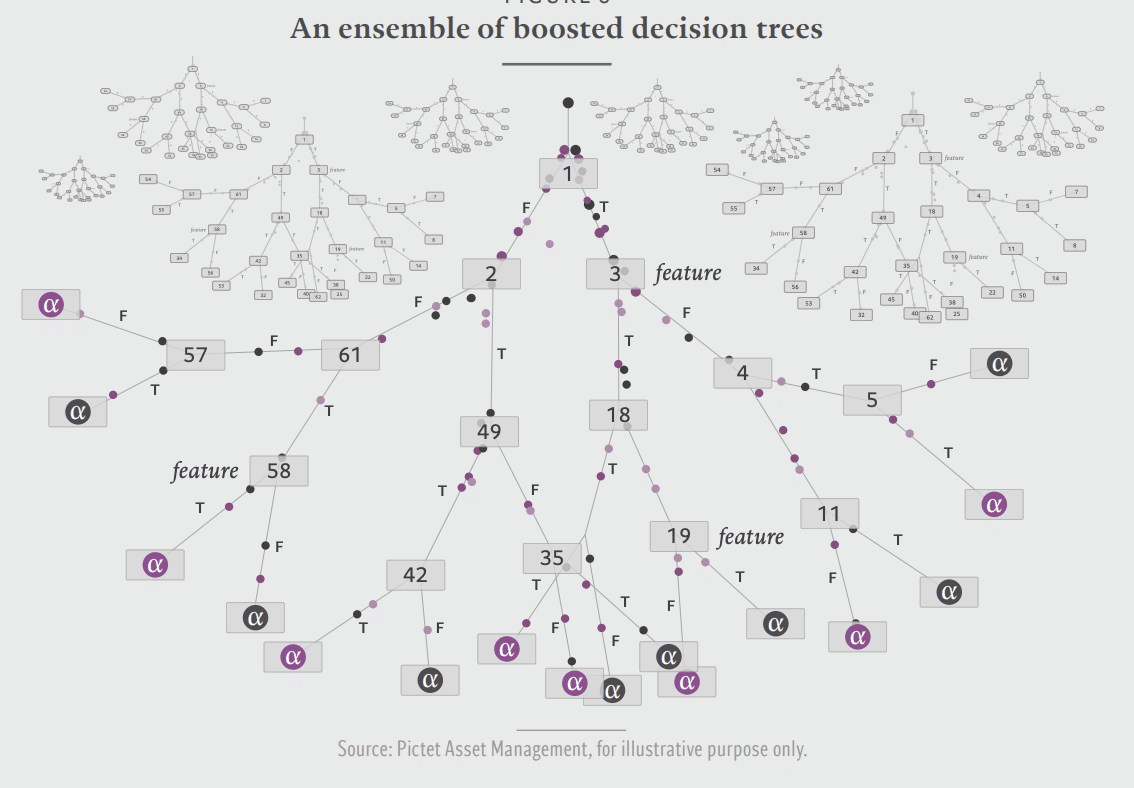
The paper said the quantitative investment team has focused on interpretability by leveraging gradient boosted trees’ and conducting in-depth research to break down and interpret the outputs of Al-driven stock selection models. As a result, between 60% and 70% of the AI model’s recommendation is derived from the same linear factors the managers already understand and monitor.
Source: Pictet
The European ETFs are using this engine in a new wrapper as Pictet wants to bring this capability to as wide a market as possible, according to Wright, especially as there is growing demand for active ETFs from European investors.
“The broader quant and enhanced index space is quite hot and that has also helped,” he added. “In the U.S. quant enhanced index has raised a lot of capital, so the European market may end up going that way as well.”
Pictet wants to have the right lineup of fund structures to meet client demands, which will include a very strong mutual fund suite. Wright said: “At the same time, we think active ETFs will gain share, especially in the UCITS market, so we want to make sure we are well positioned.”
📣 Global Active ETFs Gather Record US$500.88 Billion in YTD Net Inflows as Assets Climb to US$2.56 Trillion at the end of June Source @ETFGI https://t.co/1az1OYFoXY
— Deborah Fuhr, ETFGI (@deborahfuhr) July 28, 2026
Global active ETFs gathered a record $500.9bn in the first half of this year, more than double the previous record set in 2025, according to ETFGI, an independent research and consultancy firm. Assets invested in actively managed ETFs globally also reached a record $2.6 trillion at the end of June 2026, surpassing the previous record of $2.5 trillion set at the end of May.
🚀 ETF Industry in Europe Gathered a Record US$265.65 Billion in Net Inflows YTD Through June, Marking 45 Consecutive Months of Net Inflows – source @etfgi research
— Deborah Fuhr, ETFGI (@deborahfuhr) July 14, 2026
Read the full press release: https://t.co/DsutadeizO

NEWSLETTER SIGN UP
And receive exclusive articles on securities markets

🏆 The 2026 Global Markets Choice Awards are here! 🌍 Nominations are officially OPEN for the celebration of excellence in global capital markets trading & technology. Nominate below:
https://www.jotform.com/form/260086385121150

Delaware Life Insurance Company is becoming the first insurance carrier to offer an index that contains cryptocurrency, adding the BlackRock U.S. Equity Bitcoin Balanced Risk 12% Index to its fixed index annuity (FIA) portfolio.
As the digital assets industry pushes toward
Franklin Templeton is expanding its tokenized fund suite, signaling growing institutional demand for blockchain-based fund infrastructure and regulated investment products moving onchain. Read the full article below:
$50 billion in active ETF inflows helped fuel a record year for @BlackRock 's iShares business, as investors continue to lean into active strategies.
Shanny Basar
Senior writer
A Senior Writer at Markets Media who became a financial journalist in 2000 after working in banking for over a decade....
More about this authorRelated articles
-

Essentia Data-Out delivers behavioral intelligence directly into an asset manager's own data and AI.
-

Biggest challenge is turning growth opportunities into products that succeed at scale.
-

The firm is giving Claude and Cowork to portfolio managers, analysts and bringing Claude Code to developers.
-

The new location will accommodate more than 125 employees focused on AI and cloud transformation.
-

Fully autonomous institutional listed equity derivatives trade marks milestone in AI-powered trading.