





08.13.2026
Securitize, the tokenization platform, said it manages approximately $5bn in onchain assets as it reported its first results since going public.
Carlos Domingo, chairman and chief executive of Securtize, said on the second quarter results call on 13 August 2026 that the firm reached approximately $5bn in onchain assets during the third quarter.
“We were the only tokenization platform with more than $4bn in assets at the end of quarter two, and early in the third quarter we surpassed $5bn, becoming the first to reach that milestone,” Domingo added. “We have decoupled from the crypto market direction, and we are growing while crypto prices are declining.”
During the second quarter, average tokenized assets under management reached a record $4.3bn, up 16% year-on-year and more than seven assets reached $100m or more. Domingo said tokenization is growing faster than any other part of the digital asset ecosystem, but the industry is still in its infancy.
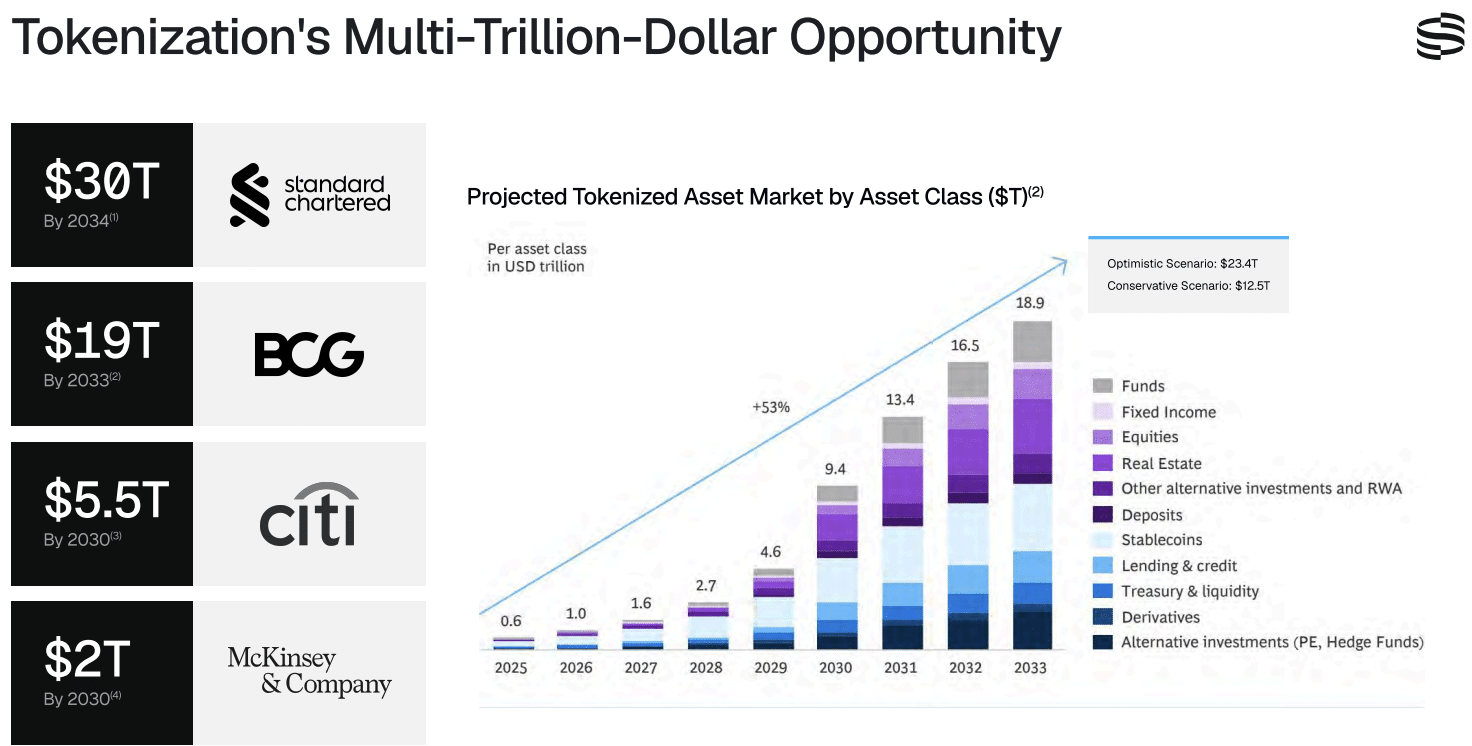
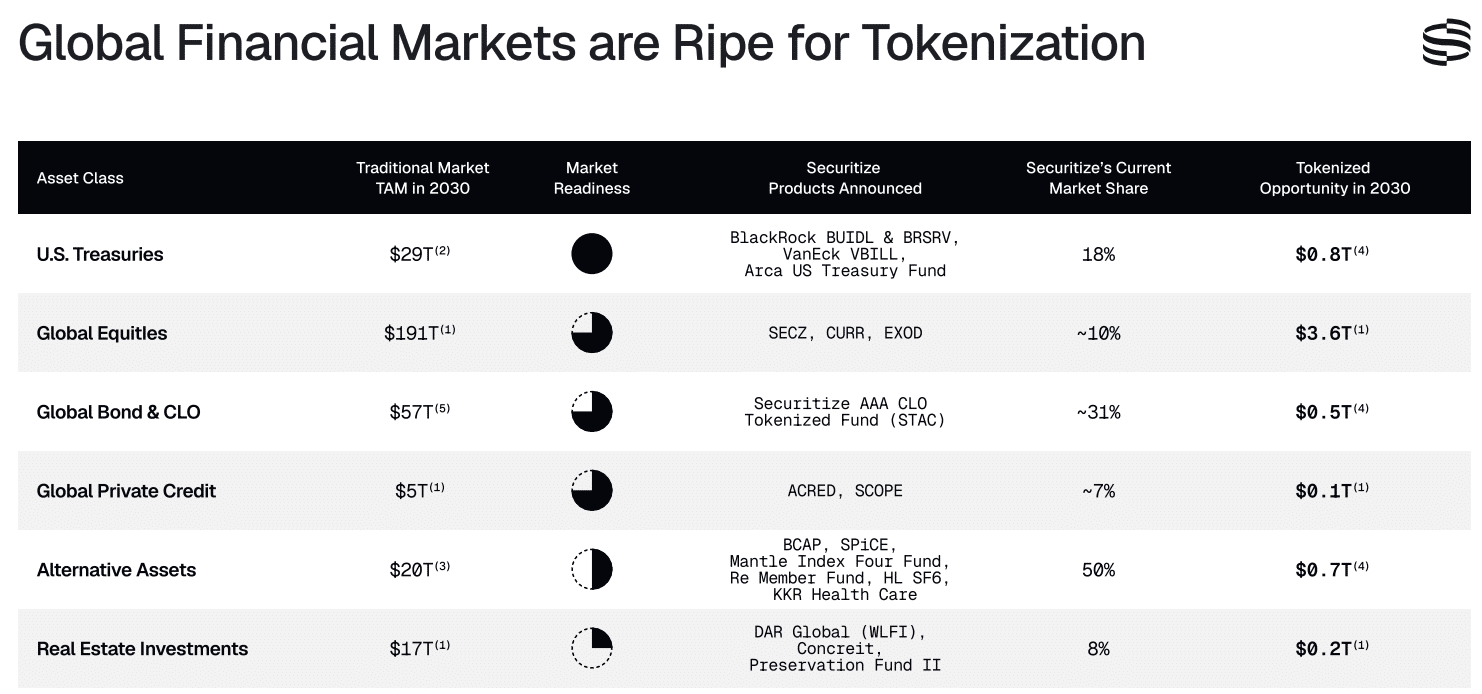
He estimated there are approximately $38bn of assets tokenized on public blockchains, excluding stablecoins. Much of the tokenization economy currently revolves around the $2 trillion crypto market but Domingo sees the shift to traditional financial institutions and investors as a much larger opportunity.
“This expands the addressable market from $2 trillion to $400 trillion,” he said. “We also see a large opportunity to become a more active participant in the onchain economy, where tokenized assets can be lent, traded, and used as collateral.”
Source: Securitize
Going public
On 2 July 2026 Securitize began trading on the New York Stock Exchange and became the first tokenization company to go public according to Domingo. At the same time as listing on the New York Stock Exchange, Securitize issued its own stock onchain. Domingo said Securitize became the largest tokenized equity in the industry and the first to go onchain in the U.S. on its first day of public trading.

Carlos Domingo, Securitize
“We demonstrated that it is possible to tokenize U.S. public equity within the existing regulatory framework,” said Domingo. “There is a tendency in crypto to assume that offshore synthetic structures are necessary because compliant tokenization cannot be done in the U.S.”
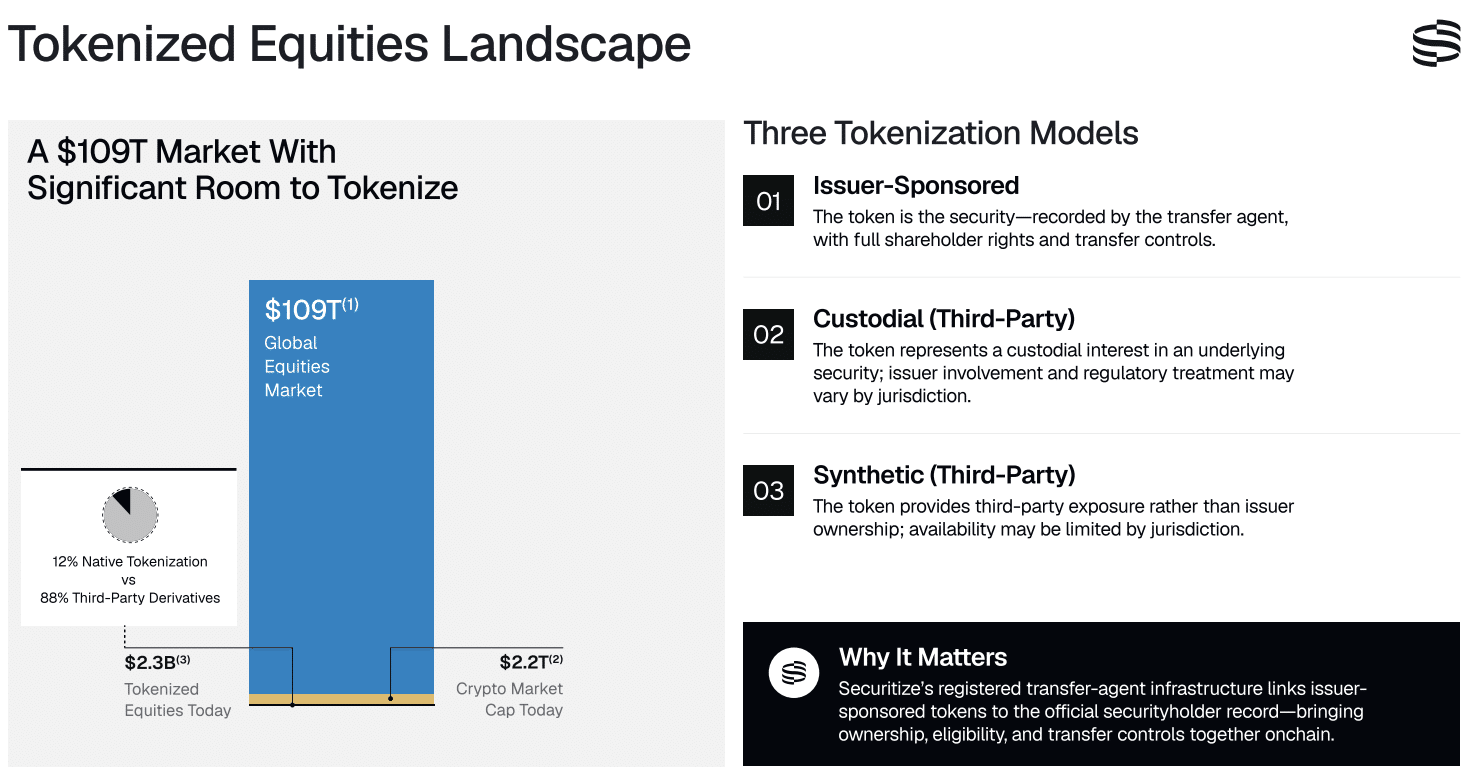
Securitize’s model is issuer-sponsored tokenized equities where tokens represent the share itself and preserve the applicable shareholder rights without introducing counterparty risk, which it used for its own equity.
DTCC has launched the first phase of its tokenization project and Domingo said the central U.S. post-trade infrastructure has a different model by tokenizing the entitlements while the shares continue to be held in a central securities depository. Domingo argued that DTCC is not changing the settlement cycle and only allowing approved market participants to access tokens on a private blockchain. In contrast, Securitize is natively issuing equities on a public blockchain where permissionless innovation can happen. Domingo believes these two models can co-exist.
“I think it’s great that the DTCC is creating awareness on the value of tokenization and forcing all their market participants to think about getting wallets and using tokens,” he added.
In addition Securitize is working with NYSE for the exchange’s launch of 24/7 trading of tokenized stock. Securitize has been selected as the design partner for the NYSE’s new digital asset trading venue as well as an initial transfer agent and tokenization partner. Securitize’s broker-dealer is also expected to connect to the venue and provide investor flow.
The firm went public in a merger with the special purpose acquisition company (SPAC) Cantor Equity Partners II. Securitize has partnered with broker Cantor Fitzgerald to enable public companies to raise capital and issue securities onchain. Domingo argued that blockchain-based infrastructure will enhance transparency, improve operational efficiency, and modernize ownership records while operating within the established capital markets framework of traditional public offerings.
Transfer agents Computershare and Continental Stock Transfer & Trust have also selected Securitize to support issuer-sponsored tokenized shares for U.S. public companies. Under this model tokenized shares remain connected to the issuer’s official shareholder register, corporate actions and existing transfer-agent infrastructure. Domigo said the relationships create opportunities for Securitize to support public companies, IPO candidates, and SPAC issuers exploring tokenization strategies.
“The question is no longer whether capital markets move onchain; it’s how fast and which companies will build the regulated infrastructure that enables that transition,” he added. “We believe this represents one of the largest shifts in financial market infrastructure in a generation.”
Domingo believes tokenized equities is one of the largest opportunities in the market, given that U.S. equities and ETF markets are worth about $100 trillion.
“If only 2% of that market moves onchain, it will double the size of the crypto market today,” he added. “But tokenized equities currently only represent around $2bn.”
Spurce: Securitize
One of the reasons for Securitize going public is because the firm thinks the crypto industry is going through a major transformation.
“We think there are opportunities to use our technology in traditional finance to improve operations,” Domingo added. “You are going to see us actively spending money in the second half of the year.”
Trading tokenized equities
Issuing assets on a blockchain is only one side of the story as Domingo said tokenized assets also need to reach investors. In May this year Securitize launched fully onchain, regulated trading of tokenized equities in collaboration with market maker Jump Trading and Jupiter, a decentralized finance (DeFI) app.
“Onchain markets do not yet have the same depth of liquidity as traditional markets, but we believe that the two can be complementary and coexist,” Domingo added.
Jump Trading provides liquidity through its PropAMM (automated market maker) deployed on the Solana blockchain, enabling tight spreads and real price discovery. Securitize enabled its tokenized stocks to trade through atomic swaps against the USDC stablecoin from self-custody wallets with Jump Trading acting as a market maker.
Jupiter is the user-facing access point, allowing investors to discover and trade tokenized equities through a familiar DeFi interface. Securitize underpins the system with its regulated broker-dealer and alternative trading system, transfer agent infrastructure, and know your customer-enabled, whitelisted wallets which ensures regulated execution and legally recognized ownership.
“We did that while operating within the regulatory requirements governing public securities in the United States, so it is possible,” said Domingo. “The next step is to continue increasing the utility of tokenized equities and to bring additional shares onchain.”
During the second quarter, Securitize Markets received regulatory approval to custody tokenized securities, enabling atomic settlement between tokenized securities and stablecoins. The approval also allows Securitize Markets to participate in underwriting and selling groups for initial and secondary offerings, expanding Securitize’s capabilities across issuance, ownership records, distribution, trading, custody and settlement.
“Our technology and regulatory stack is modernizing how capital is raised, managed, and traded,” said Domingo. “That means broader access, an always-on market, significant operational efficiencies, lower structural costs, fewer intermediaries, and more transparent ownership.”
He continued that there are additional regulatory developments under discussion in Washington D.C that could make it easier for tokenized markets to grow, including an innovation exemption and more practical custody frameworks.
Funds platform
Yield-bearing assets are in high demand among crypto market participants as they can be used as a reserve asset, as a treasury management tool for protocols and as collateral for trading and lending across centralized and decentralized markets. Therefore, Securitize has focused on building a broad spectrum of products in this category.
One end of the spectrum consists of the highly liquid, lower risk products such as BlackRock’s tokenized money market fund, BUIDL. Tokenized treasuries have been one of the fastest-growing categories in the digital asset ecosystem according to Domingo, and he said the catalyst was BlackRock’s launch of BUIDL in March 2024. At that time total assets in tokenized treasuries were less than $1bn but have increased to over $16bn across 87 products, representing a compound annual growth rate of 250%. Domingo said: “While the growth of that market has been impressive, we believe there is still significant room to grow.”
Source: Securitize
The opposite end of the spectrum consists of higher-yielding products with greater risk, including private credit strategies from firms such as Apollo and Hamilton Lane.
Securitize has started to fill the gap between those categories with the launch of the Securitize Tokenized AAA CLO Fund in collaboration with BNY last October. In the second quarter of this year Securitize was chosen to tokenize economist Dr. Nouriel Roubini’s first blockchain fund from Dubai. Roubini announced plans to launch USAFi, a digital security backed by the Atlas America Fund, an SEC-registered, actively managed ETF with reserve assets custodied at BNY,
“For the rest of the year, we will continue to expand that spectrum with products across areas like corporate bonds, asset-backed securities, and other high-yield strategies,” added Domingo.
BlackRock also chose Securtitize to tokenize a registered fund, the BlackRock Daily Reinvestment Stablecoin Reserve Vehicle, which is designed to be used as a stablecoin reserve asset to address the requirements of the Genius Act.
“Servicing registered funds is a significantly more complex and demanding task for a transfer agent, so we are very pleased that we managed to meet BlackRock requirements to manage this newly created registered fund,” said Domingo.
He highlighted that ‘daily reinvestment’ illustrates the benefit of putting assets onchain as interest can be efficiently reinvested on a daily basis with a simple blockchain transaction. Compounding interest more frequently can enhance returns for investors, making the product more attractive.
One of the reasons that Securitize is investing heavily in yielding assets is that the firm believes they can become a superior form of collateral through the ability to post, transfer, and redeem assets onchain almost instantly 24/7.
For example, Securitize has integrated BUIDL across major crypto derivative exchanges. In the second quarter OKX, a fintech company and crypto trading platform, announced the launch of a joint framework with BlackRock and Standard Chartered to integrate BUIDL into collateral workflows. This marked the first time a globally systemically important bank has acted as custodian in such an arrangement.
Domingo said: “The next step is to extend that model to traditional derivative exchanges like CME, following the CFTC’s recognition of tokenized assets as an acceptable form of collateral.”
Financials
Securitize reported a net loss of $21.7m for the second quarter as total revenue was $14.4m, down 5% versus the prior-year period.

Francisco Flores, Securitize
Francisco Flores, chief financial officer of Securitize, said on the call that quarterly revenue can be volatile at this stage of Securitize’s growth, but the firm remains focused on driving top-line growth.
“As we scale as a public company and given the underlying operating leverage we see in the business, delivering positive adjusted EBITDA will remain an important near-term goal,” Flores added.
He highlighted that going public leaves Securitize in a strong liquidity position with approximately $350m in cash and no debt on the balance sheet at the start of the third quarter.

NEWSLETTER SIGN UP
And receive exclusive articles on securities markets

🏆 The 2026 Global Markets Choice Awards are here! 🌍 Nominations are officially OPEN for the celebration of excellence in global capital markets trading & technology. Nominate below:
https://www.jotform.com/form/260086385121150

Delaware Life Insurance Company is becoming the first insurance carrier to offer an index that contains cryptocurrency, adding the BlackRock U.S. Equity Bitcoin Balanced Risk 12% Index to its fixed index annuity (FIA) portfolio.
As the digital assets industry pushes toward
Franklin Templeton is expanding its tokenized fund suite, signaling growing institutional demand for blockchain-based fund infrastructure and regulated investment products moving onchain. Read the full article below:
$50 billion in active ETF inflows helped fuel a record year for @BlackRock 's iShares business, as investors continue to lean into active strategies.
Shanny Basar
Senior writer
A Senior Writer at Markets Media who became a financial journalist in 2000 after working in banking for over a decade....
More about this authorRelated articles
-

The manager will expand the reach of tokenized securities via Prometheum’s regulated broker-dealer.
-

The deal represents the first OTC derivative to reference a fully tokenized index on DLT.
-

DLX gives clients a front-to-back platform for integrating tokenized assets.
-

They will bring tokenized real-world assets to NUVA, the Animoca Brands-backed vault marketplace.
-

Legal and regulatory certainty is needed for adoption to scale.