






08.17.2026

Superstate has built integrations with some automated market makers (AMMs) for tokenized equities but is waiting for liquidity to be unlocked by regulatory changes.
In July this year Peter Christiansen, director, digital assets and fintech services equity research at Citi, described Superstate in a report as operating at the intersection of two converging forces: the institutionalization of blockchain infrastructure and the tokenization of real-world assets.
Christiansen said: “What distinguishes Superstate from most crypto-native peers is its regulatory-first architecture – the company operates as both an SEC-registered investment adviser and an SEC-registered transfer agent (Superstate Services LLC), giving it a structurally distinct position in a market where compliance is increasingly the critical differentiator.”
Tokenized equities

Robert Leshner, Superstate
One of Superstate’s businesses is tokenizing equities. Robert Leshner, co-founder and chief executive of Superstate, told Markets Media that a differentiator for the firm is that it tokenizes issuer sponsored shares onchain, which give holders the same rights as traditional shareholders. In contrast, many other tokenized stocks are issued by a third party and are wrapped structures that reference the price of a security or represent an obligation against an intermediary.
Superstate’s Opening Bell platform allows the issuance of publicly registered equity directly ontchain. In order for the tokenized equities to be able to trade, Superstate has built integrations with some automated market makers (AMMs) and decentralized finance ( DeFi) lending protocols.
An automated market maker is a smart contract that enables liquidity and transfers according to its predefined rules. However, trading through AMMs has not yet been switched on due to the regulatory framework in the U.S. Equity trading in the U.S. is governed by the trade-through rule, which prevents trading venues from executing an order at a price that is worse than the best publicly displayed price on any other competing exchange.

Paul Atkins, SEC
In June this year the U.S. Securities and Exchange Commission proposed rescinding the trade-through rule, or Rule 611 of Regulation NMS. Paul Atkins, chairman of the SEC, argued that the rule was adopted to incentivize displayed liquidity, but instead trading activity has increasingly occurred off-exchange over the last two decades and there has been a proliferation of new trading venues, which has fragmented liquidity.
Alex Thorn, head of research at digital asset fund manager, agreed at the time that the trade-through rule is one of the biggest structural barriers to tokenized US equities trading in DeFi .AMMs use mathematical formulas and smart contracts to set prices and execute trades automatically rather than matching buyers and sellers in a traditional order book.
Leshner said that if the SEC rescinded the trade-through rule or provided an innovation exemption allowing the use of AMMs, this would be a “huge unlock” for tokenized equities.
Citi’s report said the Bullish/Equiniti combination and continued Securitize momentum represent the most acute near-term threats to Superstate. Another tokenization platform, Securitize, began trading on the New York Stock Exchange in July and at the the same time issued its own stock onchain. Securitize’s model is also issuer-sponsored tokenized equities where tokens represent the share itself and preserve the applicable shareholder rights without introducing counterparty risk, which it used for its own equity.
Bullish, the institutional-grade digital asset platform, has also agreed to acquire a transfer agent for $4bn in order to create a global transfer agent for tokenized securities.
“We believe the barrier to entry in tokenization is frequently misunderstood; while technically low, durable success requires deep Wall Street relationships that take years to develop,” added Citi. “Management expects only a few players to ultimately dominate the space, and believe it positions Superstate’s chain-agnostic, distribution ubiquitous model as best suited to that outcome.”
Fund tokenization
Leshner said Superstate is “extremely active” in tokenizing funds. For example in March this year Invesco announced a collaboration in which Invesco became investment manager of Superstate’s tokenized short-duration U.S. treasuries fund, In addition, Invesco marked the first time an independent asset manager has leveraged Superstate’s tokenization infrastructure, FundOS, according to Leshner.
In April this year Coinbase Asset Management selected FundOS to issue an onchain share class of the Coinbase Stablecoin Yield Fund (CUSHY), a stablecoin credit offering, which became the first external fund issued using Superstate FundOS from inception. Leshner told Markets Media that many more funds are in the pipeline to be issued in FundOS from both crypto-native managers and traditional asset managers.
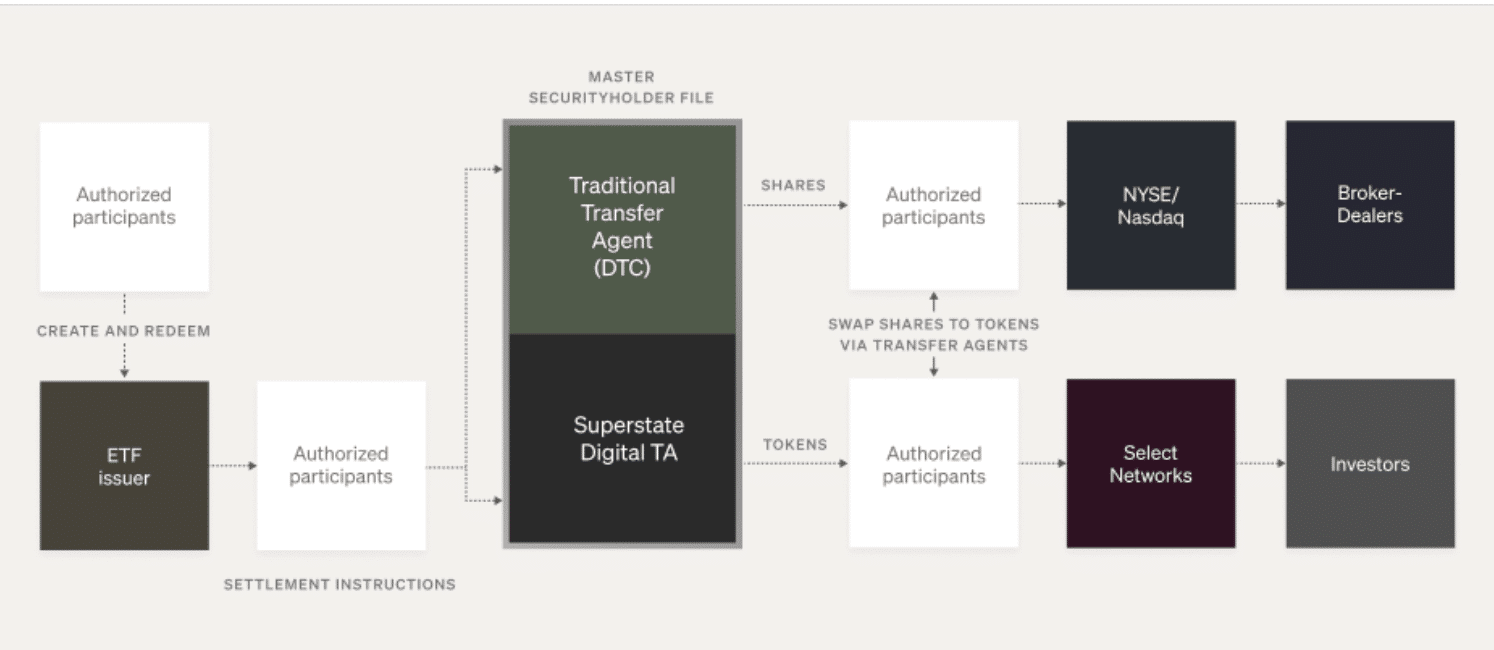
There is also “significant” demand to tokenize exchange-traded funds, according to Leshner. For example, an investor cannot easily use stablecoins to put capital into traditional ETFs
Superstate said in a blog that ETFs are well suited for onchain distribution because they are already built around access, liquidity, and tradability, allowing investors to allocate their capital in more customizable ways, including intraday.
“Ttokenization does not change how ETFs work or why investors use them,” added the blog. “It extends the ETF’s core advantages onto a new platform.”
Source: Superstate
“It is not simply a token that tracks the price of an ETF,” said Superstate. “It is the exact same product except that it can be bought, owned, and transferred onchain, with tokenized shares integrating with the ETF’s existing structure, records, and underlying market infrastructure.”
In addition the creation/redemption process for ETFs may become more efficient and available 24/7, onchain distribution can add new product intelligence, enable always-on secondary markets and collateral use cases.

NEWSLETTER SIGN UP
And receive exclusive articles on securities markets

🏆 The 2026 Global Markets Choice Awards are here! 🌍 Nominations are officially OPEN for the celebration of excellence in global capital markets trading & technology. Nominate below:
https://www.jotform.com/form/260086385121150

Delaware Life Insurance Company is becoming the first insurance carrier to offer an index that contains cryptocurrency, adding the BlackRock U.S. Equity Bitcoin Balanced Risk 12% Index to its fixed index annuity (FIA) portfolio.
As the digital assets industry pushes toward
Franklin Templeton is expanding its tokenized fund suite, signaling growing institutional demand for blockchain-based fund infrastructure and regulated investment products moving onchain. Read the full article below:
$50 billion in active ETF inflows helped fuel a record year for @BlackRock 's iShares business, as investors continue to lean into active strategies.
Shanny Basar
Senior writer
A Senior Writer at Markets Media who became a financial journalist in 2000 after working in banking for over a decade....
More about this author