






09.02.2026

Bullish, an institutional global digital asset platform that provides market infrastructure and information services, went public on the New York Stock Exchange in August 2025. One year later tokenized Bullish shares started trading on Bullish Exchange in Gibraltar.
This marked the first time that tokenized equities were approved to trade on a digital asset exchange regulated by the Gibraltar Financial Services Commission. In May this year Bullish became the first NYSE-listed company to fully tokenize its own equity cap table, bringing its ordinary shares onchain on the Solana blockchain.
Thomas Cowan, head of tokenization at Bullish, told Markets Media: “These are the same as the U.S. shares.”
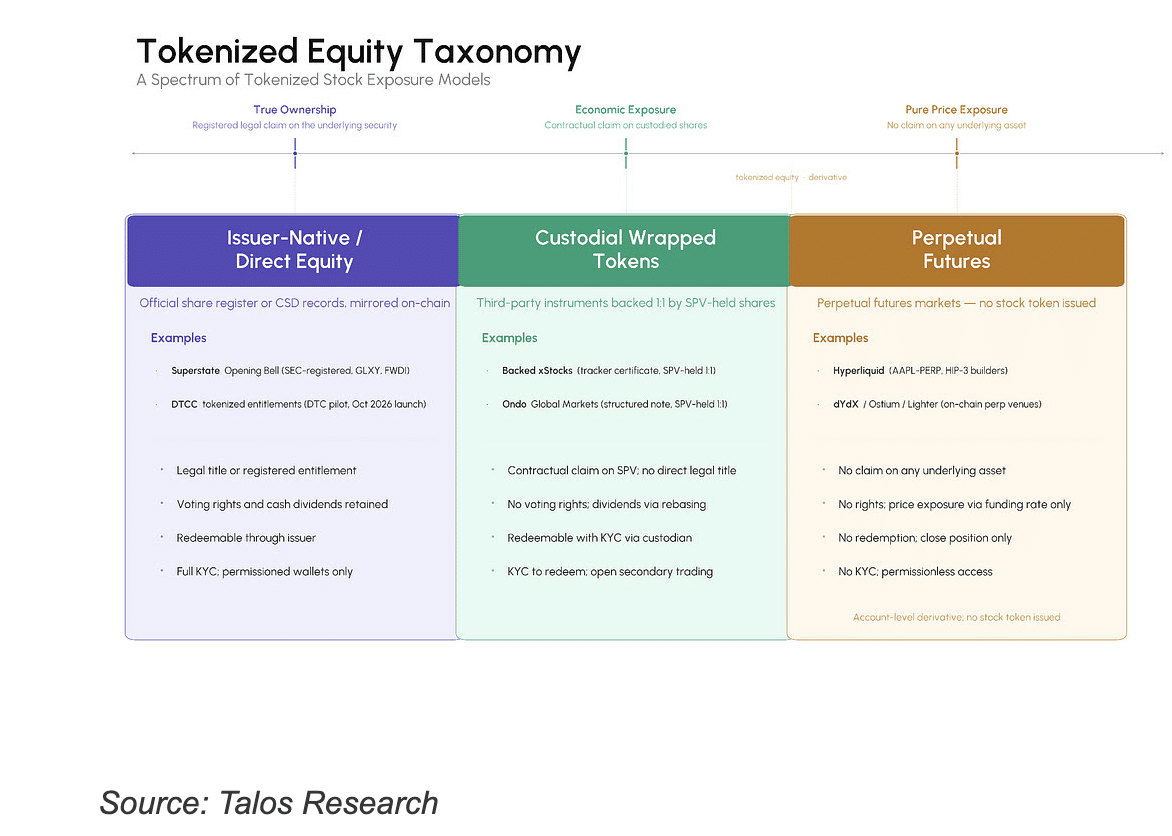
Source: Talos research
The listing was facilitated at the share registry level through Bullish’s pending acquisition of transfer agent Equiniti. Transfer agents maintain the official record of ownership of an issuer’s securities and facilitate the issuance, cancellation, and transfer of securities.
Therefore, the tokens give holders direct share ownership and the same legal standing as traditional shareholders, rather than representing a synthetic position or third-party wrapper. Every transfer of tokenized Bullish shares updates the official shareholder register so that the traditional shares and onchain stocks operate as a single integrated system.
Cowan said: “Right now there is not a ton of liquidity or a ton of use, but we wanted to prove what is possible from issuance all the way through the stack with market making and trading. The whole nine yards.”
Equiniti acquisition
Bullish said the tokenization of its own shares and enabling them to trade were steps towards building a tokenized securities program alongside its $4.2bn agreement to acquire Equiniti, which is expected to close in January 2027.

Tom Farley, Bullish
Tom Farley, chief executive of Bullish, said in a statement: “Bullish is assembling the full complement of services required to tokenize equities: the regulated exchange, the tokenization technology, and the transfer agent. We’re starting with our own stock.”
Steve McLaughlin, founder, chief executive and managing partner at Financial Technology Partners, said in a report that Equiniti is one of only two leading global transfer agents and the transaction marks a pivotal moment in the evolution of global capital markets. FT Partners was financial advisor to Siris Capital on the Equiniti sale.
“The combination of Bullish and Equiniti will create a complete, integrated, and proprietary end-to-end tokenization stack, serving as a unique bridge between onchain ownership and corporate registries and thereby creating a trusted system of record for tokenized public equities globally,” added McLaughlin.
The Tokenization Insight newsletter said the Equiniti acquisition brings Bullish issuer relationships at scale, regulated share registry infrastructure, shareholder servicing workflows and a direct bridge into native onchain issuance models. The newsletter added that as tokenization advances into traditional capital markets, tokenized equities are emerging as the next major battleground for exchanges and infrastructure providers.
“Institutions want native issuance infrastructure,” said the newsletter. “That requires integration into the regulated issuer/shareholder recordkeeping stack.”
Cowan joined Bullish in July this year from digital asset manager Galaxy, which was the first Nasdaq-listed company to tokenize its stock on a major U.S. blockchain in partnership with Equiniti and tokenization platform Superstate. He was attracted to Bullish due to the Equiniti transaction and described the merger as the “best of both worlds” as Equiniti is a traditional, well-known, trusted firm, while Bullish is a technology-first, crypto-first firm.
“We are uniquely positioned to take this market and put it onchain in a way that very few other firms can,” he added.
Equiniti has relationships with 3,000 issuers, where the average relationship between a company and a transfer agent is 18 years, according to Cowan. He continued that Bullish and Equiniti have set up a joint venture to focus on tokenization before the acquisition closes, which allowed Bullish to tokenize its own shares.
“We are speaking with many other issuers to build this out and we are not waiting until January,” added Cowan. “We are starting now.”
Bullish faces competition from other platforms such as Superstate and Securitize, who are also tokenizing equities under an issuer model to give investors traditional shareholder rights and protection.
“They both deserve enormous credit for building out the market and helping people think about what is possible,” said Cowan. “We are now shifting towards distribution and that is where Equiniti thrives because we have the distribution of all those issuers.”
Bullish also recognizes that traditional exchanges including NYSE and Nasdaq are going to embrace issuer-sponsored tokens in their own models, and Cowan views them as partners. On 1 Septemebr 2026 London Stock Exchange announced that it is assessing a UK tokenized equity structure to broaden access to capital markets whilst preserving the shareholder rights, protections and governance standards that underpin public markets today.

Thomas Cowan, Bullish
“We are going to make sure that our tokens are integrated with those systems when they are up and running,” added Cowan. “We will focus on making sure that our issuers get access to the most liquidity, whether that’s on the Bullish Exchange or another venue.”
He argued that technology that makes things better, faster, and cheaper always grows markets exponentially. Therefore, Bullish can provide infrastructure to a growing market which will allow participants to cooperate and all have a slice of a much bigger pie.
“Bullish has assembled a great set of puzzle pieces,” he said. “But we cannot do it alone, so we are very focused on growing the ecosystem.”
One benefit of putting equities onchain under the issuer sponsored model is to give issuers the ability to have a direct relationship with tokenholders. For example, an airline could have a separate boarding class for investors because they can now be identified onchain.
Cowan said: “One of the interesting things in conversations with issuers is that customers and investors have been totally separate for decades. Technology now enables them to finally come together.”
SEC proposal on transfer agents
Joshua DeVos, research lead at CoinDesk, the data provider owned by Bullish, said in a report that issuer-sponsored models for tokenized equities operate within existing registration and frameworks for transfer agents do not require new legislation to function. However, broader U.S. retail access remains constrained under current rules, and tokenized equities on public blockchains are generally restricted to non-U.S. or accredited investors.

Hester Peirce, SEC
The regulations covering registered transfer agents came into the spotlight on 1 September 2026 when the Securities and Exchange Commission proposed to update the applicable rules covering these businesses, which have not been substantively updated since the first rules were adopted in the late 1970s and early 1980s.
SEC commissioner Hester Peirce said in a statement that the regulator wants public comment on issues including the changing role of transfer agents as securities move onchain and whether the rules should be adjusted to help facilitate onchain trading of tokenized securities.
Peirce said: “For example, should transfer agents continue to be required to collect names and physical addresses of securityholders or should the rule allow other identifiers, such as email and digital wallet addresses, to be collected instead?”
This one is easy to miss, but it could end up being a really important rulemaking for tokenized securities.
The SEC just proposed its first major update to the transfer agent rules in decades, and the proposal explicitly addresses the reality that securities are increasingly… https://t.co/RhPdXHf7i8
— Nicki Sanders (@nickisanders) September 2, 2026
Nicki Sanders, fractional CTO for crypto & blockchain companies, said on X: “Transfer agents aren’t exactly the sexiest part of capital markets, but they sit right in the middle of one of the most important questions in tokenization:
Who is the official record of ownership when the security lives onchain?
The SEC is asking some very interesting questions around how transfer agent rules should work as securities move onchain, including whether digital wallet addresses and other digital identifiers should be usable in place of traditional information.
This proposal has been more than a decade in the making.
If you’re building tokenized securities infrastructure, this is one I’d actually read.
The comment period will be open for 60 days after publication in the Federal Register.”
Cowan said: “The U.S. market is known for safety and soundness, and we will make sure that we move with the pace of regulation and demonstrate what is possible while also protecting investors.”

NEWSLETTER SIGN UP
And receive exclusive articles on securities markets

🏆 The 2026 Global Markets Choice Awards are here! 🌍 Nominations are officially OPEN for the celebration of excellence in global capital markets trading & technology. Nominate below:
https://www.jotform.com/form/260086385121150

Delaware Life Insurance Company is becoming the first insurance carrier to offer an index that contains cryptocurrency, adding the BlackRock U.S. Equity Bitcoin Balanced Risk 12% Index to its fixed index annuity (FIA) portfolio.
As the digital assets industry pushes toward
Franklin Templeton is expanding its tokenized fund suite, signaling growing institutional demand for blockchain-based fund infrastructure and regulated investment products moving onchain. Read the full article below:
$50 billion in active ETF inflows helped fuel a record year for @BlackRock 's iShares business, as investors continue to lean into active strategies.
Shanny Basar
Senior writer
A Senior Writer at Markets Media who became a financial journalist in 2000 after working in banking for over a decade....
More about this authorRelated articles
-

The industry association submitted responses to two FCA consultations on UK equity market structure.
-

Revenue goes to the tokenizers and the risk goes to the companies.
-
The letter calls for lower trading costs, improved access to liquidity & stronger market infrastructure.
-

Securitize Stocks are structured to preserve the investor rights and economic benefits associated with shares.
-

Central clearing has been introduced to a securities financing transactions market that operated bilaterally.