






09.29.2026
Tokenized Securities Venues Will Not Challenge Traditional Exchanges
09.29.2026
The U.S Securities and Exchange Commission issued an innovation exemption allowing new platforms Tokenized Securities Venues (TSVs) to trade tokenized NMS stock. Limitations on the activities of TSVs mean they are unlikely to challenge traditional exchanges, especially as the SEC has approved plans from both Nasdaq and New York Stock Exchange to trade tokenized securities.
Larry Tabb, global head of financial sector research at Bloomberg Intelligence, said: “I’m not sure we are going to see a ton of TSVs, or the TSVs that we do see are not going to be substantially impactful.”

Larry Tabb, Bloomberg Intelligence
Tabb spoke in said in a webinar hosted by Bloomberg on 28 September 2026. On 15 September 2026 the U.S. Senate did not vote to pass the CLARITY Act, which provided a federal framework for digital asset market structure. Two days later the Securities and Exchange Commission issued an innovation exemption covering the trading of tokenized NMS Stock. which lasts for five years.
If NMS stock is tokenized by a third party unaffiliated with the issuer, the TSV must provide a written notice to the issuer allowing them to object A TSV must also verify that the tokenized NMS stock made available for trading provides holders the same rights and privileges as the traditional NMS stock of an equivalent class, including dividends and voting rights, which can be a complex process.
Tabb highlighted that these new markets are exempt from registration and Reg NMS, most notably order protection and sub-penny rules, but they are not exempt from anti-money laundering (AML) and know-your-customer (KYC) rules.
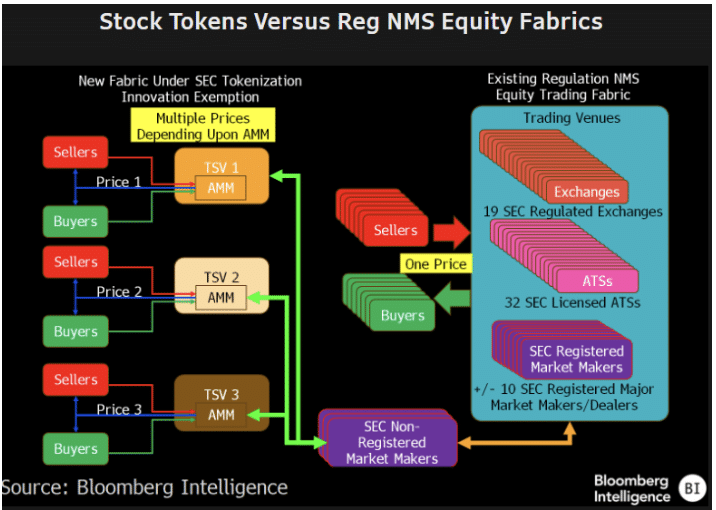
Source: Bloomberg Intelligence
“This exemption creates a separate kind of market that is not an exchange or an alternative trading system [ATS],” said Tabb. “Interestingly, they are tied to automated market makers as the definition of a TSV says that it must use one or multiple AMMs, who must settle against a stablecoin authorised by the GENIUS Act or a tokenized money market fund.”
AMMs are onchain protocols used in crypto and decentralized finance (DeFi) to price and trade digital assets without a central limit order book or intermediaries such as market makers. Instead AMMs use smart contracts to automatically determine the price based on supply and demand for tokens in liquidity pools, rather than trades being executed when the price of buy and sell orders match in a central order book.
The SEC added that a TSV must stop trading in a tokenized NMS stock concurrently with any stoppage of trading in the underlying NMS stock on the primary listing exchange, including when volatility spikes halt trading, and Tabb said this will be challenging.
“It does not say that they must recognize halts during daylight hours,” added Tabb. “I think they must recognize halts 24 hours a day, so that means the 20% moves in the after-hours markets and whatever they come up with as they go to a 24×5 or or 23×5 environment.”
Another challenge, according to Tabb, is that TSVs cannot have financing, borrowing, lending, hypothecation or leverage and cannot hold customer assets. He gave the example of Coinbase and other large crypto exchanges who include a combination of an exchange, broker and custodian and offer leverage, so it would be difficult for them to open a TSV, unless it was a separately funded subsidiary.
In addition, Tabb said the SEC has set market share thresholds, such as TSVs only being able to trade 75 tier one names, and less than 0,25% of volume on a monthly basis.
Hey folks,
Here is the replay from our webinar yesterday on the @SECGov tokenization innovation exemptionhttps://t.co/O3aia90dLX
Enjoy
— Larry Tabb (@ltabb) September 29, 2026
“When you look at a lot of the ATSs or exchanges, it really puts TSVs on the very bottom rung of the size scale in terms of what they are allowed to do,” added Tabb.
He described the innovation exemption as “kludgy at best.” For example, there could be multiple TSVs, each with an AMM that has a totally different price than a traditional stock exchange. In traditional finance, the order protection rule means that an order has to executed at the best price amongst all the Reg NMS-registered exchanges and ATSs. Tabb said: “I’m not sure this is going to be a super-functional market.”
However, TSVs are exempt from these requirements and there is no requirement for them to connect to one another. “I think that one of the main reasons the SEC wants to get rid of the order protection rule is so it can bring TSVs more in line with exchanges and ATSs.”
As a result, Tabb believes that most investors would prefer to use swaps, single stock futures, or perpetual futures rather than trading tokens on a TSV. He described the innovation as “not overly positive” for crypto as the SEC took a very careful and measured approach to introducing tokens into the equity market. He highlighted that the traditional market trades over 20 billion shares and $1 trillion by value every day, and is the core of roughly 4,000 public companies, so the SEC did not want to jeopardise the current market structure.
Mike Cagney, co-founder and executive chairman of Figure Technology Solutions, agreed on X that volume caps on TSVs make scale impossible. Figure operates a blockchain native equity market, and is a founder of NAVRA, which intends to distribute onchain trading venues. He added: “It’s unclear how holders exit a position once a stock hits its cap. The likely answer is redeeming through the tokenizer, whose mint and redeem mechanics the order leaves entirely unaddressed.”
My thoughts on the SEC Innovation Exemption: What it is, and what it isn't. https://t.co/ee2FjqCFfG
— Mike Cagney 🇺🇸 (@mcagney) September 28, 2026
Cagney also highlighted that in a standard AMM pool, prices move with the pool’s inventory rather than the national best bid and offer (NBBO), so arbitrageurs harvest the difference from liquidity providers. He said: “The order lets venues use oracles and external market data, which helps, but every fix either imports the exchange price, making the venue a price-taker, or widens fees until the venue’s pricing is worse than the exchange, which removes the reason to trade there.”
He concluded that the restrictions on TSVs mean that they will not pull meaningful volume from national markets and that is by design. Cagney said: “A quarter of 1% of daily volume, off tape, with no leverage and no practical institutional path cannot compete with the National Market System (NMS), which is precisely why this was done as an exemptive order rather than a multi-year rulemaking process.”

Mike Cagney, Figure Markets
The real value is position as firms that build compliant venues, liquidity programs, and distribution during the window will be standing where the market forms when the caps come off and the hours open up, according to Cagney.
“The five-year question is not whether TSVs beat the NYSE (they don’t), but instead who owns the template when the SEC writes the permanent rules, should this prove to be the best model for public equity onchain,” added Cagney. “The last point isn’t a given.”
Dushyant Shahrawat, senior analyst on the market structure team focusing on digital assets at Bloomberg, said on the webinar that the Nasdaq and NYSE tokenization models have no caps on what they can trade and are not affected by the innovation exemption. He added: “That’s very net positive for them.”
Shahrawat believes transfer agents, who are responsible for recording the ownership of equities, benefit from the innovation exemption as they can verify that the tokenized equity has the same rights as a real share and deliver proxy materials. Crypto exchange Bullish has announced an $4.25bn acquisition for transfer agent Equiniti, while tokenization platforms Securitize and Superstate already own regulated transfer agents.
Regulation
Nathan Dean, senior policy analyst on litigation and governance at Bloomberg, said on the webinar that the Clarity Act will not return in full if the Democrats win the mid-term elections in November this year. He said: “The crypto sector has about five years to create a sector that essentially cements itself and then ultimately dares a future CFTC or SEC to rewind it.”
He expects the SEC and CFTC will move forward with their proposals to regulate crypto markets. Dean said: “My view is that it’s most likely going to be a voluntary federal framework for how the CFTC can look at the spot markets.”

Nathan Dean, Bloomberg Intelligence
The SEC has issued its innovation exemption, which Dean expects to be codified in rule making. He also expects the CFTC to issue rules before the end of this year. On 24 September 2026 three CFTC divisions confirmed that futures commission merchants and derivatives clearing organizations can invest segregated customer funds in tokenized versions of the instruments allowed by Regulation 1.25.
If the SEC proposes rules in the middle of next year, Dean said there is enough time to finalize the rules and defend them in court, if necessary, before the election in November 2028 when there may be a change of administration. Dean said: “I wouldn’t discount the anger or discontent that traditional finance exchanges and brokers are going to have with this process, and I wouldn’t be surprised if there are legal challenges or awkward questions from members of Congress.”
If the Democrats win in 2028 it would approximately six to nine months to name new leaders of the SEC and CFTC, and if they decide to reverse these rules, that could take until 2031.
“There’s a lot here the SEC and CFTC can do to get the crypto sector to a great spot before anything were to change five years from now,” added Dean.
SEC Crypto FAQs
On 25 September 2026 the SEC’s Division of Corporation Finance also released answers to frequently asked questions (FAQs) on certain types of crypto assets and transactions.

Jeff Dorman, Arca
Jeff Dorman, chief investment officer at digital asset hedge fund Arca, said in a blog that these FAQs build on the much more important Commission-level interpretation released in March and “could change the game.” He added: “A crypto asset itself and an investment contract involving that crypto asset are not necessarily the same thing.”
Dorman said Hyperliquid, Aave, Uniswap, Maple, Aerodrome, Morpho and many other blockchain protocols now have real customers paying real money for real products and the next step is connecting those economics to the assets investors actually own.
“The crypto industry spent years trying to create assets that couldn’t possibly look like stocks,” he added. “Perhaps we can finally focus instead on creating good investments.”

NEWSLETTER SIGN UP
And receive exclusive articles on securities markets

🏆 The 2026 Global Markets Choice Awards are here! 🌍 Nominations are officially OPEN for the celebration of excellence in global capital markets trading & technology. Nominate below:
https://www.jotform.com/form/260086385121150

Delaware Life Insurance Company is becoming the first insurance carrier to offer an index that contains cryptocurrency, adding the BlackRock U.S. Equity Bitcoin Balanced Risk 12% Index to its fixed index annuity (FIA) portfolio.
As the digital assets industry pushes toward
Franklin Templeton is expanding its tokenized fund suite, signaling growing institutional demand for blockchain-based fund infrastructure and regulated investment products moving onchain. Read the full article below:
$50 billion in active ETF inflows helped fuel a record year for @BlackRock 's iShares business, as investors continue to lean into active strategies.
Shanny Basar
Senior writer
A Senior Writer at Markets Media who became a financial journalist in 2000 after working in banking for over a decade....
More about this authorRelated articles
-

Issuer Sponsored Token Coalition believes the issuer & shareholder relationship should be preserved.
-

There is a wave of liquidity constantly coming onto the platform for the buy side.
-

This makes it more capital-efficient for institutions to supply liquidity across secondary markets.
-

Starting with Oura’s IPO, eligible customers can request shares at the offer price before trading starts.
-

Volume is increasingly aggregating around the closing auction on stock exchanges.