





10.05.2026
“Tipping Point” Reached for Commercialization of Digital Assets
10.05.2026
Linux Foundation Decentralized Trust, the open source foundation for decentralized technology, said many significant blockchain projects have reached production, rather than the financial industry being dominated by proofs of concept.
Daniela Barbosa, general manager, decentralized technologies, Linux Foundation, and executive director at LF Decentralized Trust, said: “We have reached a tipping point for commercialization of digital assets.”

Daniela Barbosa, LFDT
She continued that billions of dollars of assets are already moving across production systems powered by LF Decentralized Trust technologies with more large-scale deployments going live in the coming weeks. Barbosa told Markets Media: “The kind of questions and the kind of needs that we are hearing from technical teams within banks and the regulators point to the technology going into production.”
LF Decentralized Trust commissioned a survey, Institutional adoption of LF Decentralized Trust Technologies, with Ledger Insights to look at what institutions are building and which technologies they are choosing. The survey said the last institutional DLT wave was dominated by proofs of concept, but many significant projects have reached production. The report said: “Citi alone processes close to $1bn a day through its Tokenized Deposit Service.”
The three most adopted platforms were Hyperledger Fabric, EVM compatible platforms where the specific implementation was not disclosed, and Besu.
“Ethereum mainnet adoption is substantial even in the institutional sector,” said the report. “That’s particularly for asset managers, where the reach and composability of a public chain are a natural fit.”
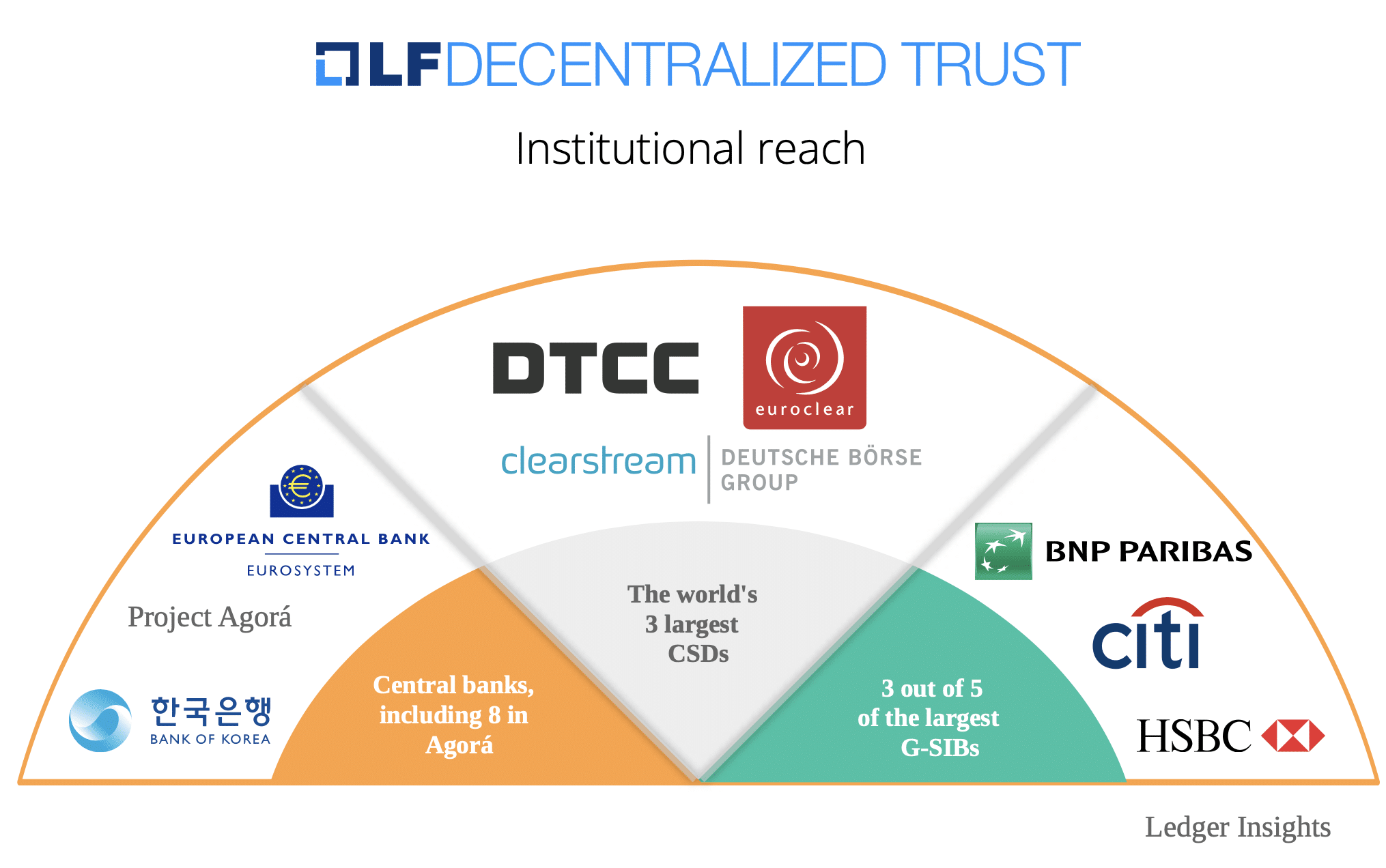
The research found that among financial platforms in production or with a clear path to it that disclose their technology choice, almost 30% run on LFDT projects, including three of the largest central bank projects, all three of the world’s biggest central securities depositories (CSDs) and three of the five largest G-SIBs (global systemically important banks).
Barbosa said on LinkedIn: “What interests me most is what sits behind that number. Technology choices made by central banks, market infrastructure providers, and commercial banks carry implications for how financial systems will connect and evolve.”
Source: LFDT
Use cases
Barbosa told Markets Media that for the last 30 years, the Linux Foundation has been the home for the most important open source project, the Linux Kernel, which she described as the operating system that runs the majority of supercomputers, the majority of cloud on the internet, and runs projects across many different industries. Ten years ago the Hyperledger project was contributed to the Linux Foundation, which she added was the first blockchain project that addressed enterprise needs for privacy.
In the financial industry, LF Decentralized Trust hosts Hyperledger Besu, an open source distributed ledger technology that promotes interoperability. Barbosa described Besu as allowing everyone to speak the same language.
In July 2026 the Depository Trust & Clearing Corporation, the U.S post-trade infrastructure, processed tokenized trades that were first phase of the launch of the DTCC Tokenization Service in October this year. More than 30 firms representing a cross-section of traditional financial institutions (TradFi) and digital market participants took part in the initiative. The digital conversions occurred on DTCC’s private network powered by Besu and Canton, Digital Asset’s blockchain for the financial industry with in-built product controls. DTCC is a founding premier member of the LiF Decentralized Trust which Barbosa said is important as they connect to hundreds of banks and financial institutions.
European central securities depositories, Clearstream and Euroclear, have also built projects on Besu to drive interoperability across the industry. In 2023 the Japan Securities Clearing Corporation (JSCC) launched its first production blockchain solution using Besu to streamline the delivery settlement of rubber futures.
Project Agorá, the public-private collaboration from the Bank for International Settlements (BIS) and the Institute of International Finance (IIF) to explore how tokenization and programmability can improve wholesale cross-border payments, also uses Besu.
Barbosa said: “They understand the value of open governance and open development as they make generational changes. There is no organization in the world that brings the kind of neutrality of the Linux Foundation where competitors can work in the same project developer groups without worrying about things like antitrust issues.”
Citi Token Services and Citi integrated Digital Assets Platform also chose Besu as a framework. In a case study the bank said that with Besu, Citi can access Ethereum’s robust public ecosystem and tools while maintaining the stronger access controls and enhanced privacy of a private network.
“Citi have contributed to the code base because it is important for them to be have influence,” said Barbosa.
She explained that firms are happy to contribute to Besu, which she described as “the unsexy plumbing,” while being able to build proprietary applications on top of the protocol.
“A rising tide lifts all boats so there is no competitive advantage per se by working at the protocol level,” she added. “They build their own services on top which is where the competitive advantage lies.”
New members
In September this year LF Decentralized Trust added 15 new members including Swift, the global messaging network used to coordinate international money transfers, and Wells Fargo, the U.S. bank.

Chintan Mehta, Wells Fargo
Chintan Mehta, CIO and head of digital technology & innovation at Wells Fargo, said in a statement that the future of financial services will require greater interoperability, trust, and collaboration across institutions and technology ecosystems. Mehta added: “By joining LF Decentralized Trust, Wells Fargo is strengthening its engagement with the open source community to help advance foundational capabilities such as digital identity, tokenization, and trusted digital infrastructure.”
Barbosa said the foundation is getting more questions about both human, company and agentic AI identity, anti-money laundering (AML) and know your customer (KYC) requirements, as well as digital wallets.
In addition to adding new members, the LF Decentralized Trust project ecosystem launched new projects and releases in September including CLPR (“clipper”), which can enable assets, data, and messages to move securely across ledgers without bridges, pooled liquidity, or intermediary validator networks; Panurus, a new platform neutral token infrastructure project for blockchain-based asset management, and Hyperledger Cacti 3.0, the biggest release in the project’s history. Hyperledger Cacti 3.0 delivers production-grade cross-chain, use-case driven interoperability infrastructure that addresses the need to move value, data, and trust across independently operated ledgers.

NEWSLETTER SIGN UP
And receive exclusive articles on securities markets

🏆 The 2026 Global Markets Choice Awards are here! 🌍 Nominations are officially OPEN for the celebration of excellence in global capital markets trading & technology. Nominate below:
https://www.jotform.com/form/260086385121150

Delaware Life Insurance Company is becoming the first insurance carrier to offer an index that contains cryptocurrency, adding the BlackRock U.S. Equity Bitcoin Balanced Risk 12% Index to its fixed index annuity (FIA) portfolio.
As the digital assets industry pushes toward
Franklin Templeton is expanding its tokenized fund suite, signaling growing institutional demand for blockchain-based fund infrastructure and regulated investment products moving onchain. Read the full article below:
$50 billion in active ETF inflows helped fuel a record year for @BlackRock 's iShares business, as investors continue to lean into active strategies.
Shanny Basar
Senior writer
A Senior Writer at Markets Media who became a financial journalist in 2000 after working in banking for over a decade....
More about this authorRelated articles
-

This is the first cross-chain repo flow separating the venue from the networks where cash & collateral settle.
-

A CSD will use a public blockchain to mirror securities ownership records for the first time.
-

Banks can easily manage smart contracts on both their own ledgers for tokenized deposits and the Swift ledger.
-

London Stock Exchange Group also intends to bring other services into the Canton Network.
-
This is the first time BlackRock's portfolio strategies have been made available to onchain investors.