




10.30.2026

Cboe Global Markets is preparing to launch key performance indicators (KPI) contracts in November this year, ahead of other exchanges who have made regulatory filings to launch similar products.
Craig Donohue, chief executive of Cboe Global Markets, said on the third quarter results on 30 October 2026 that this is the first step in Cboe’s broader event contract strategy. The new binary contracts reference company-specific KPIs.
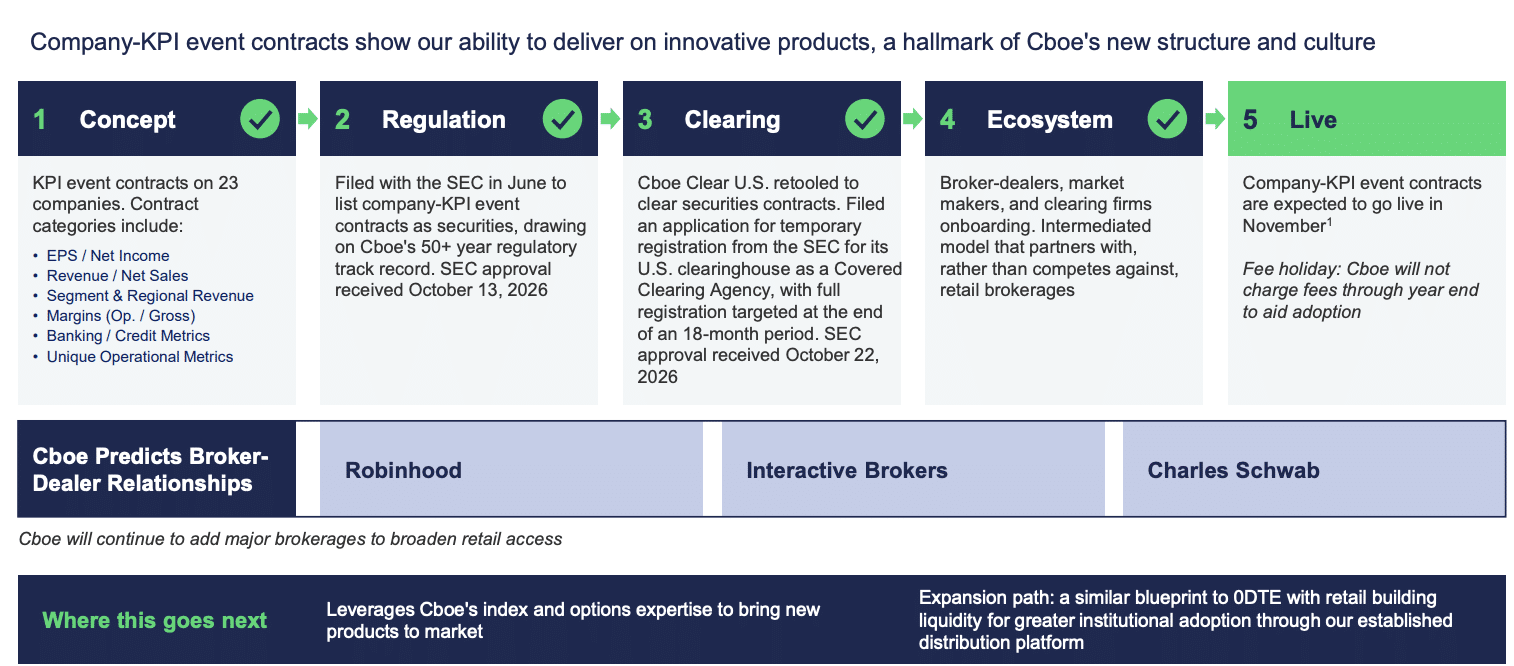
Donohue added that event contracts based on securities indices or on certain corporate performance metrics should be regulated as securities. Cboe received regulatory approval from the U.S Securities and Exchange Commission to list and clear securities-based KPI contracts on 23 companies.
Source: Cboe
For Cboe’s event contracts to scale and for prediction markets to thrive over the long term, Donohue said they need to rest on the sound legal framework that Congress has already established. He argued that event contracts based on securities indices or on corporate performance metrics that issuers disclose as material to their actual reported financial or operating performance, such as earnings and revenue, meet the definition of a security and squarely fall within SEC jurisdiction.

Craig Donohue, Cboe Global Markets
“What a platform chooses to call a product does not change that,” Donohue added. “Allowing these products to trade outside securities laws risks creating a shadow market where investors take on securities risk without the registration, disclosure, and market integrity protections the law requires.”
Therefore, Cboe built its products as securities so investors can benefit from the safeguards against manipulation and insider trading. Donohue also believe that the filings and self-certifications behind event contracts should be public, without large portions that are unavailable for public review, so that market participants can assess the risk.
“The success of prediction markets will depend on both innovation and investor confidence,” he said.
KPI contracts
The KPI contracts will be cleared by Cboe Clear U.S., LLC (CCUS), which has received temporary registration from the SEC to operate as a Covered Clearing Agency.
Rob Hocking, global head of derivatives at Cboe, said on the call: “I just want to remind everyone that we are introducing a second securities clearinghouse for the first time in over 53 years, so that’s taking some time to make sure everyone is connected and ready to trade.”
Both applications were filed in late June and Donohue anticipates a November product launch, pending the readiness of clearing members, brokers, and market makers.
Donohue said: “What stands out is how quickly we moved while staying true to our principles on market integrity. We built these products as securities, which provide retail and institutional investors with the transparency and investor protections they have come to expect from Cboe.”
In September, Cboe announced Robinhood as the launch partner for the KPI contracts, and Donohue said there has also been strong interest and support from Interactive Brokers and Schwab.
“By working across our distribution partners and our intermediated network, we reach investors where they trade, with the protections they know,” he said. “Distribution breadth is an advantage that a closed, vertically integrated system cannot match, and we believe it is why our KPI contracts are well positioned to scale.”
Cboe will analyze how KPI contracts scale alongside traditional equity options and futures, and collaborate with market participants to develop new offerings over time, supported by its enhanced clearing capabilities. Donohue sees an opportunity to expand into other asset classes, bundle new products with existing products and build capabilities across trading and data.

Rob Hocking, Cboe
Hocking said trading activity is expected to evolve in a similar way to zero days to expiry (0DTE) options, where volumes were led by retail and then institutions followed. From early conversations, he thinks institutional demand will come from places like hedge funds.
“We are building this market slowly and even on pricing, fees will be waived through the end of 2026,” added Hocking. “Right now the priority is adoption, not really revenue.”
He expects the KPI binary options to develop to a multi-listed market over time, which he thinks is a “good thing.” MEMX, NYSE and Nasdaq have all submitted filings to launch KPI contracts, according to Hocking, but he argued that Cboe has a big advantage being a first mover.
“That is how the listed options market became a multi-trillion-dollar market,” added Hocking. “You standardize the contracts, provide central clearing and lots of brokers and venues, which all help the whole category grow.”
Hocking also argued that Cboe has an advantage over platforms who have launched CFTC-regulated KPI contracts. He said that their products are not the same as Cboe’s SEC regulated products traded on a registered exchange under securities law and with insider trading protections
“That is going to be very important for brokers and institutions to adopt,” he added.
Cboe has built a clearing solution to support the launch of KPIs, and Hocking said the firm “would be open” to providing post-trade clearing services where it would benefit the larger market.
The temporary SEC registration for CCUS to clear securities expands its authority beyond futures and swaps, which it clears as a Commodity Futures Trading Commission registered derivatives clearing organization. CCUS will initially use this authority to clear the KPI contracts but it also recently received CFTC approval to clear a broad range of margined futures products, and it continues to clear digital asset derivatives under its registration.
Over the past year, Cboe has strengthened CCUS’s risk management and resilience, according to Donohue. Over time, he sees CCUS complementing the U.S. clearing ecosystem and supporting new products and emerging asset classes across the industry, while Cboe’s longstanding relationship with OCC in traditional equity options continues.
S&P Dow Jones Indices
Donohue described the regulatory approval of the KPI contracts as one of two foundational steps that will strengthen the the company, alongside signing a 25-year extension of Cboe’s exclusive licensing agreement with S&P Dow Jones Indices, which began in 1983.
“This continues our collaboration through 2051,” he added. “Cementing this relationship was the longest agreement we have had in our history of over four-decades with S&P.”
Cboe anticipates collaborating with S&P Dow Jones to pursue innovation beyond traditional index derivatives, including new products like exchange-traded, centrally cleared tokenized options contracts.
Retail volume
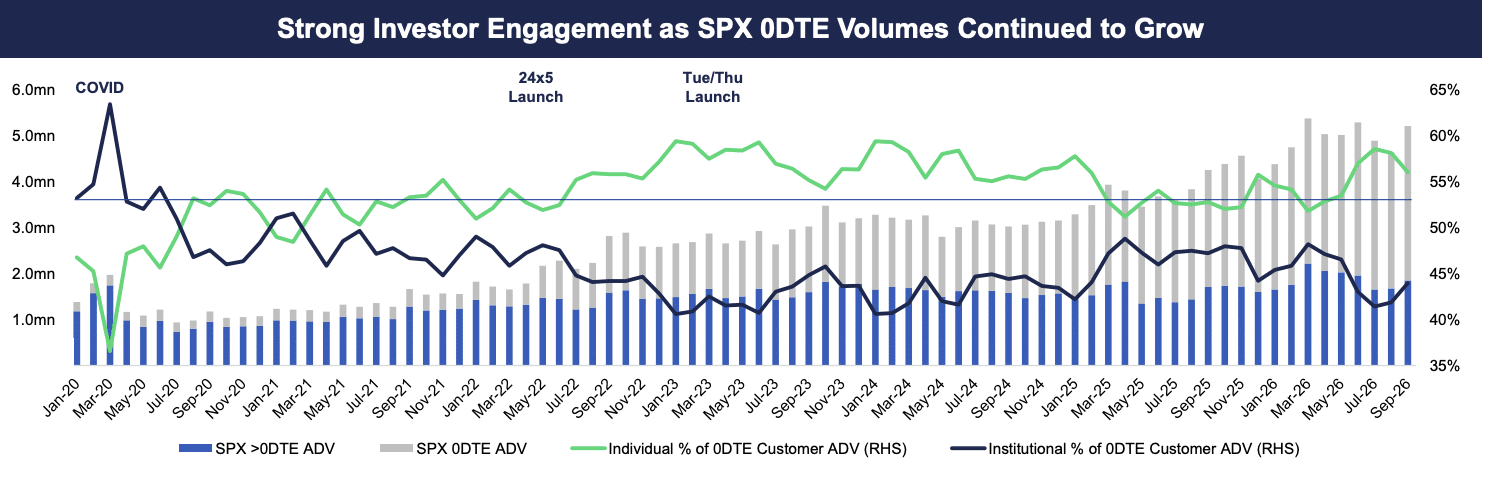
Net revenue in the derivatives business rose 22% in the third quarter, which Cboe said was driven by a 24% increase in index options average daily volume supported by record 0DTE activity.
0DTE contracts achieved record quarterly average daily volume and reached a record 65% of overall Cboe S&P 500 Index (SPX) options volume. In SPX 0DTE, retail volume jumped 46% year-over-year, outpacing institutional growth of 20%.
Source: Cboe
“In XSP, total volume more than doubled as compared to the third quarter of 2025, driven largely by retail following the June repeal of the Pattern Day Trader Rule,” said Donohue.
The Pattern Day Trader set limits on active retail traders with accounts of less than $25,000 and was eliminated by U.S. regulators the summer.
Donohue highlighted that overseas retail is also contributing to growth.
“Global trading hours had nearly 250,000 contracts traded per day in the third quarter in options as stronger retail engagement was a consistent theme across our products in the last quarter,” added Donohue.
Cboe global trading hours is an extended trading session that allows market participants to trade key options products nearly 24 hours a day, five days a week. Volume in global trading hours rose 130%, led by Asia, which makes up nearly over 30% of volume in the session, up from less than 20% a year ago.
“That success is a culmination of a long process of onboarding local brokers in the Asia Pacific region and extensive education and marketing efforts,” added Donohue. “We are excited to build on that momentum with our recent launch of extended early trading hours for single stock options, which will enable more international customers to trade U.S. options in their local hours.”
Cboe launched extended trading hours for options on 24 single stocks and five ETFs, with pre-market trading starting at 7:30 a.m. Eastern Time, and a post-market session after the close on 19 October 2026. The new sessions launched smoothly, according to Donohue, who said Cboe captured 63% of morning volume during the first week.
In June this year the firm also launched its first Cboe Predicts product – binary options on the mini S&P 500 index. Donohue said that there has been initial interest, and the firm anticipates adoption and future products to accelerate as broker-dealer partners roll out dedicated user interfaces over the coming months.
“We expect these interfaces to offer simple illustrative graphics and point-and-click trading, making it even easier for new derivatives customers to express their views on market outcomes,” he added.
Source: Cboe
Financials
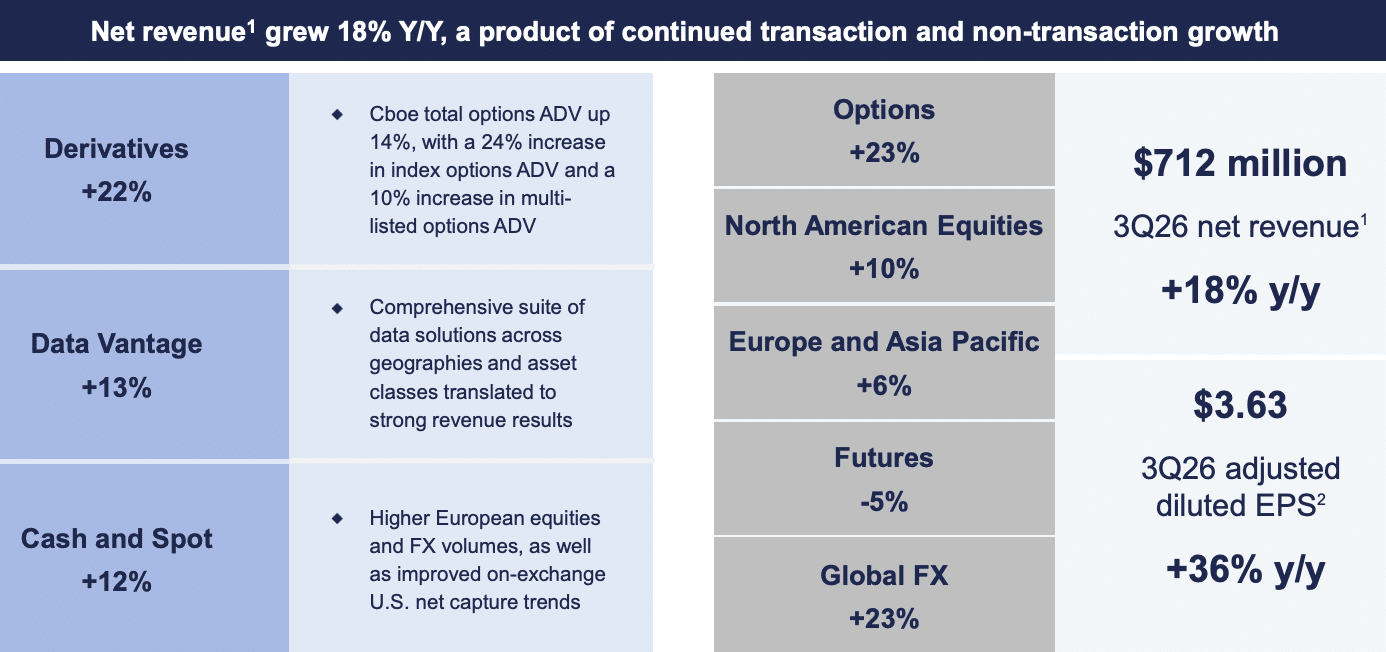
Net revenue for the third quarter was $712.2m, up 18% from a year ago. Donohue said the “strong” results were broad-based, driven by double-digit net revenue growth in every major category and year-over-year net revenue growth in four of the five company segments.
Cash and spot markets net revenue grew 12% year-over-year to 131m, with growth across Cboe’s three segments. Cboe is ready to extend cash equities trading to 23×5 in December this year, pending industry readiness.
“Looking further out, we continue to explore tokenized solutions on the path to 24×7,” added Donohue.

Jill Griebenow, Cboe Global Markets
Jill Griebenow, chief financial officer at Cboe, said on call that the sale of Cboe Australia to TMX, the Canadian financial market infrastructure, closed in the third quarter and generated a net gain of $71.5m.
The sale of Cboe Canada remains pending, subject to closing and regulatory approval. Cboe said the sales free up resources and capital to strengthen its core businesses and pursue new and emerging opportunities. Griebenow said that Cboe will be deliberate in deploying capital behind opportunities it believes will drive long-term profitable growth, including KPIs, clearing, and extended market hours.
“Given our strong year-to-date performance, we are increasing our 2026 total organic net revenue growth target to ‘high teens’ from ‘mid to high teens’ and increasing our Data Vantage organic net revenue growth target to ‘mid teens’ from ‘low teens’,” she added.

NEWSLETTER SIGN UP
And receive exclusive articles on securities markets

🏆 The 2026 Global Markets Choice Awards are here! 🌍 Nominations are officially OPEN for the celebration of excellence in global capital markets trading & technology. Nominate below:
https://www.jotform.com/form/260086385121150

Delaware Life Insurance Company is becoming the first insurance carrier to offer an index that contains cryptocurrency, adding the BlackRock U.S. Equity Bitcoin Balanced Risk 12% Index to its fixed index annuity (FIA) portfolio.
As the digital assets industry pushes toward
Franklin Templeton is expanding its tokenized fund suite, signaling growing institutional demand for blockchain-based fund infrastructure and regulated investment products moving onchain. Read the full article below:
$50 billion in active ETF inflows helped fuel a record year for @BlackRock 's iShares business, as investors continue to lean into active strategies.
Shanny Basar
Senior writer
A Senior Writer at Markets Media who became a financial journalist in 2000 after working in banking for over a decade....
More about this authorRelated articles
-

The registration expands CCUS's clearing capabilities to securities products.
-

Registration as a derivatives contract market (DCM) is expected to follow shortly.
-
A DCO is a regulated clearinghouse for derivatives.
-

SEC's rule for central clearing of eligible Treasury cash transactions goes live on 31 December.
-

The regulator is reviewing if tokenised collateral could be used safely by EU CCPs.