




11.20.2026
Perpetual futures proved to be an accurate predictor of the pricing and first day trading of the initial public offering of Anthropic, the AI company best known for its Claude chatbot, which was the largest in history.
Anthropic priced its IPO on 18 November 2026 at $83 per share, an increase from the initial price range of $70 to $78. The $81.3bn IPO beat the previous $75bn record raised when SpaceX, Elon Musk’s AI and space company, went public in June this year.

Alex Thorn, head of firmwide research at digital asset fund manager Galaxy, said in a newsletter that Anthropic shares began trading on Nasdaq under the ticker ANT at 11:48 a.m. ET on 19 November 2026 at $111.50, 34% above the IPO price, which briefly gave the company a market capitalization of $2 trillion.
Thorn said: “Onchain, Hyperliquid showed the success of its pre-IPO perp market yet again. Its markets correctly called the deal pricing, with the perp trading well above the $70-78 range for weeks, signaling that demand was stronger than the underwriters’ original target.”
Cash-settled pre-IPO perpetual futures track where a stock may trade without conveying any ownership of the underlying shares when the company goes public. For example, Trade.xyz, the largest third-party deployer on blockchain-based trading platform Hyperliquid by volume and open interest, starts its contract at a price it chooses and then lets traders set the price.
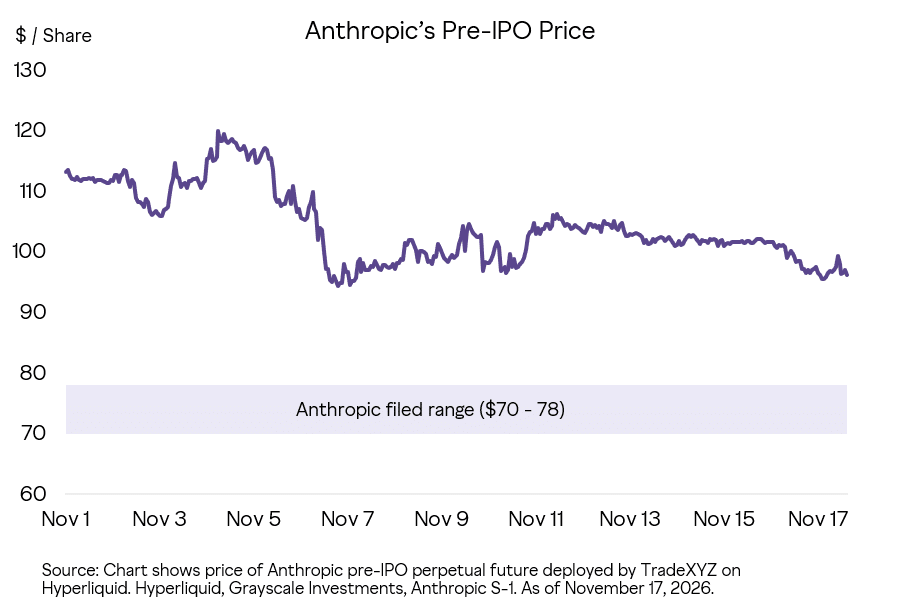
The Anthropic pre-IPO perpetual future on Hyperliquid undershot the open by about 7%, with the contract trading around $103.67 at 8:40 AM ET, according to Thorn. However, he argued that the perpetual future in the week before the IPO “nailed where the stock ended up trading.”
“It was about $96.93 as of Nov. 17 and $98.83 on the hourly chart the night before pricing, having briefly fallen below $94 during the earlier tech selloff,” added Thorn. “After the opening pop faded, the stock traded right back into that band, around $94–$97 by the afternoon.”
The Hyperliquid Research Collective said:
The Hyperliquid Research Collective said: “Before any Nasdaq indication, Hyperliquid was already at $104.04, pricing a +25.3% pop. Miss vs the open: 6.3%.”
Zach Pandl, head of research at digital asset investment manager Grayscale, said in a newsletter on 18 November 2026 that traders on Hyperliquid had estimated that Anthropic’s shares would open roughly 23% above the company’s filed IPO range using pre-IPO perpetual futures.
Pandl highlighted that in eight previous IPOs, pre-IPO perpetuals correctly signaled whether the stock would open above or below its IPO price seven times. In the Hong Kong listing of fast fashion retailer SHEIN, Pandl said the pre-IPO contract pointed to about 9% below the IPO price, and the stock opened at its offer price but fell 10% within the first hour.
“For investors, the takeaway is not that these contracts predict the open precisely, but that they offer a real-time, round-the-clock read on demand before a company goes public, something traditional markets do not provide,” Pandle added.
Byron Gilliam, market strategist at Blockworks, said in The Breakdown newsletter: “Contrary to what bankers have been telling companies for decades, there’s really no way to know what investors will pay for a stock until you go out and ask them. And even then, you’re only speaking to a subset of institutional investors.”
Gilliam argued that bankers have a “long and terrible track record” of predicting what investors will pay for IPO shares, while perpetual futures have a short but very good track record. He said the IPO valuation range should be perpetual futures minus 15% to 25%.

“I don’t know whether Anthropic deliberately priced its IPO 20% below where the perps were trading,” Gilliam added. “But if the market gets a few more of these right, I suspect future IPOs will be.”
Deniz Besiroglu, market structure research analyst at Bloomberg Intelligence, said in a report that Anthropic’s IPO would test whether perpetual futures can provide useful price discovery before a listing. He noted that a perpetual future on Hyperliquid had traded 24/7 since the S-1 filing and, at about $101 a share, implied a $1.83 trillion valuation, about 30% above the top of the $70-$78 IPO range.
IPO data
Besiroglu also said in a newsletter that the Anthropic IPO could deepen U.S. dominance of the next global listing cycle, pushing the U.S. share of 2026 proceeds toward two-thirds as mega-listings increasingly concentrate issuance on Nasdaq and widen the gap with Europe and Hong Kong.
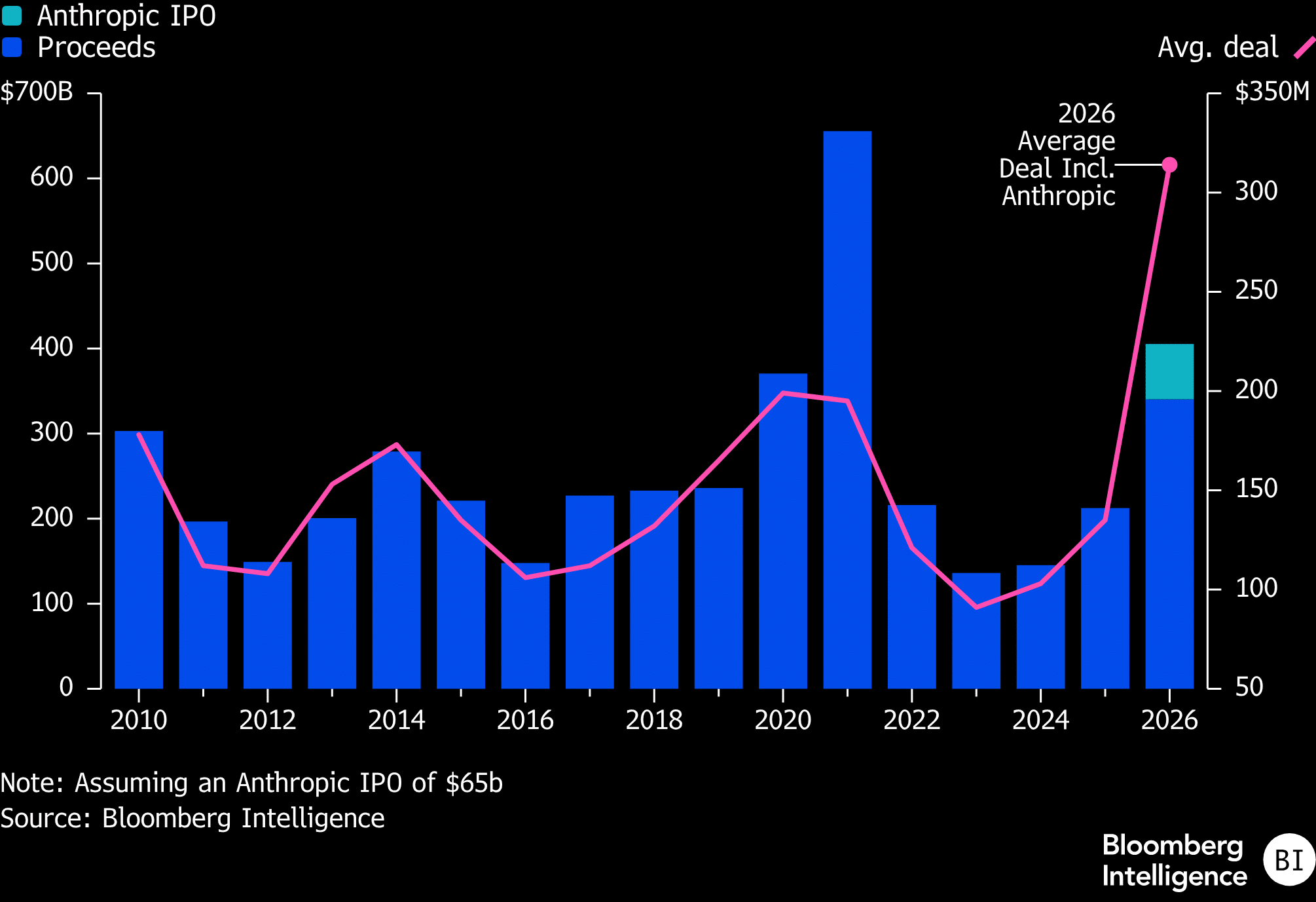
“With a handful of technology giants now capable of reshaping annual totals, the IPO recovery may depend less on a broad rebound in deal volume than on where the next wave of mega-cap issuers chooses to list,” Besiroglu added.
Besiroglu also highlighted that Anthropic could rank tenth in the Nasdaq 100 index at a $1.3 trillion valuation within weeks of listing, making demand from tracker funds significant relative to a potentially thin float even with Nasdaq’s low-float weight cap.
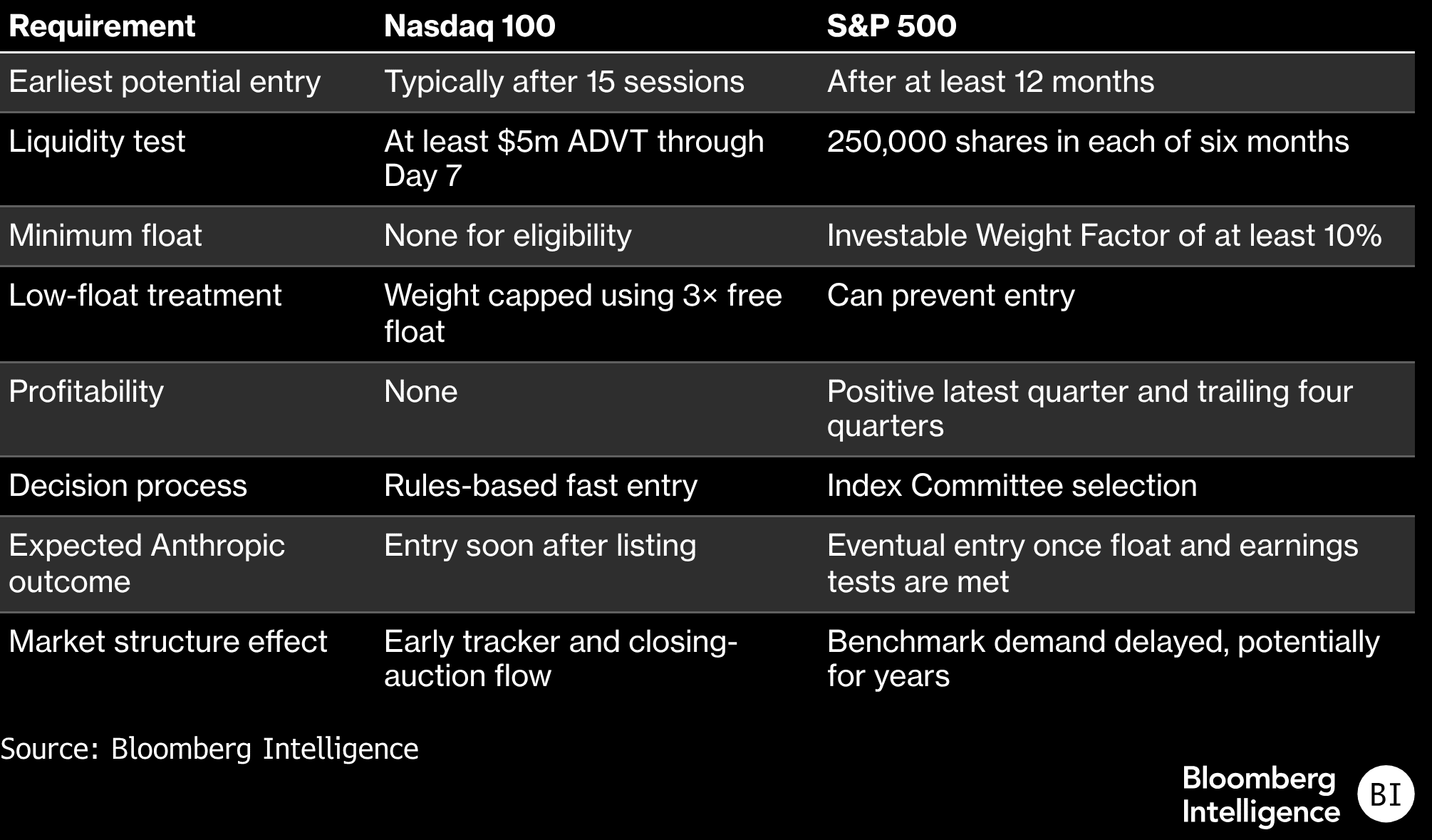
“S&P 500 eligibility would take at least 12 months, leaving Nasdaq-linked buying as the main source of index demand during Anthropic’s first year,” Besiroglu said.
Eric Balchunas, global head of ETF research for Bloomberg, said Anthropic shares traded $84bn in volume on their first day, overtaking $82bn when SpaceX went public:
Balchunas also highlighted that Anthropic is already included in 82 exchange-traded funds, which is a reflection of the mega IPO trend and the proliferation of active ETFs “which can do what they want, not beholden to index rules”:
.

NEWSLETTER SIGN UP
And receive exclusive articles on securities markets

🏆 The 2026 Global Markets Choice Awards are here! 🌍 Nominations are officially OPEN for the celebration of excellence in global capital markets trading & technology. Nominate below:
https://www.jotform.com/form/260086385121150

Delaware Life Insurance Company is becoming the first insurance carrier to offer an index that contains cryptocurrency, adding the BlackRock U.S. Equity Bitcoin Balanced Risk 12% Index to its fixed index annuity (FIA) portfolio.
As the digital assets industry pushes toward
Franklin Templeton is expanding its tokenized fund suite, signaling growing institutional demand for blockchain-based fund infrastructure and regulated investment products moving onchain. Read the full article below:
$50 billion in active ETF inflows helped fuel a record year for @BlackRock 's iShares business, as investors continue to lean into active strategies.
Shanny Basar
Senior writer
A Senior Writer at Markets Media who became a financial journalist in 2000 after working in banking for over a decade....
More about this authorRelated articles
-

U.S. users can trade leveraged perps via Backpack’s fully licensed, blockchain-based infrastructure.
-

This gives common clients a seamless T+0 solution for exchange-traded derivatives and listed options.
-

Heightened market volatility led to increased risk management demand.
-

MEMX has launched a new exchange as the group prepares for its combination with BOX Options.
-

The firm can now support derivatives trading and clearing through its own regulated entities.