




11.23.2026
State Street GlobalLINK Benefits From Containerized Technology
11.23.2026
Four years ago State Street GlobalLINK was an early adopter of containerized technology and also built a modern data infrastructure. This allowed the firm to launch its LINK distribution platform about two years ago, which reached adoption by more 500 clients in September this year.
Greg Fortuna, head of State Street GlobalLINK, described the platform as the firm’s collection of agnostic electronic execution, analytics and clearing platforms across the gamut of the marketplace. It is a wholly owned subsidiary that sits within the markets division of State Street. He told Markets Media: “We embarked on two things four years ago, which I think we were ahead of the market on.”
The first was being an early adopter of containerized technology and the second was building a modern data infrastructure. Fortuna added that the market traditionally used deep vertical solutions and State Street spent time breaking them up into micro-services.
He said the foundational layer involved building a proper data lakehouse, as the world is inundated with data. Clients can take data in digestible pieces and create their own experience. Fortuna said allowing that curation has been transformational over the last several years as they want automation, data and a more seamless experience that works with all their existing workflows.
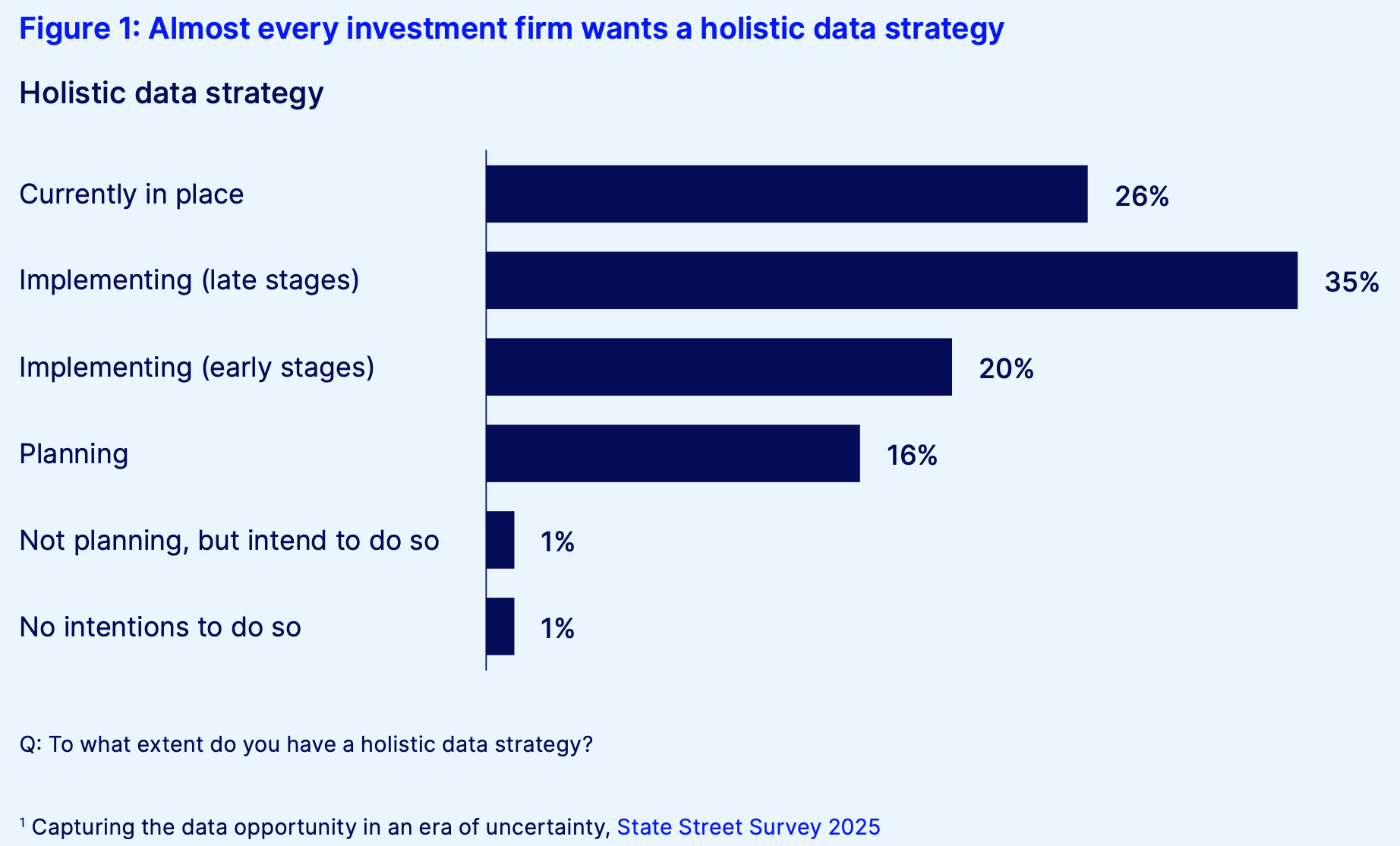
In State Street’s 2025 global survey on data use and management, covering 920 institutional investors, the majority of firms said they were pursuing a more holistic data strategy to achieve better integration of their front-to-back data and systems. However, only 26% had a holistic data strategy in place.
Source: State Street
More than half, 55%, of respondents said the growing volume and complexity of data is a huge challenge. The integration of emerging technologies and new data sources into increasingly complex tech stacks was a significant concern with half of the respondents viewing this as a key challenge. Nearly three-quarters, 74%, of respondents believe that such a strategy could boost their firm’s investment returns by at least 10%.
LINK distribution platform
LINK provides a single sign-on and, more importantly according to Fortuna, contextual sharing between applications. For example, a trader can enter a dollar/yen trade and pre-trade TCA will immediately appear on dollar/yen in real time without needing a bespoke and separate integration.
State Street said LINK is designed to seamlessly connect platforms, breaking down silos between front-, middle-, and back office operations. For instance, it enables integration between portfolio management and trading systems with analytics, research, risk, collateral, and settlement applications. To support the platform State Street has adopted the FDC3 open standards which establishes a common language across applications, eliminates the need for custom integrations and simplifies the complexity of connecting diverse tools.

Greg Fortuna, State Street
“I think we are workflow process experts,” said Fortuna. “For example, they may want to see a certain blotter alongside a particular chart because they like what is coming out of their TCA [transaction cost analysis]”
In another example, State Street has built a decision augmentation tool which takes the billions of data points that the firm gets every day, and allows users to curate their own decisions. For example, is it better to use RFQ [request for quote] or an algorithm to trade, or which algo is best to use depending on what is most important to them.
A core tenet of the LINK strategy is to provide nearly limitless customization capabilities for every organization and its users, according to State Street. Therefore, LINK is designed with modular components, offering users an intuitive, often “no-code” ability to customize their experience and create bespoke workflows and services.
State Street also partners with third parties to help clients take their decision making to “the next level” according to Fortuna. The firm said in a report: “The model is conceptually similar to a kind of app store for institutional investors. Clients will have the ability to use top-tier products and services on demand – not only by combining State Street’s own market-leading products within LINK’s intuitive interface, but also by providing access to an ever-expanding range of complementary third-party applications.”
For example, one partner uses AI to scrape news and provide colour of what is going on in the market.
“We are looking to add natural language AI ability for clients to come in and interact with us in a different way, and we are doing a number of things on that front,” added Fortuna. “We are looking to curate and pick some partners that are interesting to clients.”
Digital assets
State Street has minted and burned into its own tokenized engine within State Street Digital. Fortuna expects clients to slowly start using digital assets.
“Clients are going to use a dimmer switch, and start to utilize some tokenized assets and 24/7 settlement,” added Fortuna. “I think we are going to be in this in-between state for several years.”
The firm runs global FX platforms, so the platform already supports high frequency, low latency, 24/7 FX, a global 24×6.5 help desk that supports multiple languages, and already has people spread out across the globe.
“We are ready for whatever the market brings because we have 30 years of experience supporting a global marketplace,” said Fortuna.
He argued that State Street sits in a “unique position” at the crossroads of traditional and digital finance, especially in the institutional space due to GlobeLink’s modern data stack, modern infrastructure and modern back end.
“Clients don’t want to have 25 platforms and 25 separate integrations and we are able to do that in a way that is completely modern, different and more efficient,” said Fortuna. “There is a huge opportunity where clients now have the ability to look horizontally versus vertically. That shift has started to happen because clients are much more apt to look at a multi-asset class system.”

NEWSLETTER SIGN UP
And receive exclusive articles on securities markets

🏆 The 2026 Global Markets Choice Awards are here! 🌍 Nominations are officially OPEN for the celebration of excellence in global capital markets trading & technology. Nominate below:
https://www.jotform.com/form/260086385121150

Delaware Life Insurance Company is becoming the first insurance carrier to offer an index that contains cryptocurrency, adding the BlackRock U.S. Equity Bitcoin Balanced Risk 12% Index to its fixed index annuity (FIA) portfolio.
As the digital assets industry pushes toward
Franklin Templeton is expanding its tokenized fund suite, signaling growing institutional demand for blockchain-based fund infrastructure and regulated investment products moving onchain. Read the full article below:
$50 billion in active ETF inflows helped fuel a record year for @BlackRock 's iShares business, as investors continue to lean into active strategies.
Shanny Basar
Senior writer
A Senior Writer at Markets Media who became a financial journalist in 2000 after working in banking for over a decade....
More about this authorRelated articles
-

This is part of a roadmap to explore onchain mobilisation of assets issued and settled on DLT networks.
-

Customers can use the bank's Hong Kong dollar-denominated stablecoin to access tokenised funds.
-

The bank will also benefit from future automation of settlement, through integration with digital money.
-

The European ETF market is evolving rapidly with growing demand for active strategies.
-

With Citi & Circle, the Bank will explore how stablecoins could improve funds disbursement.