






03.13.2026

Ben Lucas, chief executive of Amundi Technology, the subsidiary of Europe’s largest asset manager, said the use of artificial intelligence is reaching an inflection point where it can begin to transform the business.
Lucas spoke on a panel at the Investment Association’s EnTech Global conference on 12 March 2026 in London. He said that over the past 18 months AI had improved task-level productivity, but that has not translated into his business’ bottom line.

Ben Lucas, Amundi Technology
“In the last three months, I have seen more material advancement on things that I believe will hit the top or bottom line than I had seen in the last 18 months,” Lucas added. “I’m much more confident in what is coming through at the moment.”
As a technology business owned by an asset manager, he argued that Amundi Technology can provide a European data platform for building magnetic AI capabilities for clients.
“We are starting to see that from a top-line perspective,” he added. “We are starting to see the flow through on the other side in terms of our own margin and efficiency.”
He believes that firms that use AI for systemic level transformation will emerge as winners.
Mark Duckworth, group chief executive of Schroders Personal Wealth, said on the panel that only 9% of U.K. adults take financial advice over any two-year window. In addition, there are now only 28,000 financial advisers in the country, compared to 230,000 in 1990, so there is a huge role for technology to increase that 9%.
“For the first time I am genuinely hopeful for a seismic shift, and the technology that comes along with that is pivotal,” Duckworth added. “I feel the technology, models and data are all in place to help clients.”

Mark Duckworth, Schroders Personal Wealth
Duckworth continued that in 2020 and 2021 the business was quite small, and he implemented a strategy that centred around technology, starting with voice recognition to record every video and call with clients. He said the technology has improved enough to become “transformational.” Advisors can now sit with clients without taking notes as the whole meeting is captured.
“The next step is to algorithmically move that into a recommendation,” said Duckworth. “The creation of new ways of thinking about interacting with clients is still in its infancy.”
Schroders Personal Wealth is due to put agentic AI in front of clients for the first time in the second quarter of this year, according to Duckworth. He said: “I am hoping that will be the start of this creation.”
Technology spend
Aside from AI, Lucas also highlighted that the industry is not currently using many of the widely available technologies that could dramatically improve productivity.
He gave the example of Zoom existing for many years before it was widely used for hybrid working. In another example, people still need to sign paper documents for many transactions, rather than being able to use a digital signature.
“Everybody is obsessed with the latest AI agent that is going to change the world but there is latent productivity everywhere around us,” Lucas added. “If we can transform some of the cultural and human inertia that holds us back and make better use of what we already have, that would be a brilliant starting point.”
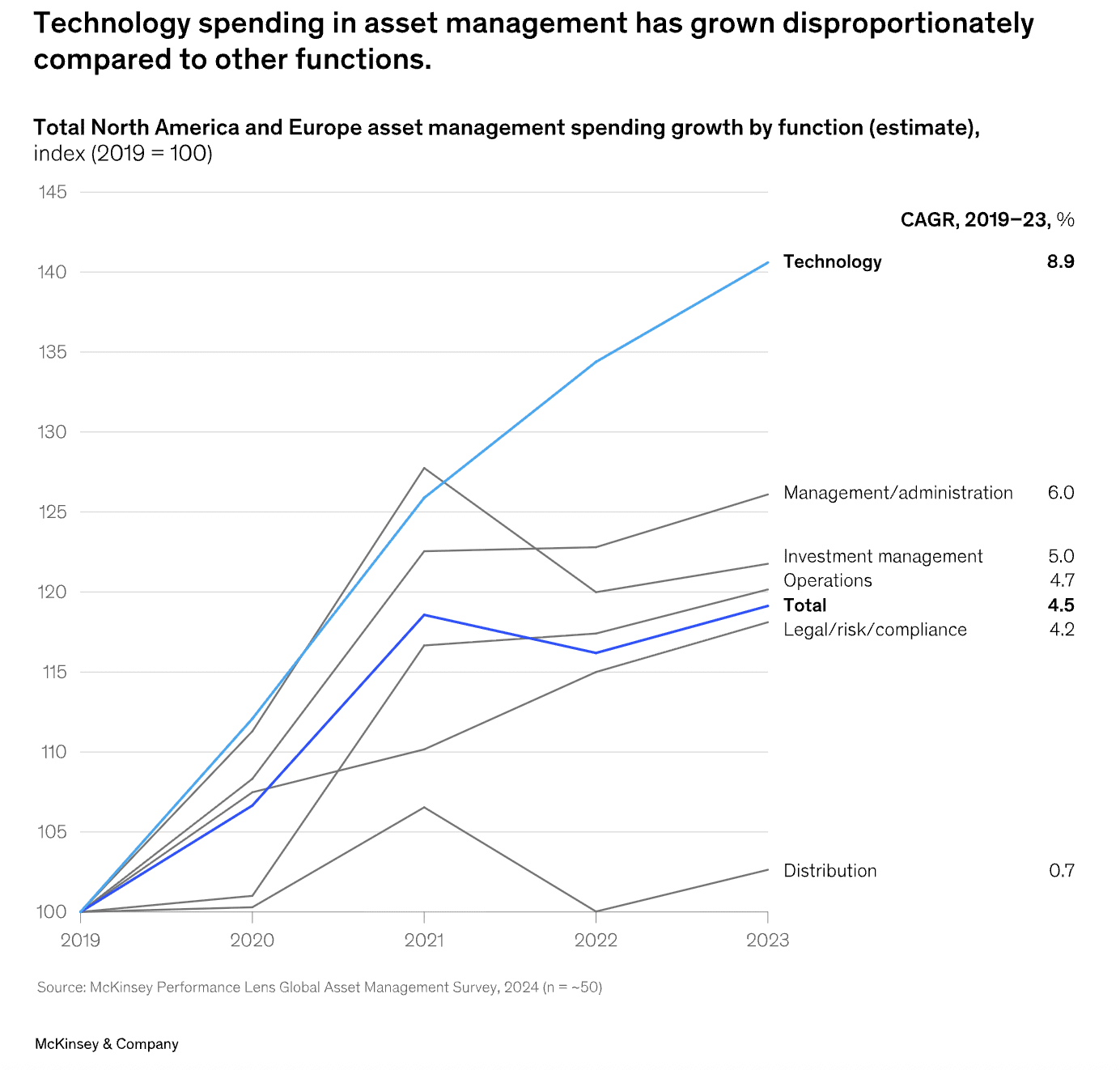
Technology spending has been a significant driver of rising costs in the asset management industry, but there is no meaningful relationship between spend and productivity according to a report from consultancy McKinsey in June last year. The report, How AI could reshape the economics of the asset management industry, said technology investment has risen with a compound annual growth rate of 8.9% in North America and Europe over the past five years.
Over the same time period, margins have declined by 3% in North America and 5% in Europe. McKinsey said: “Against this backdrop, technology costs have grown disproportionately, yet this increased spending has not consistently translated into higher productivity.”
Source: McKinsey
McKinsey argued this was due to the complexity of asset managers’ systems. In addition, they allocate the majority, on average 60% to 80%, of their technology budget to run-the-business initiatives, rather than change-the-business operations. Just 10% to 30% of change-the-business operations is used for firmwide digital transformation, with the remainder supporting individual use cases that fail to scale and drive impact.
The report highlighted that AI is emerging as a transformative force and some asset managers are starting to use the technology to fuel the next wave of productivity.
“For an average asset manager, the potential impact from AI, gen AI, and now agentic AI could be transformative, equivalent to 25% to 40% of their cost base, according to our analysis,” said McKinsey.
The consultancy concluded that it is not optional, but essential for the asset managers to embrace AI-driven transformation.
“It offers asset managers a unique opportunity to rewrite the story around technology-related return on investment and adopt processes and build capabilities that allow them to capture real value from their investment,” said McKinsey. “However, doing so will require a step-change in how they approach these technologies.”

Sam Alexander, DWS
Lucas added that financial services is very well set up to capitalize on AI as it is an information industry based on trust and a lot of the migration to the cloud has been completed.
Sam Alexander, UK country officer & chief operating officer at DWS Group, said at the conference that it will be important to embed responsible human-led AI into workflows to unlock innovation while maintaining control and accountability.
“I would like to see AI replace repetitive tasks,” she added. “Get rid of those, and we can do more interesting stuff.”

NEWSLETTER SIGN UP
And receive exclusive articles on securities markets

🏆 The 2026 Global Markets Choice Awards are here! 🌍 Nominations are officially OPEN for the celebration of excellence in global capital markets trading & technology. Nominate below:
https://www.jotform.com/form/260086385121150

Delaware Life Insurance Company is becoming the first insurance carrier to offer an index that contains cryptocurrency, adding the BlackRock U.S. Equity Bitcoin Balanced Risk 12% Index to its fixed index annuity (FIA) portfolio.
As the digital assets industry pushes toward
Franklin Templeton is expanding its tokenized fund suite, signaling growing institutional demand for blockchain-based fund infrastructure and regulated investment products moving onchain. Read the full article below:
$50 billion in active ETF inflows helped fuel a record year for @BlackRock 's iShares business, as investors continue to lean into active strategies.
Shanny Basar
Senior writer
A Senior Writer at Markets Media who became a financial journalist in 2000 after working in banking for over a decade....
More about this authorRelated articles
-

Governed agentic workers will address manual processes that persist across capital markets.
-

The French Bank is moving towards broader deployment of agentic AI.
-

The initial focus will be on how supervised entities use artificial intelligence and tokenisation.
-

Corporate bond trading is shifting toward more electronic and automated execution.
-

Essentia Data-Out delivers behavioral intelligence directly into an asset manager's own data and AI.