






08.04.2026
Apollo Drives Toward Daily Net Asset Values for Fixed Income
08.04.2026
Apollo Global Management has launched daily pricing for its investment-grade fixed income suite of products as it seeks to increase transparency in private markets.
Marc Rowan, chairman and chief executive officer of Apollo Global Management, said on the second quarter results on 4 August 2026 that the alternatives manager is at the forefront of modernizing how private markets operate by enhancing transparency, improving liquidity, and broadening access.
On 1 July 2026 Apollo went live with an estimated daily net asset value (NAV) for its entire investment grade fixed income suite of products. On 1 October Apollo expects to have daily pricing for all its credit assets.

Marc Rowan, Apollo
“That will be quite an accomplishment,” added Rowan. “The drive to an estimated daily value is very investor friendly.”
Rowan argued that increasing transparency will make private markets more acceptable to pension schemes, to traditional asset managers and to individuals.
“The desire for private assets has never been stronger but not everyone loves the wrapper,” he added. “Imagine if they had access to private markets without restriction in liquidity, and in ways that did not create mismatches of funds. That is what Daily NAV is about.”
In addition to increasing transparency for investors, Rowan said daily pricing forces “massive” change internally through digitisation and the use of data in a form that allows the manager to take advantage of new technologies, new sources of information and new sources of efficiency. He said: “This is a win-win.”
The partnership that Apollo announced with Intercontinental Exchange is also driving change. In March this year ICE announced the launch of ICE Private Credit Intelligence, an industry-wide initiative started by ICE and Apollo to build the foundational data infrastructure for the private credit market. ICE Private Credit Intelligence establishes a private credit data infrastructure layer similar to public credit markets.

Eric Needleman, Apollo
Eric Needleman, partner and head of Apollo Capital Solutions, said in a statement at the time: “As private credit continues to scale, the next phase of the market’s evolution will require stronger infrastructure and more standardized data that enables market participants to own and transact in private credit in a way that mirrors the public credit experience.”
In July this year ICE also announced the launch of a classification service that creates unique, persistent identifiers for private credit instruments for the first time. ICE IDs will span the investment lifecycle from origination through to the final payoff date and closure of each instrument, including through potential credit events.
Rowan said more than 2,000 ICE IDs have already been created and Apollo is increasingly adding more data to them.
“Over time we expect the entirety of our product set, debt and equity, to have ICE IDs,” added Rowan. “We expect ICE IDs will do what CUSIPs have done for public credit.”
CUSIPs are codes used to uniquely identify North American securities to make the entire trade life cycle more efficient. Rowan argued that ICE IDs will ultimately help in settlement and in market making.
ICE plans to offer additional new datasets through ICE Private Credit Intelligence later this year.
Market making
In addition to initiating more frequent pricing and increasing transparency, Apollo launched a dedicated secondary trading effort last year. The effort has already facilitated more than $30bn in trading volume according to Rowan, and volume continues to double.
“People want to trade these assets, but they have never been in a form where liquidity has been available in a fair way, at a fair price and in a reasonable amount of time to settle,” said Rowan, “Every day, this franchise gets better and improves.”
Financials
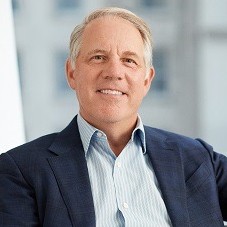
Jim Zelter, Apollo
Jim Zelter, president of Apollo Global Management, said on the call that the opportunity in private investment grade fixed income, daily pricing, increasing transparency, and market making are working in tandem to “massively” expand Apollo’s total addressable market. Zelter added: “To sustain our growth and capture the opportunity ahead, we must remain focused on what’s most critical: delivering excess return per unit of risk.”
Apollo reported record fee-related earnings of $785m for the second quarter, up 25% year-over-year, and record spread-related earnings of $877m. Earnings totalled $1.7bn which the firm said showcased the strength of the combined earnings streams.
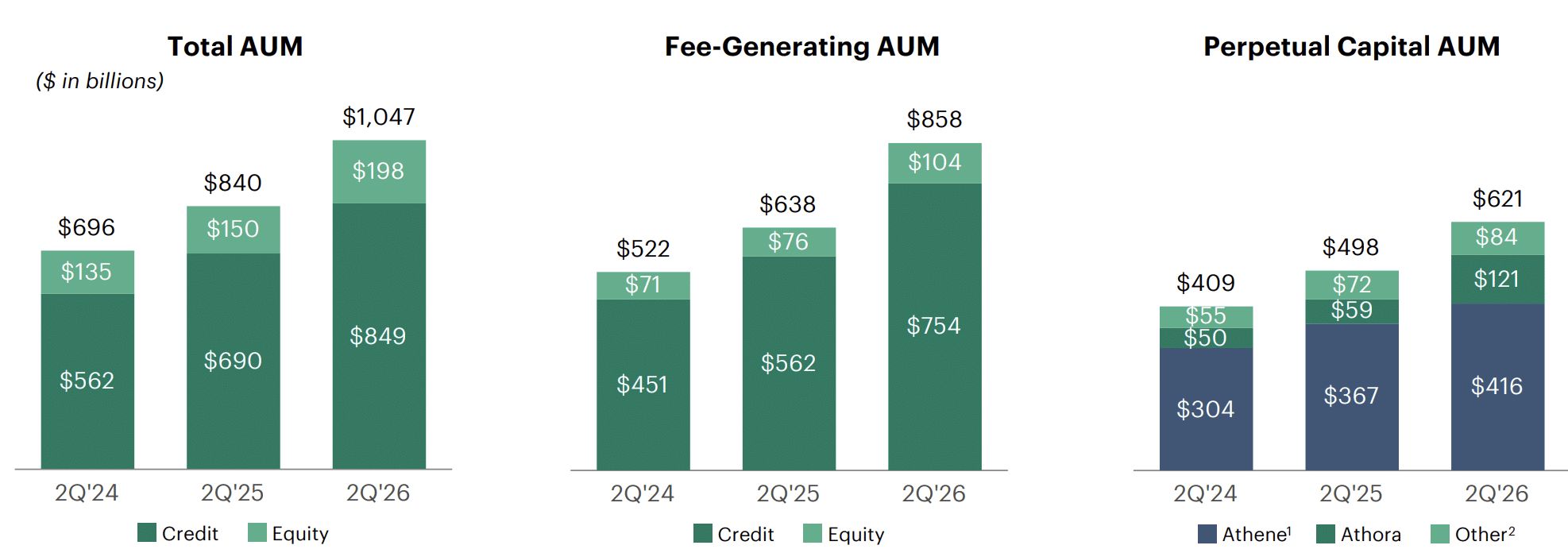
Total assets under management of $1.05 trillion benefited from inflows of $60bn in the second quarter and $298bn over the last twelve months, a 25% year-over-year increase.
Rowan said: “Our earnings are increasingly durable and directly tied to our level of originations. We believe that almost everything starts with origination.”
Origination had a very strong quarter of $74bn according to Rowan. This took first half volumes to nearly $150bn, and origination volume over the last 12 months to nearly $320bn. He continued that Apollo only accounts for deals when they close, so there is a $50bn pipeline that will benefit coming quarters. Rowan added: “The pipeline has never been stronger, reflecting the global industrial renaissance.”
During the second quarter, Apollo led a $35bn financing as part of Broadcom’s new AI XPV platform, in partnership with private equity firm Blackstone and a group of global banks. The platform is designed to enable over 20GW in compute capacity for leading frontier AI labs through 2028. This marks the largest ever private credit financing according to Zelter and he argued that it demonstrates the core benefit of Apollo’s flywheel of sourcing, structuring, principal investment, and syndication.
Capital formation was a record $60bn of organic inflows for the quarter, with $38bn in asset management and $22bn in Athene, the retirement services and insurance business.
“The growth in our sector continues to be driven by the need for capital to finance the global industrial renaissance, the need for yield from retirees directly and indirectly, and by the need of investors to find diversification from increasingly crowded, correlated and indexed public markets,” said Rowan.
On 3 August 2026 Apollo said in a statement that Austin, Texas, is the location of a new hub built around innovation. The hub will incubate emerging and new businesses across Apollo’s asset management and retirement solutions platforms.
Rowan said Apollo is increasingly going to use Austin as a place to focus on change, build the businesses and processes of the future and access a workforce that is different from the vast majority of the industry. Austin is also home to some of Apollo’s strongest limited partner relationships and one of the firm’s largest fundraising ecosystems.
“The second quarter was about momentum,” added Rowan. “We are incredibly pleased at how the year is shaping up, we are embracing and leading changes and we are playing to win.”

NEWSLETTER SIGN UP
And receive exclusive articles on securities markets

🏆 The 2026 Global Markets Choice Awards are here! 🌍 Nominations are officially OPEN for the celebration of excellence in global capital markets trading & technology. Nominate below:
https://www.jotform.com/form/260086385121150

Delaware Life Insurance Company is becoming the first insurance carrier to offer an index that contains cryptocurrency, adding the BlackRock U.S. Equity Bitcoin Balanced Risk 12% Index to its fixed index annuity (FIA) portfolio.
As the digital assets industry pushes toward
Franklin Templeton is expanding its tokenized fund suite, signaling growing institutional demand for blockchain-based fund infrastructure and regulated investment products moving onchain. Read the full article below:
$50 billion in active ETF inflows helped fuel a record year for @BlackRock 's iShares business, as investors continue to lean into active strategies.
Shanny Basar
Senior writer
A Senior Writer at Markets Media who became a financial journalist in 2000 after working in banking for over a decade....
More about this authorRelated articles
-

Erik Hirsch has been named executive co-chairman.
-

The asset manager has been in the process of adding more than 50 new client-facing roles.
-

Investors want FX execution to connect more seamlessly with portfolio and risk systems.
-

The launch is made possible by a new SPV, 21shares x FalconX Limited, created to issue synthetic exposure.
-

Fink said the compute market could follow the growth of mortgage-backed securities.