




11.03.2026
Apollo to Shift Private Markets Infrastructure with Custody & Settlement
11.03.2026
Apollo has introduced daily pricing across its credit portfolio, introduced unique private securities identifiers and set up a dedicated secondary trading desk for credit. The alternatives manager said the next step is to introduce clearing and settlement so that private markets trade more like public assets as investors demand more frequent reporting and greater transparency.
Marc Rowan, chairman and chief executive at Apollo Global Management said on the third quarter results call on 3 November 2026 that there is a convergence of public and private markets, driven by public markets being increasingly concentrated, correlated, and indexed. He added: “In short, investors are in search of alternatives.”
Therefore, Apollo is focused on unlocking a much larger market and many more business opportunities. Preqin, part of asset manager BlackRock, forecast that private markets will exceed $34 trillion in assets under management by 2031 in its Private Markets in 2031 report.
Rowan said that almost the entirety of the alternatives industry was previously driven by one client, the alternative bucket of the institutional client base. Another five clients have now been added – individuals, insurance companies, traditional asset managers, 401(k) pension schemes and direct contribution pensions. He added: “Each of those markets are roughly the same size as the original.”
However, these new buyers have lived their entire lives in the public market and their operating systems operate in the public market. Rowan said: “We are putting in place the foundation necessary to serve them where they are.”
On 30 September 2026 Apollo began providing daily pricing across all of its $850bn credit business including direct lending, asset-backed finance, multi-credit and opportunistic credit vehicles.
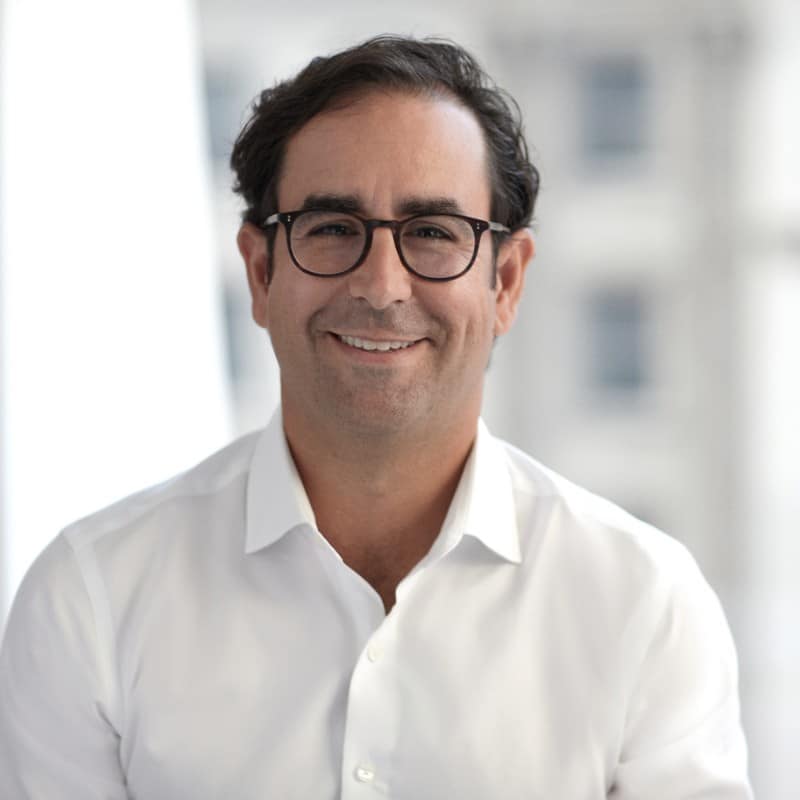
John Zito, Apollo
John Zito, co-president of Apollo Asset Management, said in a statement that investors increasingly expect a more consistent experience across their portfolios. Zito said: “That requires more timely pricing information, standardized data and the infrastructure to support more efficient market making. Daily pricing is another step in that evolution.”
This was an expansion of daily pricing across the entirety of Apollo’s investment-grade product suite which was launched at the end of June this year. Daily pricing is based on Apollo’s internal pricing methodology and benchmarked to relevant public market data.
“Those who said this could not be done simply don’t understand,” Rowan added.
Rowan gave the example that only 7% of investment grade bonds trade $1m or more every day, so more than 90% of the market is valued using estimates from a model. He said: “Provided we make the necessary investment in data and systems, we see this as an incredible unlock.”

Donna Milrod, State Street
On 28 October 2026 State Street also announced the implementation of a daily net asset value (NAV) operating model for certain private markets strategies to support the expansion of daily pricing across Apollo’s private credit business. Donna Milrod, chief product officer at State Street, said in a statement that the next phase of private markets will be defined as much by infrastructure as by investment opportunity.
Rowan continued that investors also want standard identifiers for private securities. Therefore, in March this year Apollo partnered with Intercontinental Exchange to launch ICE Private Credit Intelligence, which has introduced unique asset identifiers, ICE IDs, and analytics and independent pricing on private assets. To date, over 5,000 ICE IDs have been created and Rowan expects other firms to also use ICE IDs.
ICE IDs allow securities to be processed within existing systems and operations of large asset management firms without the need for expensive intermediated structures. A unique identifier also allows associated data to be made available to investors, who have realised that information and transparency can produce better investment outcomes.
In addition to introducing daily pricing and ICE IDs, Apollo set up a dedicated secondary trading desk in 2024. Rowan said this business will have traded more than $40bn by the end of thus year and large banks are entering this marketplace and providing liquidity.
“Far from being a competitive threat, we see that as a great opportunity in a world where more information, more price discovery, and more liquidity results in a better outcome,” added Rowan.
He continued that the next place Apollo is moving to is custody and settlement, in partnership with other firms.

Marc Rowan, Apollo
“Our goal is to make buying and selling of private assets as easy and familiar as possible,” said Rowan. “We will start with credit in 2027.”
Rowan envisages a world in which private assets have a price, a unique identifier, are tradable and have accessible custody and settlement, without the need for expensive intermediated structures. Investors will be able to access private markets without the illiquidity of certain structures.
Once that is set up, Apollo believes it can create new businesses that have traditionally been associated with public markets and argued there will be new profit and growth opportunities for the whole industry. Rowan said Apollo will build these new businesses primarily in Austin, allowing the team in Texas to focus on development and not being distracted by what Apollo needs in 2026 and 2027
“Over the next 24 months, we will incur roughly $350m of planned expenses to make this happen,” he added. “We will write off our software and eliminate the systems we previously relied on as we update and take advantage of new technologies.”
Jim Zelter, president of Apollo Global Management, said on the results call: “If we are providing solutions, we will get a lion’s share of the economics.”
AI
Zelter continued that America has financed 10 great capital expenditure cycles in 200 years, from canals and railroads to electricity and shale, and most have been between 2% and 3% of gross domestic product. Zelter added that this AI cycle is unique due to who is spending the capital as major players are scaled investment-grade franchises with high gross margins and historic high free cash flow conversion.
Apollo’s origination investment activity has been predominantly focused on the capital imbalances in two sectors, power and chips, where the firm sees an attractive risk and reward and has high conviction.

Jim Zelter, Apollo
“Our goal for AI-related assets is to beat a basket of investment-grade public debt with better structure, security and spread,” Zelter added. “My rule is simple: never take equity-like risk for debt-like returns.”
Zelter continued that it is clear that no single source of financing can meet the demand, so private capital will play a pivotal role.
“Our high-grade capital solutions franchise puts us in a strong position, having originated more than $150bn across 200 transactions to date, as the world’s leading companies look for new ways to finance their growth in many industries,” Zelter said.
Preqin agreed that structural demand is supporting infrastructure growth, which is expected to reach $2.74 trillion by 2031, representing annualized growth of 9.8%. The report said growth is expected to be driven by the growing focus on power and energy security, digital connectivity, and supply-chain resilience, creating opportunities across infrastructure sectors, investment strategies and regions.
Financials
Apollo reported record fee-related earnings of $802m for the third quarter, up 23% year-over-year, and record spread-related earnings of $909m. Earnings totalled $1.6bn which the firm said showcased the strength of the combined earnings streams.
Total assets under management of $1.07 trillion benefited from inflows of $53bn in the third quarter and $270bn over the last twelve months, an 18% year-over-year increase.
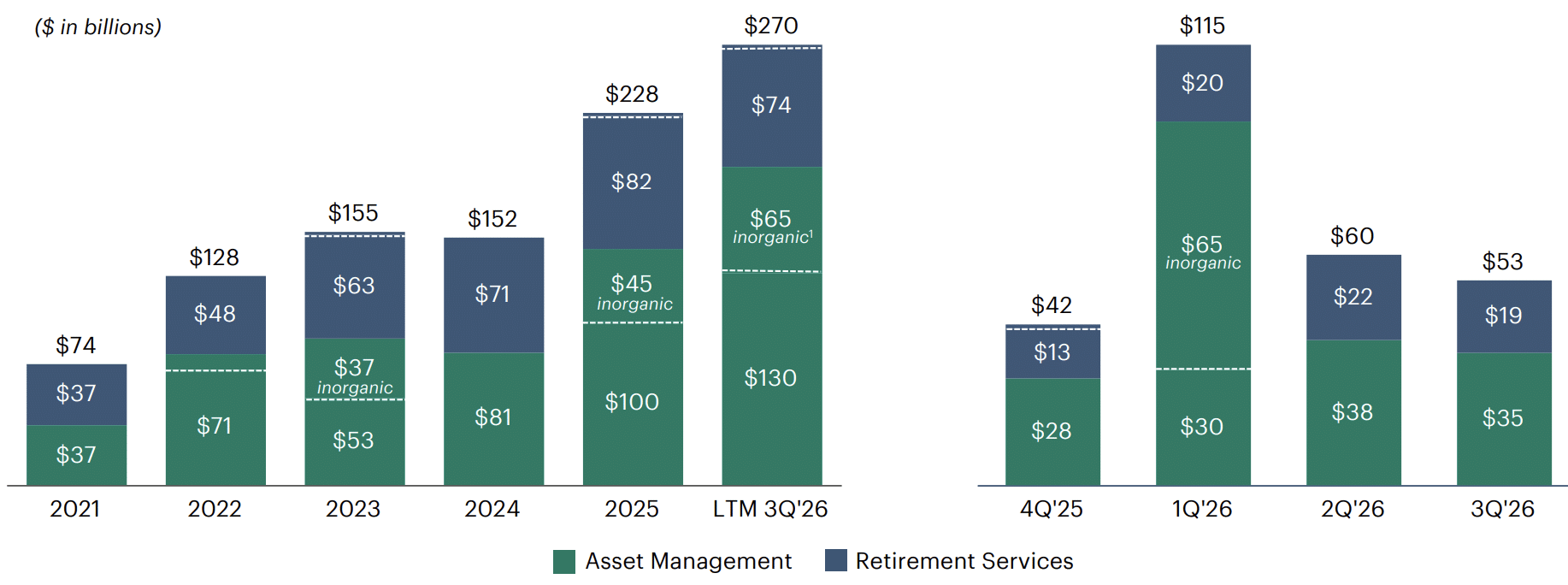
Source: Apollo
Rowan said: “I see good momentum across the entirety of our franchise. What tells me we have good momentum is the strength of the origination pipeline, which I always believe is the core of a private assets firm.”
Origination for the third quarter was a record $114bn, and $356bn over the last 12 months. Rowan said the firm was “incredibly active” across all channels, most sectors and geographies, and with an attractive, consistent spread.
Valuations in almost all markets are relatively high, according to Rowan, and risk is relatively elevated, so Apollo is taking down risk. In the credit business, Apollo is moving from below investment grade to investment grade, and from unsecured to secured. The majority, 98%, of origination in the third quarter was debt and more than 80% was investment grade.
In the equity business, Apollo is reducing leverage and moving toward hybrid structures. Rowan added: “We increasingly focus on businesses that we think are enduring franchises and are relatively immune, or will actually benefit from, technology cycles.”
Zelter added that companies are investing “enormous” amounts of capital, and that is creating “tremendous” opportunity for the broad origination businesses. There is also historic capital investment across infrastructure and energy, defense, manufacturing, and compute.

NEWSLETTER SIGN UP
And receive exclusive articles on securities markets

🏆 The 2026 Global Markets Choice Awards are here! 🌍 Nominations are officially OPEN for the celebration of excellence in global capital markets trading & technology. Nominate below:
https://www.jotform.com/form/260086385121150

Delaware Life Insurance Company is becoming the first insurance carrier to offer an index that contains cryptocurrency, adding the BlackRock U.S. Equity Bitcoin Balanced Risk 12% Index to its fixed index annuity (FIA) portfolio.
As the digital assets industry pushes toward
Franklin Templeton is expanding its tokenized fund suite, signaling growing institutional demand for blockchain-based fund infrastructure and regulated investment products moving onchain. Read the full article below:
$50 billion in active ETF inflows helped fuel a record year for @BlackRock 's iShares business, as investors continue to lean into active strategies.
Shanny Basar
Senior writer
A Senior Writer at Markets Media who became a financial journalist in 2000 after working in banking for over a decade....
More about this authorRelated articles
-

Demand for quantitative investment strategies continues to grow.
-

The company has more than €10bn of lending capacity.
-

ETF innovation has shifted to finding new ways to combine exposures within a portfolio.
-

Managers can tokenize selected share classes within existing umbrella structures such as UCITS.
-

Private market strategies have traditionally operated on monthly and/or quarterly schedules.