






01.28.2026

Average daily volumes on Broadridge Financial Solutions’ Distributed Ledger Repo (DLR) platform rose 490% year–on–year in December 2025, and the fintech aims to add intraday repos and increase its tokenization capabilities across asset classes.
Repos allow one firm to sell a security to another firm with a simultaneous promise to buy the security back at a later date at a specified price, which has the economic effect of a collateralized loan, as they are mainly used to borrow cash using securities as collateral.
Broadridge said in a statement that DLR processed an average of $384bn in daily repo transactions in December 2025, with volumes totalling nearly $9 trillion. The daily average was a 490% increase year–over–year and a 4% increase from the previous month.

Horacio Barakat, Broadridge
Horacio Barakat, head of digital innovation at Broadridge, described 2025 as a “breakout year” for DLR and the firm expects continued expansion in participants, use cases, and volumes in 2026.
Growth was driven by more clients onboarding, and the extension of use cases since the platform was launched in 2021, according to Barakat. He told Markets Media that the introduction of sponsored repo has been a big driver of growth.
In addition, the platform has been boosted by changes in U.S digital asset regulation and increased enthusiasm as market infrastructure providers and exchanges think about using blockchain technology. Barakat argued that Broadridge will continue to benefit from its first mover advantage.
“A rising tide lifts all boats,” he added. “We are in the position of having a platform that operates at scale, is trusted, transformative and makes it easy for clients to jump into the technology.”
Interoperability
Broadridge intends to maintain DLR’s leadership position though extending the use cases, technology and interoperability.
In April last year Broadridge said in a statement that it had successfully demonstrated interoperability between DLR and Fnality’s Payment System (FnPS), from the blockchain-based wholesale payments firm. This paves the way for real-time delivery versus payment (DvP) settlement of intraday repo transactions so institutions can optimize their liquidity management, reduce operational risk and drive greater efficiency.

Michelle Neal, Fnality
Michelle Neal, chief executive of Fnality International, said in a statement: “The move towards instantaneous settlement will be pivotal in strengthening the financial sector’s growth and global competitiveness.”
In 2025 DLR also incorporated JP Morgan’s JPM Coin token as a digital cash alternative to provide atomic settlement for both the cash and securities legs of a repo.
Barakat stressed that it is important to keep DLR’S interoperability and open architecture. He added: “We will drive interoperability with stablecoins, fiat cash, other innovative platforms and existing market infrastructure to make sure that our platform can cover multiple types of assets, jurisdictions and central securities depositories.”
Onchain securities
In November 2025 Societe Generale, the French bank, issued its first digital bond in the U.S. using Broadridge’s tokenization capability, which is incorporated in DLR. This capability enables firms to issue, trade, and manage securities in digital form with embedded privacy, credential management, and direct investor ownership capabilities.
Barakat expects there to be more native onchain issuance of securities due to increased speed to market. He said: “We believe this is the future.”
He argued that institutions want to license Broadridge’s tokenization capabilities rather than building all the necessary infrastructure and technology, and recruiting the necessary talent themselves, which would take time. DLR has been used for repos but Barakat said the tokenization capability can be used for any asset class.
“Operating at scale and tokenizing $400bn of repos every day gives clients comfort that they can use this technology to achieve their own goals,” he added.
Broadridge is having several conversations with clients to tokenize private credit, according to Barakat, and is also “very involved” in initiatives with partners to tokenize equities.
Tokenized money-market funds are emerging as a core building block of next-generation collateral and liquidity infrastructure, according to a report from Dfns, which provides wallets-as-a-service, in partnership with consultancy BCG. The report, The Future is Onchain, said that as more high-grade assets move onchain, treasurers and market infrastructure leaders view tokenized money market funds as the “onchain cash” of choice.
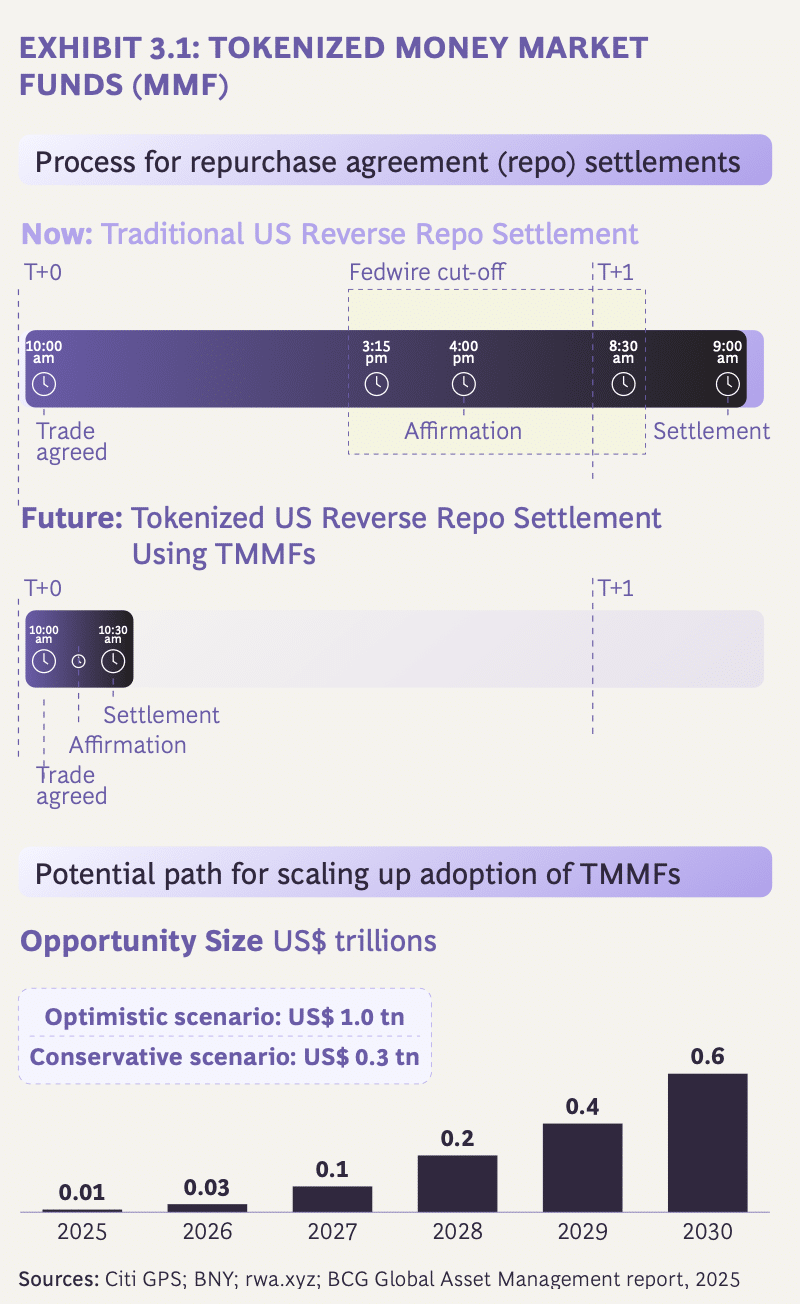
Source: Dfns and BCG.
In a traditional repo, a trade triggers a series of steps across multiple systems, each with its own deadline, and the process may take days. However, if tokenized money market funds can be used as collateral, settlement can be automated with smart contracts and completed in minutes.
“Features such as continuous margining through smart contracts, automated top-ups and recalls, and the absence of end-of-day cut-off windows all help reduce counterparty and operational risk while freeing intraday liquidity and lowering processing costs,” added the report. “Over time, these efficiencies can translate into narrower spreads and lower all-in financing costs for corporate treasurers and, where passed on in pricing, lower fees or higher net yields for end investors.”
The report highlighted that for tokenized money market funds to be used as collateral there needs to be consistent regulatory treatment, robust institutional infrastructure, and scaled high-value use cases that bring meaningful balances onchain.
Barakat said: “Intraday repo and collateral mobility is the next opportunity. The room for growth is massive.”

NEWSLETTER SIGN UP
And receive exclusive articles on securities markets

🏆 The 2026 Global Markets Choice Awards are here! 🌍 Nominations are officially OPEN for the celebration of excellence in global capital markets trading & technology. Nominate below:
https://www.jotform.com/form/260086385121150

Delaware Life Insurance Company is becoming the first insurance carrier to offer an index that contains cryptocurrency, adding the BlackRock U.S. Equity Bitcoin Balanced Risk 12% Index to its fixed index annuity (FIA) portfolio.
As the digital assets industry pushes toward
Franklin Templeton is expanding its tokenized fund suite, signaling growing institutional demand for blockchain-based fund infrastructure and regulated investment products moving onchain. Read the full article below:
$50 billion in active ETF inflows helped fuel a record year for @BlackRock 's iShares business, as investors continue to lean into active strategies.
Shanny Basar
Senior writer
A Senior Writer at Markets Media who became a financial journalist in 2000 after working in banking for over a decade....
More about this authorRelated articles
-

The ability to use USDC will enhance capital efficiencies and allow a new wave of innovation.
-

This deepens the integration of Chinese assets into the international financial infrastructure.
-

Secured General Collateral notes are a step forward for Canada's short-term funding & collateral markets.
-

Cross-margining offers an opportunity to unlock liquidity that remains frozen in separate accounts.
-
The project is due to launch in October.