






02.04.2026

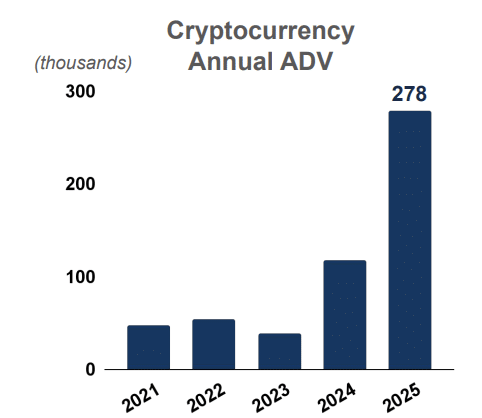
CME Group intends to launch 24-hour trading, seven days a week, for its cryptocurrency futures and options in the second quarter of this year.
Terry Duffy, chairman and chief executive of CME Group, said on the results call on 4 February 2026 that the cryptocurrency suite had record volumes in 2025. CME facilitated nearly $3 trillion notional in crypto trading in 2025 and said momentum accelerated in the fourth quarter. Over $13bn in notional value traded every day in the fourth quarter and open interest increased more than 100% as participants moved to regulated platforms. On 9 February 2026 CME will expand the crypto suite by launching Cardano, Chainlink and Stellar futures.
“We will begin offering 24/7 trading for our entire crypto suite in the next quarter to enable our customers to hedge exposure to the underlying cash markets for these products, which currently trade throughout the weekend,” Duffy added. “As markets continue to evolve we will strategically evaluate whether other asset classes would also benefit from 24/7.”
Source: CME
In addition to 24/7 crypto trading, Duffy said CME is focused on further increasing average daily margin efficiencies provided to users and expanding access through initiatives such as U.S. Treasury clearing and prediction markets.
Prediction markets
Last December CME and FanDuel, Flutter Entertainment’s online gaming company, launched FanDuel Predicts which expands the exchange’s retail footprint. The joint venture offers event contracts on financial markets and key economic indicators, as well as event contracts on sports in certain states. In addition DraftKings Predictions connected to CME as a distribution partner at launch.
“This initiative represents the next step in our multi-year strategy to expand our customer base by providing greater access to markets for the next generation of traders,” Duffy added. “While still early days, these products are delivering promising initial results and have generated traction with previously untapped customer segments.”
More than 68 million event contracts have traded at CME in the six weeks since launch, including over seven million markets-related event contracts.

Tim McCourt, CME
Tim McCourt, global head, equities, FX and alternative products at CME, said on the call: “We’ve seen new individual participants come to our market as we look to attract that next generation of trader and get more people to trade all products at CME Group across traditional markets, futures-based event contracts or sports.”
In addition, McCourt said CME is seeing new institutional and market makers coming to the group.
“It’s great to see new participants also being attracted to our long-standing benchmark products and markets at CME Group,” he added.
Treasuries clearing
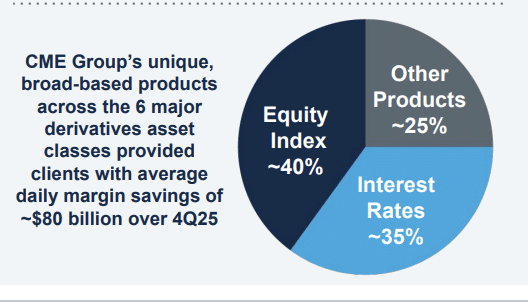
Duffy said CME also continued to deliver “unmatched” capital efficiencies to its customers. In the fourth quarter, customers had average daily margin savings of $80bn across all six asset classes, an increase of approximately $20bn over 2024.
Source: CME
“The ability to offset margin isn’t just a nice benefit,” Duffy added. “It’s a necessity for our clients due to the diversity of our asset classes.”
Last December the U.S. Securities and Exchange Commission approved CME Securities Clearing which Duffy said is on track to launch this this year, in advance of the regulator’s US Treasury clearing mandate.
“CME Securities Clearing combined with our work to extend cross-margining to end users in early 2026 will unlock even more capital efficiencies for the industry,” he said.
The new central counterparty will provide benefits of central clearing for cash treasury and repo transactions to guarantee financial performance, reduce counterparty risk, and encourage prudent risk management.
However, Duffy highlighted that while clearing Treasuries is “nice to have”, CME’s arrangement with DTCC, the U.S. post-trade infrastructure, is “critically important” for growth.
Last December the Fixed Income Clearing Corporation (FICC), part of DTCC, filed with the SEC to expand its long-standing cross-margining arrangement with CME Group.
CME had filed with the Commodity Futures Trading Commission in late September 2025. The CFTC also published for comment a proposed order granting a limited exemption necessary for CME and FICC to make their existing cross-margining arrangement available to certain customers with appropriate safeguards.

Terrence Duffy, CME Group
“The true value that we see right now is with DTCC and FICC,” Duffy said. “That’s where the value is and that’s what we are keeping our minds focused on
In its clearing business CME is reviewing the benefits of tokenizing collateral to increase mobility and capital efficiency. Duffy said CME has an initiative with Google and a depository bank that will be coming out this year on tokenized cash.
CME may decide to accept tokens as collateral, but it will depends on who is issuing the token and the associated risks. For example, he would be more comfortable with a token issued by a global systemically important bank.
“Not only are we looking at tokenized cash, but we are looking at different initiatives with our own coin that we could potentially put on a decentralized network,” he added. “There are multiple ways that we are approaching this to create efficiencies for our clients without introducing any additional risk into the system.”
Volumes
CME said a risk-always-on environment in 2025 resulted in the fifth consecutive year of record volume. Average daily volume increased 6% year-on-year to 28.1 million contracts. The growth was broad-based and included records in the interest rate, energy, metals, agricultural and crypto complexes, according to Duffy.
He added that retail-focused products helped drive strong performance in 2025 with micro products up 59% in the fourth quarter to a record 4.4 million contracts per day. The exchange will be launching a 100 ounce silver contract this month to help retail investors manage exposure when the precious metals markets are very active.
Precious metals prices, especially gold and silver, have been very volatile but Duffy said that, overall, the customer is very healthy throughout the different asset classes.

Derek Sammann, CME Group
Derek Sammann, global head of commodities market at CME, said on the call that all client segments are growing. He added: “Retail is growing, but our institutional base is growing at double-digits right now and open interest is steady to increasing.”
Last year was also a record for CME’s international business, which averaged 8.4 million contracts per day, up 8% from the previous record in 2024.
Europe, Middle East and Africa increased average daily volume by 6% to 6.1 million, with records in five out of six asset classes. Asia Pacific also had record average daily volume of 1.9 million, up 13% year-on-year, with records in four out of six asset classes
In the fourth quarter CME opened an office in Dubai which it said was driven by increasing institutional and retail participation in financial markets in the region and demand for broader trading access in the Middle East. Average daily volume in the United Arab Emirates in the fourth quarter rose 31% year-on-year.
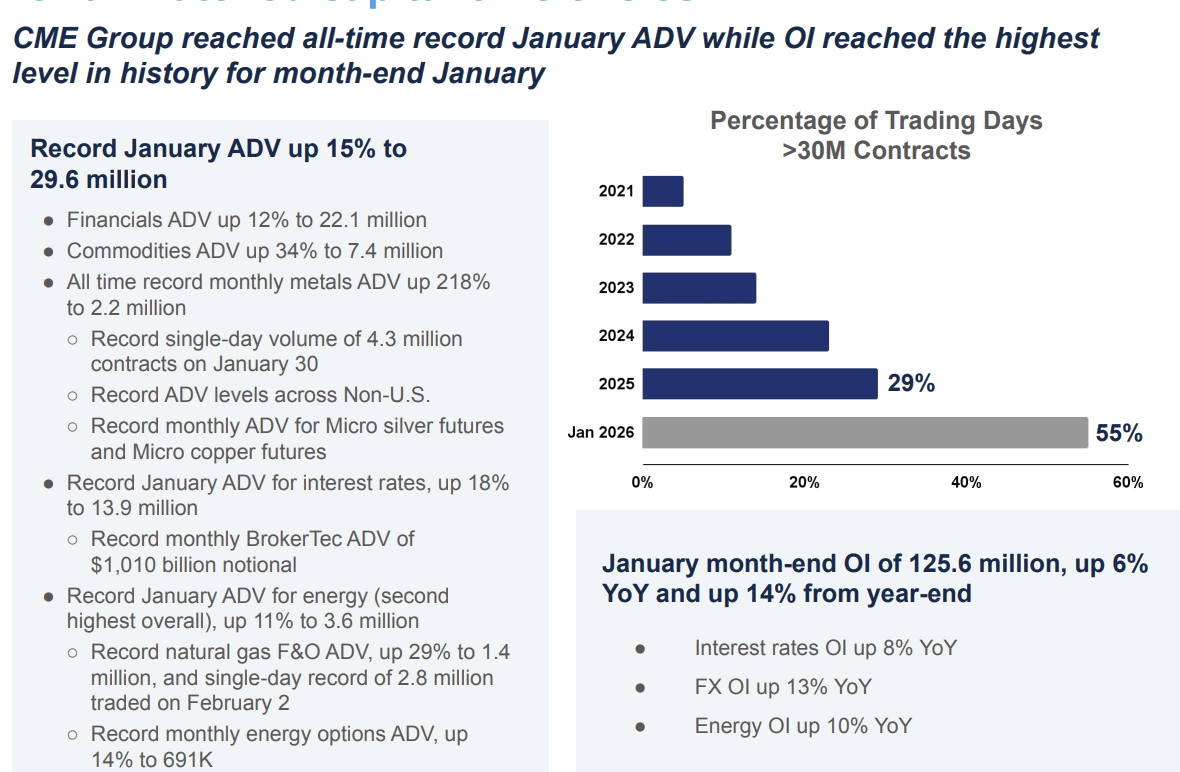
In January this year, CME also reached a record average daily volume for the month and record open interest for the end of the month.
Source: CME
Financials
Duffy said CME delivered the best year in its history in 2025 and its fourth consecutive year of record revenue, adjusted operating income, adjusted net income and adjusted earnings per share.
CME reported annual revenue of $6.5bn, up 6% from 2024, and operating income of $4.2bn.

Lynne Fitzpatrick, CME
Lynne Fitzpatrick, chief financial officer at CME, said on the call that the group has published transaction fee changes which will be effective from 1 April 2026.
“Taken in aggregate with the market data fee change which took effect 1 January and incentive program revisions, the fee adjustments would increase total revenue by approximately 1% to 1.5% on similar activity to 2025,” she added.
Fitzpatrick said CME will be evaluating transaction fees on a regular basis going forward, and may make changes as conditions warrant, rather than aggregating in December as in previous years.

NEWSLETTER SIGN UP
And receive exclusive articles on securities markets

🏆 The 2026 Global Markets Choice Awards are here! 🌍 Nominations are officially OPEN for the celebration of excellence in global capital markets trading & technology. Nominate below:
https://www.jotform.com/form/260086385121150

Delaware Life Insurance Company is becoming the first insurance carrier to offer an index that contains cryptocurrency, adding the BlackRock U.S. Equity Bitcoin Balanced Risk 12% Index to its fixed index annuity (FIA) portfolio.
As the digital assets industry pushes toward
Franklin Templeton is expanding its tokenized fund suite, signaling growing institutional demand for blockchain-based fund infrastructure and regulated investment products moving onchain. Read the full article below:
$50 billion in active ETF inflows helped fuel a record year for @BlackRock 's iShares business, as investors continue to lean into active strategies.
Shanny Basar
Senior writer
A Senior Writer at Markets Media who became a financial journalist in 2000 after working in banking for over a decade....
More about this authorRelated articles
-

The rules could codify a new designated contract market registration, a crypto asset market.
-

Crypto firms operating in the UK will be brought into full FCA regulation for the first time.
-
There is demand for institutional-grade risk management tools across high-liquidity altcoin markets.
-

Standard Chartered, Cumberland DRW were counterparties for inaugural spot crypto trade.
-

Proposals would create a tailored regime for certain investment contracts involving crypto assets.