





04.07.2026

In March this year CoinShares said it became the first regulated European asset manager to combine decentralised finance (DeFi) protocol yields with tokenized real world assets in a single institutional-grade product.
Jérôme Castille, head of compliance & regulatory affairs – France at CoinShares, told Markets Media that the asset managers original intention was to launch onchain products and the infrastructure is now ready for tokenized products.

Jérôme Castille, CoinShares
Castille said Coinshares has been waiting for institutions to tokenize assets for a “long time” and the market ha developed to allow portfolio managers to increase onchain allocations. He added: “Now is the time for crypto to grow.”
CoinShares is a traditional regulated asset manager, but Castille said it may also be the only one with an authorisation under MiCA, the European Union’s Markets in Crypto-Assets regulation. The dual authorizations enable CoinShares to allocate across regulated securities, tokenized financial instruments and native crypto markets under a single compliant framework.
“This is the first vehicle worldwide to bring together traditional and digital assets, and the first European vault,” he added.
Castille described a vault as a new onchain vehicle that creates a corporate structure for funds. The vault needs a legal structure to put assets onchain with a smart contract replacing the fund structure. The assets in the vault are deployed in lending markets to generate yield by a a curator who selects the markets and risk manages the exposure. In the U.S. Bitwise Asset Management launched its first offering as the curator of a non-custodial vault in January this year.
“In the long term, vaults will become the default mechanism for asset management but this will take time,” said Castille. “This will be the infrastructure for the next decade.”
CoinShares aims to provide the strategy to platforms and fintechs who are sitting on large stablecoin balances, on which they do not earn interest, while they are competing to retain their customers.
“The potential market is huge,” said Castille. “We want to provide yield without them having to use complex DeFi strategies.”
At launch, CoinShares’ vault will allocate assets across four yield buckets – DeFi protocols, tokenized money market funds and ETFs, institutional repo and market neutral strategies.
Smart contracts give CoinShares the ability to actively manage allocations across these buckets with automatic orders flows and automatic calculation of the net asset value, according to Castille. He added: “As an asset manager, we will focus on active allocations through the smart contract.”

JM Mognetti, CoinShares
CoinShares has set some thresholds but will actively manage the exposures and will rebalance every week. Jean-Marie Mognetti, chief executive and co-founder of CoinShares, highlighted in a statement that the strategy is not a single-protocol yield product. Instead, the strategy allocates across multiple independent risk premia – credit, liquidity provision, secured financing, and relative value – in one regulated framework.
Castille explained that DeFi provides the big liquidity bucket that gives investors the ability to subscribe and redeem 24/7. He said: “We will not make any compromises on liquidity, which will be first priority.”
There is a lot of value in bringing together traditional asset management and DeFi, especially for diversification, according to Castille. He argued that DeFi is very liquid, programmable, and available 24/7 while traditional assets are more secure.
Castille stressed that CoinShares will be “very conservative” in its DeFi allocations, and will only deploy capital on the biggest markets against eligible collateral. He said: “We won’t be playing with fancy coins to get big yields.”
Railnet
CoinShares is partnering with Kiln, the institutional onchain yield infrastructure provider, to launch the strategy.
“We love the separation of duties as Kiln is building the infrastructure to connect the smart contract to the pool of assets, third parties and distribution using its Railnet protocol,” added Castille.
Railnet provides the infrastructure connecting multiple markets and venues, enabling CoinShares to execute its allocation decisions across diverse yield sources in a single auditable framework. Mognetti said Railnet technology allows CoinShares to access yield sources that others cannot reach and combine them in ways others cannot structure, allowing CoinShares to become “the one-stop shop for digital asset investment.”
Laszlo Szabo, Kiln
Laszlo Szabo, chief executive and co-founder of Kiln and Railnet, said in a statement that Railnet was built as the foundational layer for the next era of finance. CoinShares can focus on identifying value, managing risk, and designing new investment products while Railnet can handle the complexity of financial time, settlement, and constraints, providing the rails for a more trustworthy, efficient, and institution-ready financial system.
Szabo said: “As blockchains increase the velocity of global capital, verifiable and programmable constraints become essential.”
Growth potential
CoinShares said the launch of onchain asset management represents the third pillar of its investment platform alongside its crypto exchange-traded products and its active alternative strategies designed to generate alpha, Mognetti said: “Onchain is not another crypto product. It’s a new distribution rail.”
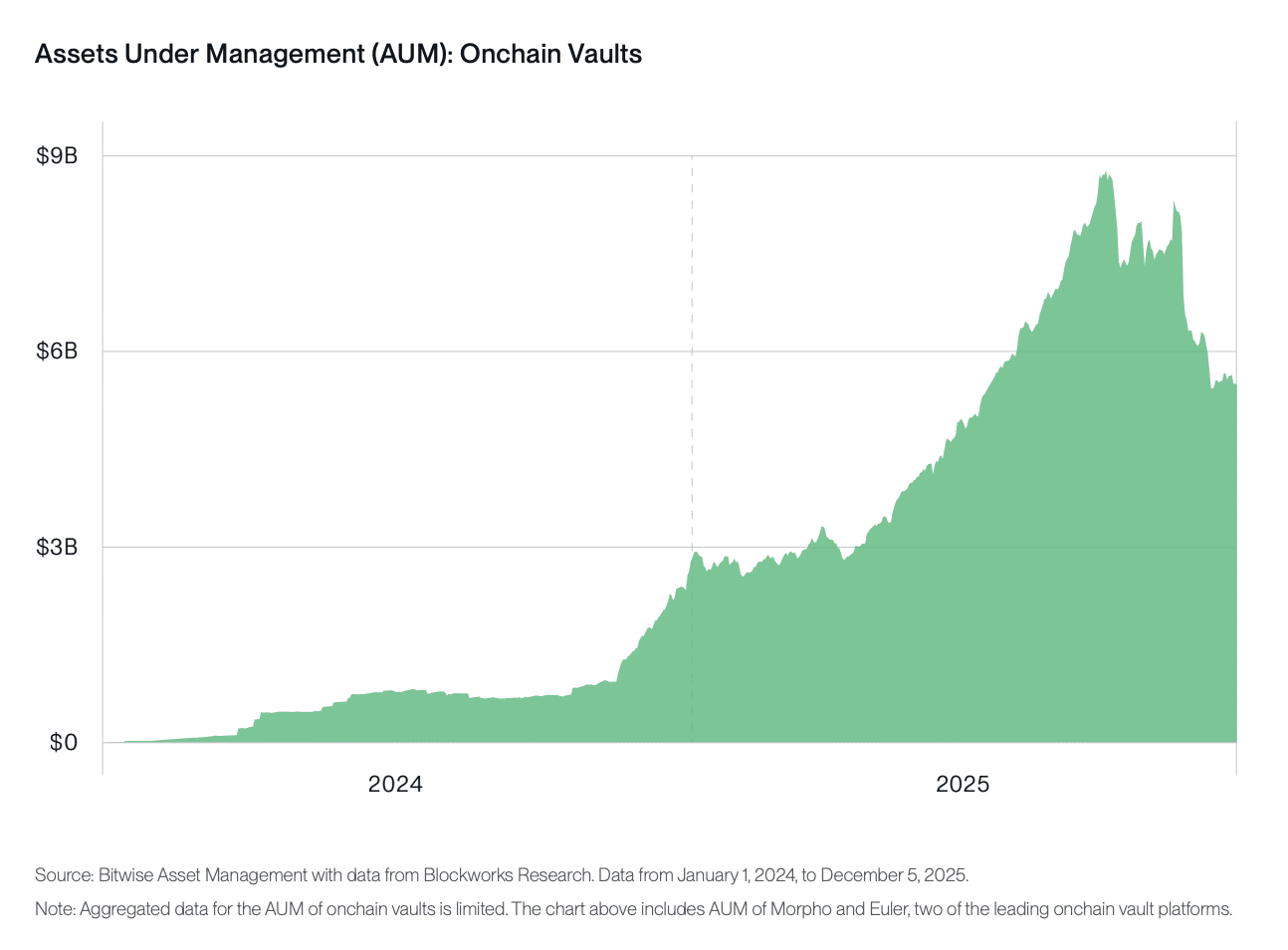
Bitwise said in its 10 Crypto Predictions for 2026 that a wave of high-quality vault curators will enter the market this year drawing billions of dollars of capital into the vaults they manage. Vaults emerged in a meaningful way in 2024, according to Bitwise, with assets rising from less than $0.1bn to $2.3bn.
Soource: Bitwise
“Interest surged in 2025, with assets under management peaking at $8.8bn before the October 2025 volatility spike led to losses across poorly managed strategies,” said Bitwise. “Since then, the assets under management in vaults has retracted. But that won’t last for long.”
CoinShares’ 2026 Digital Asset Outlook said ‘hybrid finance’ is merging crypto ecosystems with traditional financial systems.
“As public blockchains prove their robustness, scalability and efficiency, traditional financial institutions are increasingly adopting them for settlement, liquidity, custody and product issuance,” said the report. “It is visible in the strong growth of stablecoins, decentralised exchange activity, tokenized real world assets and revenue generating on chain applications.”
Mognetti said in the report that if 2025 was the year of the graceful return, 2026 looks positioned to be a year of consolidation into the real economy. The 2026 outlook forecast that major wirehouses would formally open Bitcoin ETF allocations, at least one major 401(k) provider would enable crypto access, and custody banks would provide direct institutional settlement services.

NEWSLETTER SIGN UP
And receive exclusive articles on securities markets

🏆 The 2026 Global Markets Choice Awards are here! 🌍 Nominations are officially OPEN for the celebration of excellence in global capital markets trading & technology. Nominate below:
https://www.jotform.com/form/260086385121150

Delaware Life Insurance Company is becoming the first insurance carrier to offer an index that contains cryptocurrency, adding the BlackRock U.S. Equity Bitcoin Balanced Risk 12% Index to its fixed index annuity (FIA) portfolio.
As the digital assets industry pushes toward
Franklin Templeton is expanding its tokenized fund suite, signaling growing institutional demand for blockchain-based fund infrastructure and regulated investment products moving onchain. Read the full article below:
$50 billion in active ETF inflows helped fuel a record year for @BlackRock 's iShares business, as investors continue to lean into active strategies.
Shanny Basar
Senior writer
A Senior Writer at Markets Media who became a financial journalist in 2000 after working in banking for over a decade....
More about this authorRelated articles
-

The QQI ETF invests in companies outside the U.S.
-

Morgan Stanley Institute for Sustainable Investing polled 900 institutional investors.
-

Year-to-date net inflows of $432.4bn are the highest on record.
-
Fixed income is the largest asset class in global finance.
-

Erik Hirsch has been named executive co-chairman.