




10.26.2026

The combined revenue pool for corporate and investment banking (CIB) and nonbank financial institutions (NBFIs) this year will be more than 7% higher than in 2025, reaching $1.4 trillion by 2030, according to Boston Consulting Group.
In a study, A Golden Window for Growth: Corporate and Investment Banking Report 2026, BCG forecast that the combined revenue pool will reach $1.1 trillion by the end of this year, well ahead of the roughly 5% five-year compound annual growth rate. By 2030 this revenue pool will reach approximately $1.39 trillion according to the consultancy.
“That strength has opened a golden window for banks to fund the next phase of growth,” added the report. “But that window will not stay open indefinitely.”
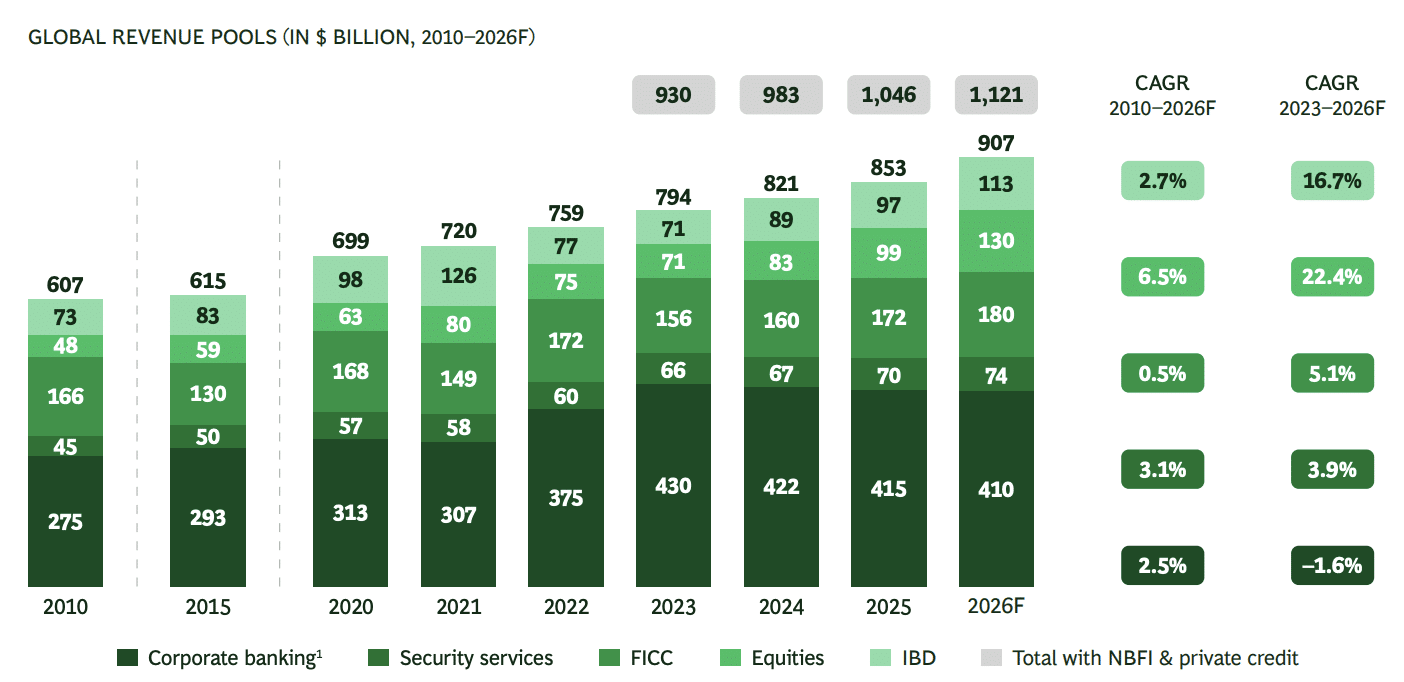
Source: BCG
Corporate and investment banking has accounted for nearly half, 46%, of banking group revenues for the top seven banks since 2020, up from the low 40s between 2015 and 2019, said BCG. At the same time, the business has cut its cost-income ratio by 9.8%, almost twice as fast as the 5.2% cut by the banking groups
NBFIs
Although the overall fee pool is growing, BCG said growth is increasingly shifting toward sponsors and hedge funds. NBFIs made up 4% of the total CIB revenue pool in 2013 and that has grown to an estimated 19% by the end of 2026, and they are increasingly active in areas where banks have historically generated significant revenues. For example, BCG estimated that nonbank liquidity providers will capture about 38% of flow and market making by 2030.
“These institutions offer some of the most robust prospects, with revenues expected to compound at roughly 8% and 9%, respectively, through 2030,” said the report. “Overall, NBFIs will take a significant portion of the CIB revenue pool by that year, with a 23% share.”
As a result, BCG said banks need to decide which sponsors and hedge funds to partner in a full relationship and which to finance, and adapt their operating models. For example, NBFIs tend to buy advisory, financing, markets, and transaction banking together, yet most CIBs still price and staff those products separately. The consultancy said the 2030 mix will differ in three important respects – private credit will become a more direct revenue line, digital assets will move onto production rails, and financing and prime brokerage will focus more within markets as transaction banking loses share.
“The 2030 CIB revenue pool will be larger but redistributed across clients, products, and operating models,” added BCG. “NBFIs will gain share, financing and markets will account for a larger percentage of total CIB revenue, and technology will broaden the range of economics at which institutions can serve the same opportunities.”
Technology
BCG said firms with AI-led operating models will be well placed to access their “fair” share of an expanding fee pool, while those still piloting productivity use cases will struggle to keep up.
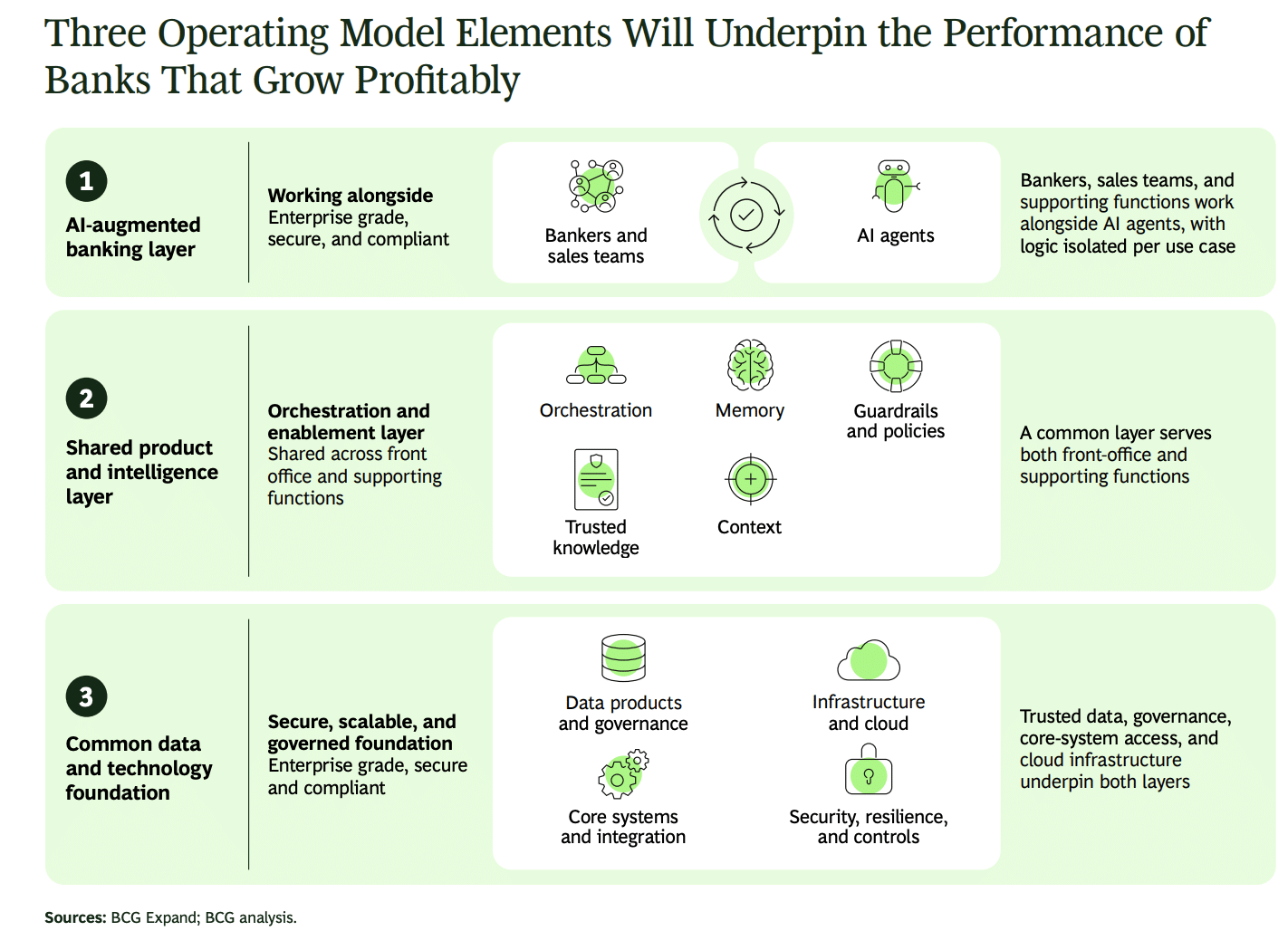
The next stage of AI adoption will be less about individual tools than the shared data and intelligence layers beneath them, as the consultancy argued that the intelligence layer is where infrastructure investment becomes commercial advantage most directly. For example, a bank that surfaces pricing history, transaction flow, and counterparty signals directly to front-office staff brings more of what it knows into a client conversation. BCG expects leading CIBs will consolidate multiple AI use cases into a common front-office workbench.
Source: BCG
“Individual AI tools can improve productivity, but shared intelligence layers, integrated platforms, and unified data infrastructure can redraw the cost curve and expand where a bank can compete,” added the report. “Given the varying capacities for applying AI among banks, AI can widen the competitive gap.”
Three operating model elements will underpin the performance of banks that grow profitably according to the study – bankers, sales teams, and supporting functions working alongside AI agents; a shared product and intelligence layer serving front office and supporting functions; and a common data and technology foundation underneath both.

NEWSLETTER SIGN UP
And receive exclusive articles on securities markets

🏆 The 2026 Global Markets Choice Awards are here! 🌍 Nominations are officially OPEN for the celebration of excellence in global capital markets trading & technology. Nominate below:
https://www.jotform.com/form/260086385121150

Delaware Life Insurance Company is becoming the first insurance carrier to offer an index that contains cryptocurrency, adding the BlackRock U.S. Equity Bitcoin Balanced Risk 12% Index to its fixed index annuity (FIA) portfolio.
As the digital assets industry pushes toward
Franklin Templeton is expanding its tokenized fund suite, signaling growing institutional demand for blockchain-based fund infrastructure and regulated investment products moving onchain. Read the full article below:
$50 billion in active ETF inflows helped fuel a record year for @BlackRock 's iShares business, as investors continue to lean into active strategies.
Shanny Basar
Senior writer
A Senior Writer at Markets Media who became a financial journalist in 2000 after working in banking for over a decade....
More about this authorRelated articles
-

Financial institutions are increasingly using AI in specialized workflows.
-

Years of LSEG tick history can be analysed in seconds rather hours.
-

FSB highlighted risks including volatility in sovereign bonds, private credit and AI.
-
The alternative investment manager has released its own multi-model AI harness.
-

Governed agentic workers will address manual processes that persist across capital markets.