





02.12.2026

There have been concerns that artificial intelligence will disrupt data and analytics businesses but Stephan Leithner, chief executive of Deutsche Börse Group, believes AI presents an opportunity.
In Deutsche Börse Group’s annual press conference in Frankfurt on 12 February 2026 Leithner said that Germany’s Chancellor Merz described changes in geopolitics and advances in the application of AI as an “epochal turning point.”
“We are using the epochal turning point as an opportunity,” Leithner added. “This triggers a transformation, and this is the focus of our new strategy called ‘leading the transformation.’”
Leithner argued that Deutsche Börse Group’s technology is on an equal footing with the U.S.
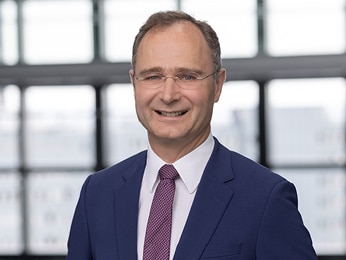
Stephan Leithner, Deutsche Börse
“We invest so that Europe remains globally competitive by playing a leading role in financial market technology,” he said. “Much of our business has moved to the cloud, so we are very well positioned to be able to shape the AI trend.”
Over three quarters of the group’s workload is in the cloud including calculation of the DAX, the flagship German index, since last December. Leithner said that in the last seven to eight years, Deutsche Börse has assumed the leading role in the cloud for the German and European financial industry.
“We are doing the same now for AI, and we have the strength to do that thanks to our margins with an investment of €700m,” he added.
SimCorp, which provides software for large asset managers globally, is expected to particularly benefit from using AI to improve the investment process, according to Leithner. He added that SimCorp gained significant new clients last year, particularly in North America, including Canso, a major Canadian asset manager and that a new “heavyweight” in North America will be added soon.
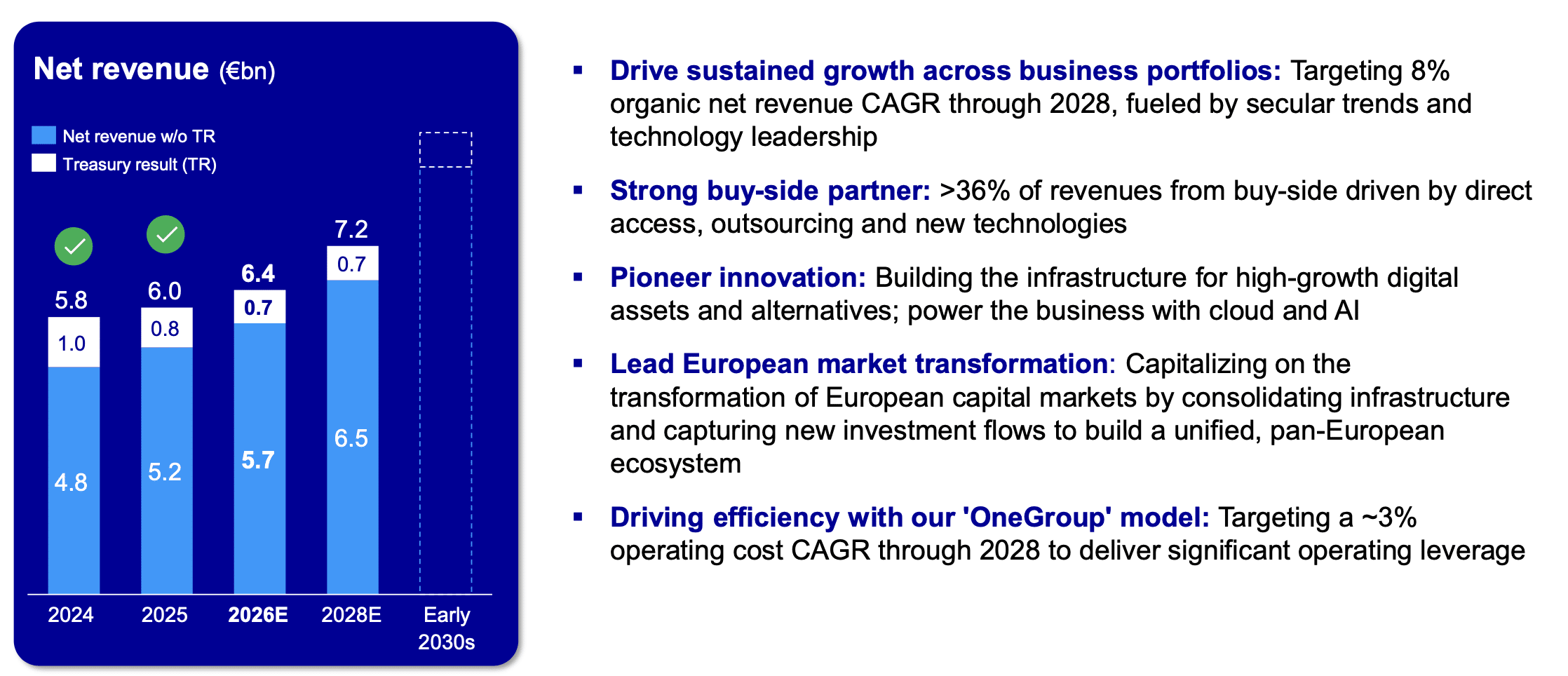
Leither said it has become increasingly important for the group to partner asset managers, and over one third, 36%, of net revenue now comes from the buy side.
Allfunds acquisition
The €5.3bn acquisition of Allfunds, a global platform marketplace connecting financial institutions that distribute funds, is Deutsche Börse Group’s largest acquisition. The group said the combination aligns with the Europe Union’s Savings and Investments Union (SIU) by bringing end investors closer to investment fund products in an efficient and seamless way and allowing for wider choice of products.
On 21 January 2026 Deutsche Börse Group said in statement that it had entered into a binding agreement on the terms of the recommended acquisition. Allfunds had €1.7 trillion of assets under administration on 30 September 2025 and connects over 1,400 funds and more than 900 distributors across 66 countries.
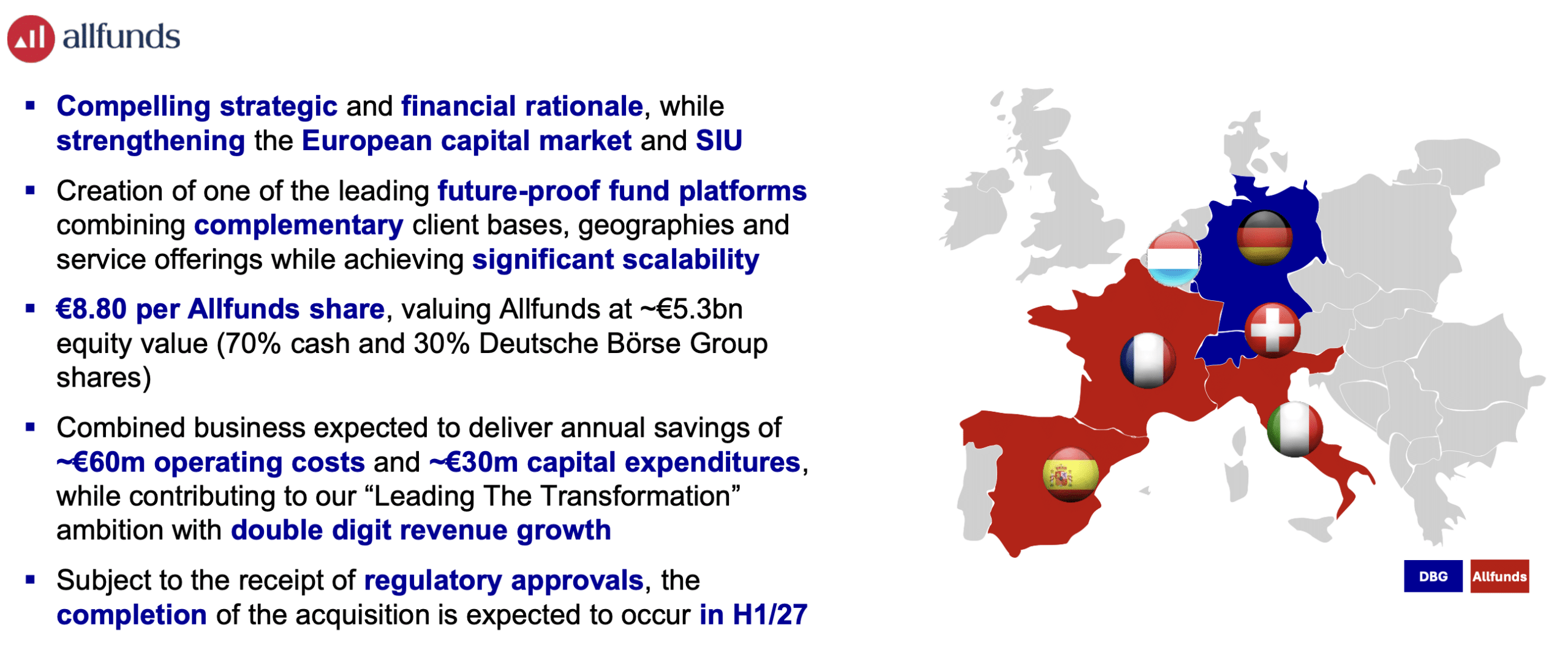
Source: Deutsche Börse
Deutsche Börse argued that the combination of Allfunds’s technical expertise and entrepreneurial drive with Clearstream Fund Services will create a leading business in the sector and support development of the funds sector in Europe and around the world.
Clearstream is primarily present in Central Europe, while Allfunds is present in Southern Europe and Leithner said the two companies also complement each other in terms of their customer base and services. Deutsche Börse expects the deal to lead to double-digit revenue growth after completion in the first half of 2027, subject to regulatory approval.
Leithner highlighted that investors in Germany and Europe have recognised the growing importance of the capital markets for long-term savings and this has led to “massive” inflows that are being invested via the group’s platforms. He described the development of savings behavior in Europe as a “sea change.”
There were a record 14 million shareholders in Germany at the end of last year, according to Leither, In addition, there are now 33 million ETF accounts in Europe and ETF trading volume grew 50% year-on-year.
In addition, international capital inflows into Europe have been increasing. He added: “We are the gateway to the European capital market, and we are seeing long-term inflows, especially at Clearstream.”
Digital assets
D7, the group’s platform for issuing tokenized securities, has exceeded 2.6 million digital issues and Leithner said tokenization is becoming a “key driver.”
Last month the European Central Bank also said it would accept tokenized securities from custodians such as Clearstream as collateral. In addition, Deutsche Börse is working with partners for stablecoins and taking part in tests for the digital Euro which is due to launch in 2027, according to Leithner.
“Through our collaboration with Kraken and, most recently, Bitpanda, we are building bridges between traditional and digital investment markets for institutional clients,” he added. “We expect these partnerships to have considerable effects on our net revenue.
ISS Stoxx
Deutsche Börse Group said in a statement that it has agreed to acquire the remaining 20% minority stake in ISS STOXX, the data, analytics and index provider, from private equity firm General Atlantic for $1.1bn.
The partnership with General Atlantic began in 2019 with the acquisition of Axioma, followed by the acquisition of ISS’ stewardship and ESG solutions and then the STOXX index in 2023.
The two firms have been pursuing a dual track, allowing General Atlantic to exit until 2026. The transaction allows General Atlantic to sell its shares after an IPO was cancelled last year, which Leithner said was due to market conditions.
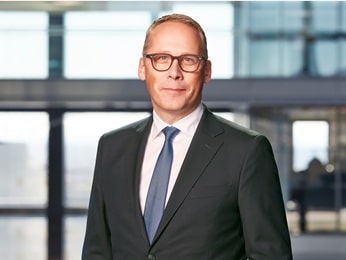
Christian Kromann, Deutsche Börse
Christian Kromann, member of the executive board of Deutsche Börse Group, said in a statement: “This step now re-confirms our strategic ambition to empower the investment management industry with leading data, analytics, and index solutions.”
There has been a backlash against proxy advisors in the U.S. and The Wall Street Journal reported in January this year that JPMorgan Chase’s asset management division is ending all relationships with proxy advisory firms. Instead, the bank intends to use an internal AI-powered platform called Proxy IQ. In an executive order, the U.S administration also claimed that ISS and Glass Lewis are using “their substantial power to advance and prioritize radical politically-motivated agendas.”
Leithner answered that the proxy advisory business operates on long cycles with waves of support and waves of criticism. In addition, investors have said they need central research capabilities for annual general meetings.
“Only a few of the really big asset managers can research tens of thousands companies, do the necessary analysis and then translate that into advisory services,” he said.
In addition, ISS is closely cooperating with the U.S. authorities.
“We are convinced that people will come to realize that proxy advisors are important for healthy functioning of the investment market,” he added.
Source: Deutsche Börse
Financials
Deutsche Börse Group reported record net revenue of total of €6.03bn for 2025, up 9% from the previous year, which it said was mainly due to strong structural growth.
Jens Schulte, chief financial officer of Deutsche Börse Group, said in the press conference: “This means we have achieved our target of €5.2bn. EBITDA without treasury result rose by 14% to €2.7bn and here too we achieved our target.”
Leither described this as the best result in the history of Deutsche Börse Group.
“Five of our eight businesses once again achieved double-digit growth,” Letihner added. “That sets us apart from many others.”
Schulte said that in the trading and clearing business, Eurex achieved “solid” growth with the highest growth in interest rate derivatives.
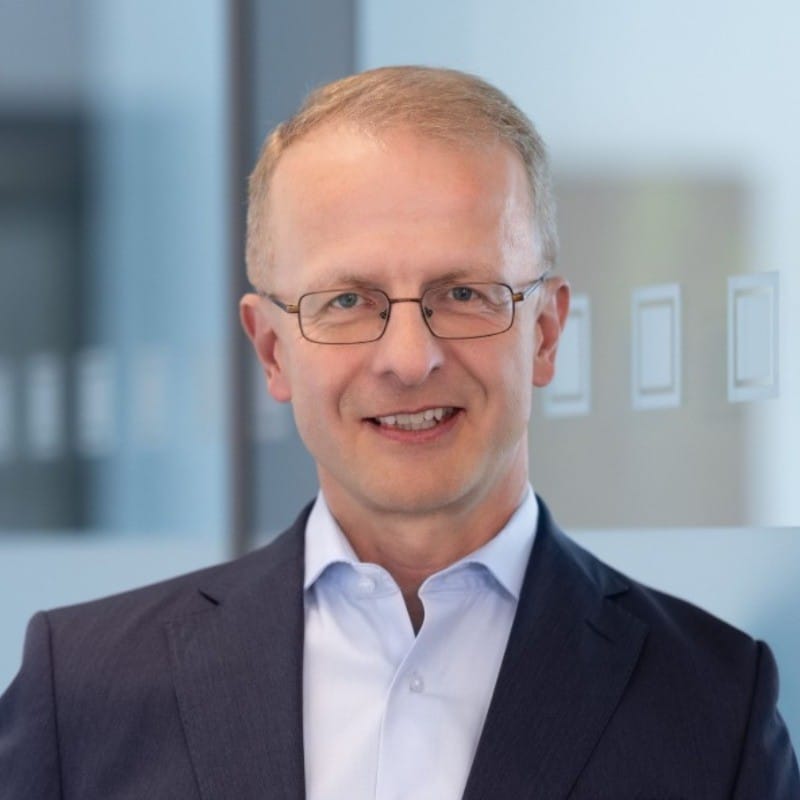
Jens Schulte, Deutsche Börse
Clearing of over-the-counter interest rate derivatives grew net revenue 14% in the fourth quarter. New European Union regulation requires clients to maintain an active account for systemically relevant products with an EU CCP is due to take effect this year. Schulte added that many account have been onboarded in advance of becoming active.
On 1 June 2026 Laura Bayley will join Eurex Clearing as chief executive officer. Bayley joins Eurex Clearing from SIX Group, where she has been head of clearing services and chief executive of SIX x-clear since 2022.
Trading in ETFs and ETPs increased by 52.7% and Leithner said this was the most successful year since the market launch. He added that last year nearly half, 45%, of European ETF growth was based on Stoxx indices and the largest trading volume was on Xetra in Frankfurt. The majority, 60%, of trading volume came from non-German ETFs with the defense sector and precious metals as the main focus of investor interest.
“Europe needs players who can drive forward a capital market of global quality and players who are globally competitive,” Leithner added. “That is what Deutsche Börse Group has built: from a pure stock exchange operator to a leading European provider of market infrastructure that is relevant worldwide.”

NEWSLETTER SIGN UP
And receive exclusive articles on securities markets

🏆 The 2026 Global Markets Choice Awards are here! 🌍 Nominations are officially OPEN for the celebration of excellence in global capital markets trading & technology. Nominate below:
https://www.jotform.com/form/260086385121150

Delaware Life Insurance Company is becoming the first insurance carrier to offer an index that contains cryptocurrency, adding the BlackRock U.S. Equity Bitcoin Balanced Risk 12% Index to its fixed index annuity (FIA) portfolio.
As the digital assets industry pushes toward
Franklin Templeton is expanding its tokenized fund suite, signaling growing institutional demand for blockchain-based fund infrastructure and regulated investment products moving onchain. Read the full article below:
$50 billion in active ETF inflows helped fuel a record year for @BlackRock 's iShares business, as investors continue to lean into active strategies.
Shanny Basar
Senior writer
A Senior Writer at Markets Media who became a financial journalist in 2000 after working in banking for over a decade....
More about this authorRelated articles
-

Financial institutions are increasingly using AI in specialized workflows.
-

Years of LSEG tick history can be analysed in seconds rather hours.
-

FSB highlighted risks including volatility in sovereign bonds, private credit and AI.
-
The alternative investment manager has released its own multi-model AI harness.
-

Governed agentic workers will address manual processes that persist across capital markets.