






02.19.2026

Stéphane Boujnah, chief executive and chairman of the managing board of Euronext, said the financial market infrastructure is working on several tokenization initiatives.
On the results call on 19 February, Boujnah was asked if Euronext was missing out on tokenization and he replied that the firm works on many things that it does not share with investors.
“We don’t turn up with PowerPoint presentations entitled ‘Change of Paradigm,’ but we do the hard, meticulous work of trying to assess the legitimate role for Euronext, so we are exploring several initiatives in the tokenization world,” he added.
He said Euronext will be involved in tokenization and will provide a plan when the firm is confident that it will deliver.
“We will not do growth by press release,” he said. “We will deliver real projects that make money to address the needs of our clients and the requirements of our shareholders.”
Giorgio Modica, Euronext
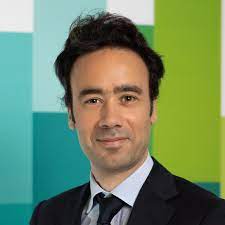
Artificial intelligence is viewed as another technology likely to affect exchanges, and especially their data businesses. Giorgio Modica, chief financial officer, stressed on the call that Euronext’s revenue for data solutions mostly comes from monetizing raw proprietary data, such as from its order book data. Modica said this data is unique to Euronext, used in real time to make trading decisions, and to meet regulatory requirements, such as best execution, surveillance and reporting. In addition, he argued that clients are searching for data that is safe, secure, and stored in Europe.
“This data cannot be replaced by AI,” added Modica. “This is an important message.”
Boujnah argued that Euronext will not be hit by AI as there is a huge difference between data businesses that process existing information and businesses that create new data.
“The data we produce is the output of matching a bid and ask that are matched on a platform in a very demanding latency environment,” Boujnah added. “This is very different from what AI does, which is to process things that already exist better than human beings.”
He continued that Euronext had not bought a data business because the group could not justify the valuations, and had lost many bids for assets as other firms had more bullish viewa. As a result, Euronext has had a lower valuation than peers.
“I was told Euronext is missing the data boat,” he said. “Maybe the boat that we missed was the Titanic.”
Boujnah argued that the environment has returned to the fundamentals of generating real growth, real EBITDA, real free cash flow generation and real sustainable growth. He added: “We are delivering numbers, even if we are not part of the new ‘data as oil” revolution.”
Meeting objectives
Boujnah said Euronext delivered the first meaningful milestones of its Innovate for Growth 2027 strategic plan and will acceleration execution in 2026.
To meet the objectives of the strategic plan, Euronext scaled up its software-as-a-service (SaaS) offering when it completed the acquisition of
Admincontrol for an enterprise value of NOK 4.6bn ($480m) in May 2025. Admincontrol is part of Euronext corporate solutions, boosting the franchise in the Nordics and U.K and increasing subscription-based revenues. In January this year, Admincontrol expanded into France and the first clients in the country are being onboarded.
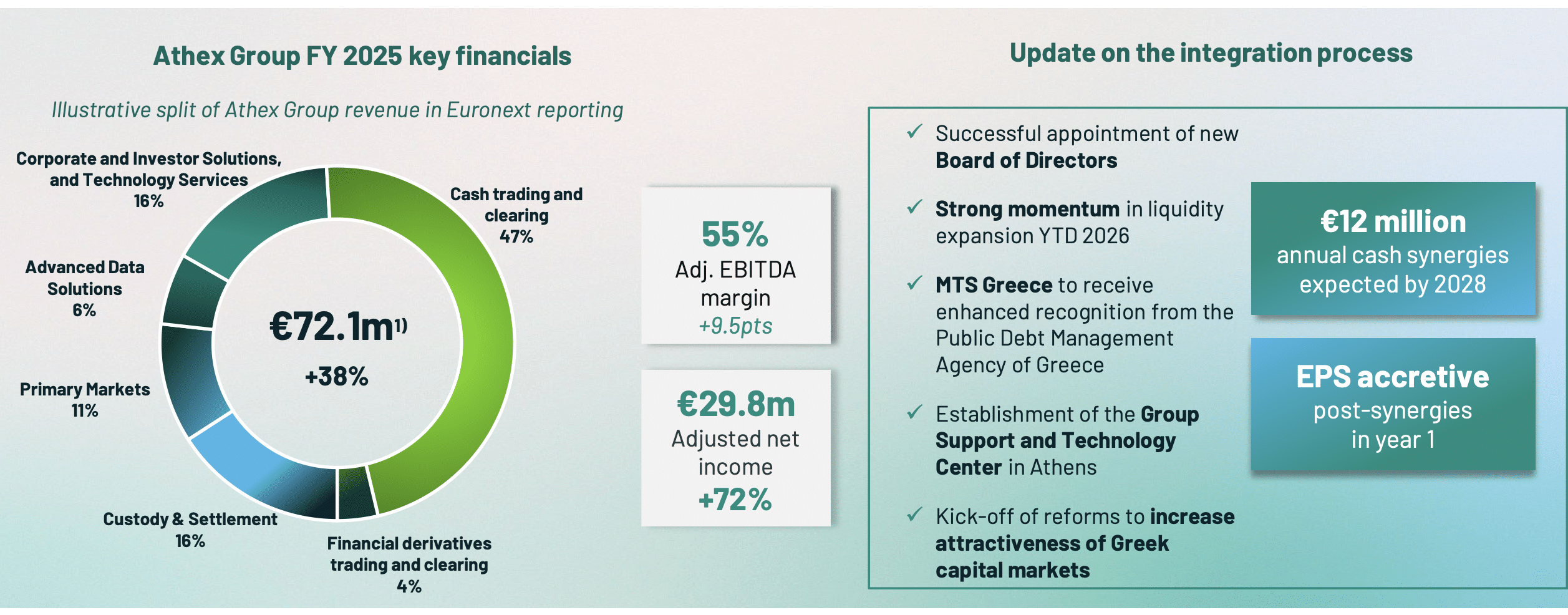
In another acquisition, Euronext completed its voluntary share exchange offer for Athex Group (Hellenic Exchanges-Athens Stock Exchange) last November and now owns approximately three quarters, 76%, of the Greek firm. Euronext aims to take the company private to accelerate integration.
Source: Euronext
The deal was in line with Euronext’s investment criteria and its aim of building more integrated European capital markets to support the European Union’s Savings and Investment Union, which aims to boost the trading bloc’s capital markets, according to Boujnah.
Athex’s new board of directors was appointed in January 2026, but integration has not truly started. Euronext expects to deliver €12m of annual cash synergies by the end of 2028 through migrating Greek trading to Optiq, the group’s proprietary trading platform, the harmonization of central functions and the expansion of top line initiatives. Implementation costs will be €25m and the deal is expected to be accretive for Euronext shareholders within the first year after synergies are realised.

Stéphane Boujnah, Euronext
Boujnah said: “We continue to see dynamic growth of Athex and the Greek economy, with average daily volume twice as large in January 2026 compared to January 2025.”
Last year Euronext also expanded its retail offering to meet growing demand across Europe. Euronext said it is the largest aggregator of retail flows in Europe, with over €1bn daily volumes on its platform in 2025. The best execution service for retail investors, Euronext Best of Book (BoB), was expanded to Milan in November 2025, and the firm said there have been strong volumes in Italy. As of the end of January 2026, daily volumes on BoB in Italy were above €100m.
In addition, Euronext expanded its Global Equity Market, a trading facility for over 1,000 securities including pan-European shares and around 600 U.S single stocks. In 2025, Euronext Global Equity Market average daily volumes grew by more than 30% year-over-year.
in September 2025 Euronext also launched the first integrated ETF market in Europe. Boujnah said: “This strategic initiative allows us to benefit from rapid growth of this asset class across the value chain.”
Accelerating execution
Euronext aims to add power futures in March 2026 to diversify its commodities franchise. The technical launch took place on 2 February 2026 to allowed members to test operational readiness and the migration of Nasdaq open interest to Euronext is planned on 14 March 2026. The firm has been a player in spot electricity markets, but not in power derivatives, according to Boujnah.
“We are going to disrupt market structure by becoming a challenger to some incumbents,” he added. “This is an additional project which is as important as delivering the financial targets.”
Boujnah gave another example of disrupting market structure through the launch of Euronext Securities, a central securities depository (CSD), which he described as a “very important” project. In September 2026, Euronext Securities will operate in France, Italy, Belgium and the Netherlands, for equities and ETFs, which Boujnah said is an important step in becoming the CSD of choice in Europe.

Pierre Davoust, Euronext
Last December Euronext announced further progress in the creation of Euronext Securities, which will combat post-trade fragmentation across Europe. Euronext Securities is working with key issuing agents to build an issuance model for the region which would offer issuers greater choice, improved liquidity and broader investor access,
Pierre Davoust, head of Euronext Securities, said on the call that some issuers have decided to switch from their current CSD to Euronext Securities, which he described as a “breakthrough” for the project. The first listing will be on Euronext Amsterdam and shares of the new listed company will be issued in Euronext Securities.
“We are working with the largest settlement agents and custodians for them to be ready to offer the model to their clients from September 2026,” Davoust added.
The group will also complete its repo offering to create a European market by June 2026.
Source: Euronext
Financials
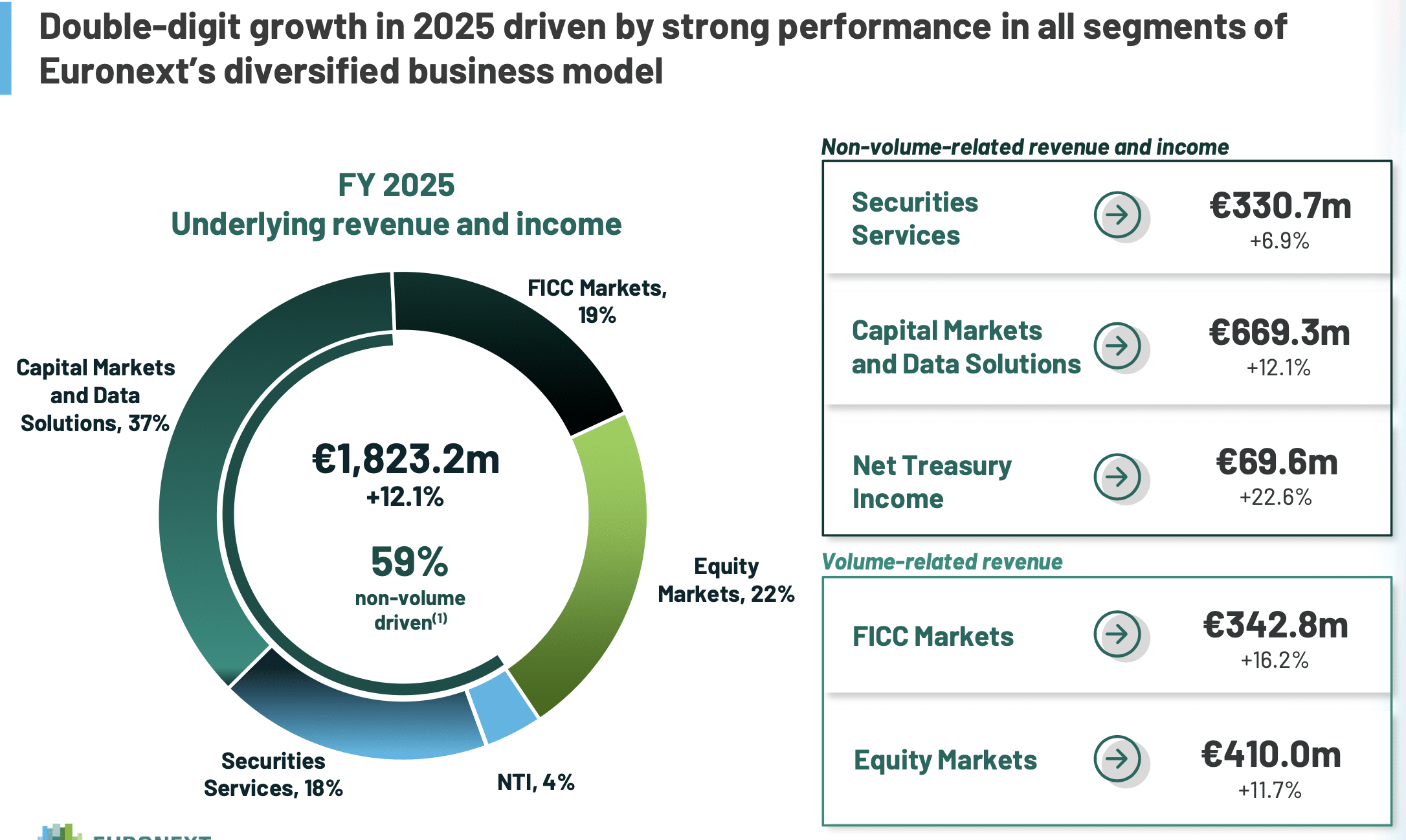
Boujnah said: “2025 was an excellent start to our ‘Innovate for Growth 2027’ strategic plan, with double-digit growth in revenue, EBITDA and EPS. Performance was driven by balanced contributions from volume and non-volume related activities, supported by disciplined capital allocation.”
In 2025, Euronext’s underlying revenue and income was €1.8bn, up 12.1% from the previous year.
Non-volume-related revenue and income represented the majority, 59%, of total revenue and income, a 10.9% increase compared to 2024. Boujnah said this was driven by growth in custody and settlement.
He highlighted that volume-related revenue also increased 13.9%, driven by double-digit growth in fixed income, commodities trading and clearing.
Boujnah confirmed that Euronext is committed to delivering the target of above 5% growth in its strategic plan.

NEWSLETTER SIGN UP
And receive exclusive articles on securities markets

🏆 The 2026 Global Markets Choice Awards are here! 🌍 Nominations are officially OPEN for the celebration of excellence in global capital markets trading & technology. Nominate below:
https://www.jotform.com/form/260086385121150

Delaware Life Insurance Company is becoming the first insurance carrier to offer an index that contains cryptocurrency, adding the BlackRock U.S. Equity Bitcoin Balanced Risk 12% Index to its fixed index annuity (FIA) portfolio.
As the digital assets industry pushes toward
Franklin Templeton is expanding its tokenized fund suite, signaling growing institutional demand for blockchain-based fund infrastructure and regulated investment products moving onchain. Read the full article below:
$50 billion in active ETF inflows helped fuel a record year for @BlackRock 's iShares business, as investors continue to lean into active strategies.
Shanny Basar
Senior writer
A Senior Writer at Markets Media who became a financial journalist in 2000 after working in banking for over a decade....
More about this authorRelated articles
-

The group set single day volume records in equities and fixed income.
-
From September 2026, Euronext Securities aims to offer a European CSD service.
-

The new elastically scalable system is one of the largest CSD transformation projects in the world.
-

A single, consolidated platform wil provide settlement and custody across multiple EU markets.
-

Hong Kong aims to develop its post-trade securities infrastructure into a major CSD in the region.