






07.16.2026
Fireblocks Trust Focuses on Growth in Financial Services
07.16.2026
Adam Levine joined Fireblocks in 202 and became chief executive of Fireblocks Financial Services at the start of this year as the digital asset infrastructure provider focuses on licensed services.
Levine described Fireblocks as an infrastructure layer providing the technology and connectivity to enable companies to achieve their strategy for digital assets across payments, crypto and tokenization. He told Markets Media that on top of that technology infrastructure, firms need financial infrastructure.

Adam Levine, Fireblocks
“We are not a financial market infrastructure (FMI) but we provide core services in areas such as qualified custody and stablecoin payments where have appropriate licensing in the U.S.,” Levine added.
Bitcoin used to provide the highest volume through the Fireblocks Network, according to Levine, but that has changed to stablecoins over the last 12 to 18 months. Levine said: “I think that is going to be a material area of growth.”
He told Markets Media that the group will continue to provide more services throughout Fireblocks Trust Company, the authorised custodian, especially collateral management, facilitating decentralise finance (DeFi) and helping clients grow their stablecoin payments. Another aim is to solve the distribution problem for digital assets.
“We are racing to market with an MVP (minimum viable product) in a few weeks to provide clients with an easier way to buy tokenized real world assets,” he added. “We are not an exchange but the SEC guidance suggests there is a way for us to leverage our security and technology.”
He stressed that Fireblocks is not pivoting away from technology, but financial services is part of a broader strategy to help meet clients where they are.
Qualified custodian
Back in May 2024 Fireblocks Trust Company, was authorized as a qualified custodian by the New York Department of Financial Services (NYDFS), to allow it to safeguard digital assets for institutions. Levine described the NYDFS approval as “foundational.”
He highlighted that when Fireblocks applied for the license, there was not a viable federal option for digital asset custody.
“We did not want to do forum shopping,” added Levine. “We are based in New York and felt that was the high water mark.”
Becoming a qualified custodian allowed Fireblocks to support clients in a different way, according to Levine, as registered investment advisors (RIAs) and asset managers need to work with a regulated custodian. For example, in February this year FalconX, the digital asset prime broker, said in a statement that it had integrated Fireblocks Trust Company. FalconX said regulated custody has become an increasingly important consideration for many U.S.-based institutions.
“FalconX remains committed to supporting institutional clients globally, with custody solutions tailored to regional regulatory requirements,” added the prime broker. “This integration represents a pivotal step in expanding FalconX’s institutional capabilities as the digital asset market continues to evolve.”
Levine said another area of significant growth is crypto-native clients who use Fireblocks wallets and also want to use a regulated custodian for their own security and risk tolerance. Levine added: “What is really exciting for them is that they can use literally the same user interface or API for the qualified custodian.”
Fireblocks Trust Company can hold virtually any tokenized asset including tokenized money market funds, securities, altcoins and crypto, said Levine. In the long term, he expects clients will want to use the same custodian for traditional and digital assets.
There are other crypto-native custodians, as well as traditional custodians entering the digital asset space but Levine argued that Fireblocks Trust Company can provide a more comprehensive solution. For example, the firm receives many requests from wallet clients who want a regulated custodian. In addition, clients at the custodian want to give their underlying customers an embedded wallet, which Fireblocks can provide. In addition, Fireblocks Trust Company can be a sub-custodian if traditional custodians want to provide digital asset services.
“We have a few clients today that have fully outsourced their custody solution,” added Levine. “We are speaking to some of the large traditional financial players that intend to launch their own digital asset solution and they want a sub-custodian relationship.”
Levine described collateral management as “foundational” Collateral management is far more efficient for tokenized assets, which scam be moved more quickly 24/7.
“There are ways for Fireblocks Trust to provide collateral services that unlock huge commercial opportunities,” Levine added. “That could be for DeFi, trading relationships and even future M&A transactions.”
Source: Broadridge
DeFi grows in importance
There has been more institutional interest in tokenization since the Genius Act was passed by the U.S. administration last year to provide the first federal framework for stablecoins. Levine said that since then, the tenor of conversations with institutions has focused on non-crypto tokenized assets and lending, especially bitcoin, in order to earn yield. Institutions are increasingly coming to Fireblocks for a combination of DeFi and collateral management.
“Getting access to DeFi through a custodian, or having a collateral solution that provides lending and borrowing, are things we could not do in the same way without a quality custodian,” Levine added.
For example, in April this year Morpho, the open blockchain-based credit network, said in a statement it had integrated into Fireblocks Earn. Morpho said Fireblocks processes over $200bn in stablecoin transactions every month, but they sat idle between settlement windows and deployment cycles, largely because the infrastructure to put them to work did not exist.
Institutional users can access Morpho Vaults directly from the Fireblocks platform and deposit stablecoins into vaults curated by institutional-grade asset curators within the same custody, governance, approval, and security frameworks to turn stablecoin balances into yield-generating positions without adding operational complexity. Crypto vaults are onchain software applications that are often designed to allow users to earn yield passively through the deployment of their assets into yield-generating opportunities onchain, and operated by a curator, such as an asset manager, who sets the investment guidelines.
“There is no separate DeFi workflow to adopt. No new platform to onboard,” added Morpho.
Fireblocks’ custody clients can put idle stablecoin balances to work all long as the curated vault meets Fireblocks’ criteria. Levine said the founder of a very large asset manager told him that he thinks their whole business will be curating vaults in five years time.
“I think that we are going to see DeFi become really important for investment management globally,” added Levine.
Tokenization infrastructure grows
On 15 July 2026 DTCC, the U.S post-trade financial market infrastructure, launched the initial phase of its tokenization project when it processed live U.S. trades using tokenized securities for the first time.
Fireblocks, the digital asset infracture provider, was in the group of more than 30 firms across traditional finance and decentralized finance selected as a contributor. Fireblocks provided the wallet infrastructure behind the custody, connectivity, and policy controls for tokenized DTC-held assets.
Stephen Richardson, chief strategy officer and head of banking at Fireblocks, said in a statement that scaling tokenized securities has been talked about for years.

Stephen Richardson, Fireblocks
“On 15 July they settled inside the same infrastructure that clears most U.S. equities and Treasuries, carrying the same ownership rights and protections investors already expect, and moving tokenization beyond where any previous pilots could,” added Richardson. “That’s the piece that had to work, and now it has.”
DTCC’s full tokenized service is scheduled to launch in October 2026.
In the U.K. Chris Woolard, the country’s wholesale digital markets champion, published his inaugural report to the government on 13 July 2026, which said tokenisation could add hundreds of billions of pounds of value to the economy by 2035.
The report highlighted actions for industry, supported by government and the UK regulators, to tokenize UK financial markets at scale which included building secondary markets, tokenizing collateral and building on the issuance of DIGIT, the U.K. digital gilt.
Over the next 12 months, members of a cross-industry taskforce of 54 firms, including Fireblocks will be working with Woolard and industry partners to deliver live end-to-end use cases, initially focusing on tokenized repo. Levine describe the initiative as “really important”.
“The private sector is going to continue to innovate but cannot do that in a vacuum,” he added.
He continued that Fireblocks has a long history of working closely with governments to ensure they understand the technology, the “art of what’s possible”, as well as listening to their priorities.
“In every market where you have the government or regulators leaning into the technology, there has been innovation, such as in Australia and Brazil,” he added.
Tokenization Pulse Survey
Tokenization is no longer a future-state concept, as financial institutions increasingly view it as a strategic priority and prepare for a future in which digital and traditional assets operate side by side, according to a survey from fintech Broadridge Financial Solutions
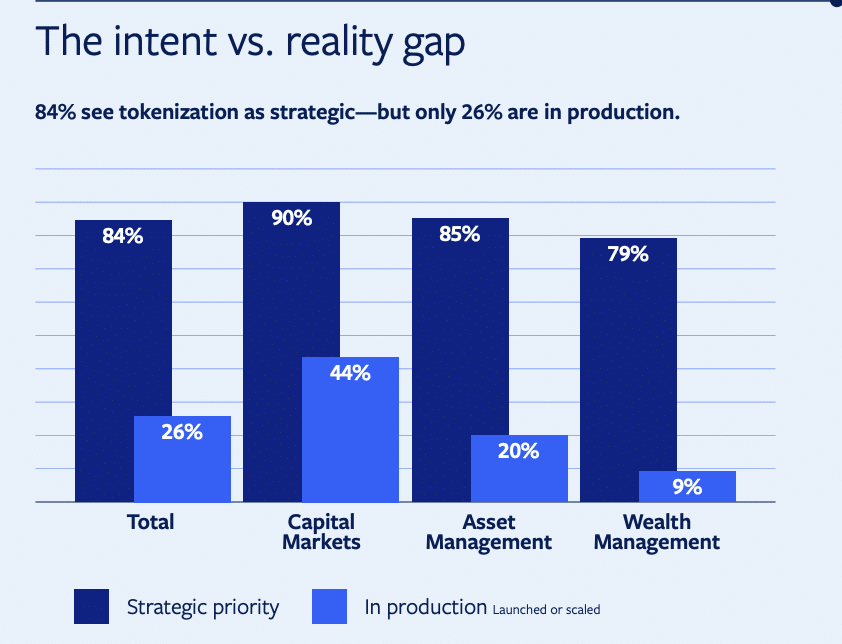
More than three quarters, 84% of firms, said tokenization is strategically important to their organization in the inaugural Broadridge Tokenization Pulse Survey. Nearly all, 92%, also expect digital and traditional assets to coexist for the foreseeable future. The survey covered 200 North American financial services leaders and was conducted by Phronesis Partners in May this year.
German Soto Sanchez and Mark Nichols, co-presidents of digital assets at Broadridge, said in a statement: “Across the industry, there is clear recognition that tokenization has the potential to reshape how assets are issued, traded, financed, and serviced.”
Source: Broadridge
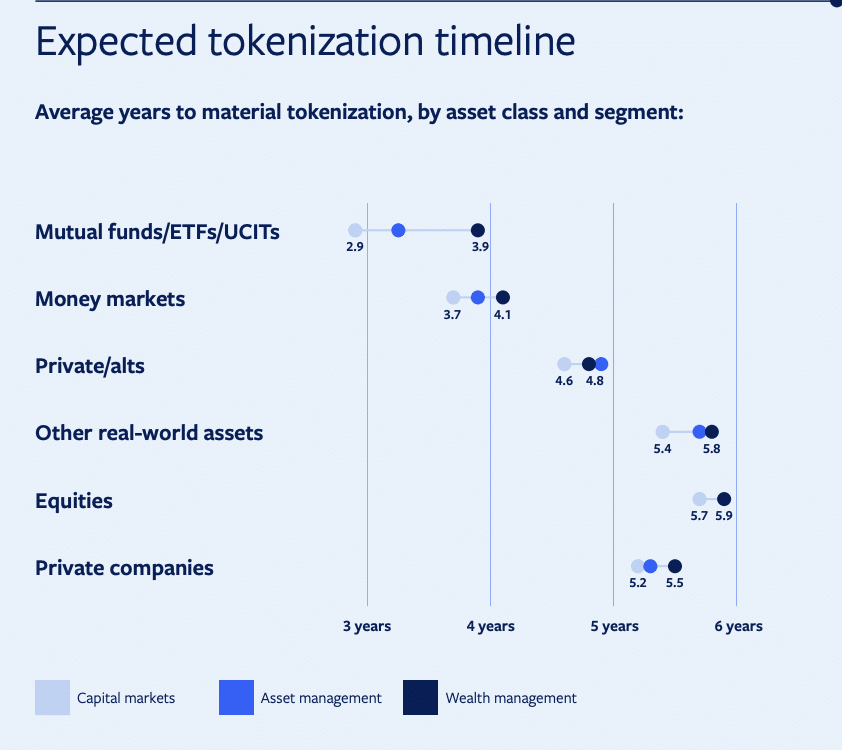
Public market funds are among the leading areas of early adoption, with 80% of respondents expecting tokenized mutual funds and money market funds to play a meaningful role in five years.
The report said adoption is progressing at different stages across the industry with capital markets firms leading implementation efforts. Asset managers and wealth managers are continuing to build capabilities and evaluate operating models.

NEWSLETTER SIGN UP
And receive exclusive articles on securities markets

🏆 The 2026 Global Markets Choice Awards are here! 🌍 Nominations are officially OPEN for the celebration of excellence in global capital markets trading & technology. Nominate below:
https://www.jotform.com/form/260086385121150

Delaware Life Insurance Company is becoming the first insurance carrier to offer an index that contains cryptocurrency, adding the BlackRock U.S. Equity Bitcoin Balanced Risk 12% Index to its fixed index annuity (FIA) portfolio.
As the digital assets industry pushes toward
Franklin Templeton is expanding its tokenized fund suite, signaling growing institutional demand for blockchain-based fund infrastructure and regulated investment products moving onchain. Read the full article below:
$50 billion in active ETF inflows helped fuel a record year for @BlackRock 's iShares business, as investors continue to lean into active strategies.
Shanny Basar
Senior writer
A Senior Writer at Markets Media who became a financial journalist in 2000 after working in banking for over a decade....
More about this authorRelated articles
-

Digital assets are new rails that can coexist with existing market infrastructures.
-

Bank is modernizing its infrastructure to meet demand for always-on markets.
-
The launch comes as digital assets become increasingly integrated with traditional capital markets.
-

They will bring together digital asset custody and staking in a single institutional servicing model.
-
The exercise will run from the second half of 2026 to the first half of 2027.