






08.05.2026

Galaxy Digital, a digital asset and data center infrastructure firm, launched an institutional vault curation offering in July this year as the vault ecosystem is expected to continue to consolidate and become more institutional.
Hester Peirce, the outgoing commissioner of the Securities and Exchange Commission, described vaults as facilitating asset deployment by using smart contracts to allocate user assets to various yield-generating activities, including staking and lending. She added that vaults are not uniform and exist on a spectrum between programmatic allocations determined solely by immutable smart contracts using risk parameters established by the curator to allocations at the sole discretion of another person or group of persons. Depositors receive share tokens representing their claim on a vault’s assets and returns.
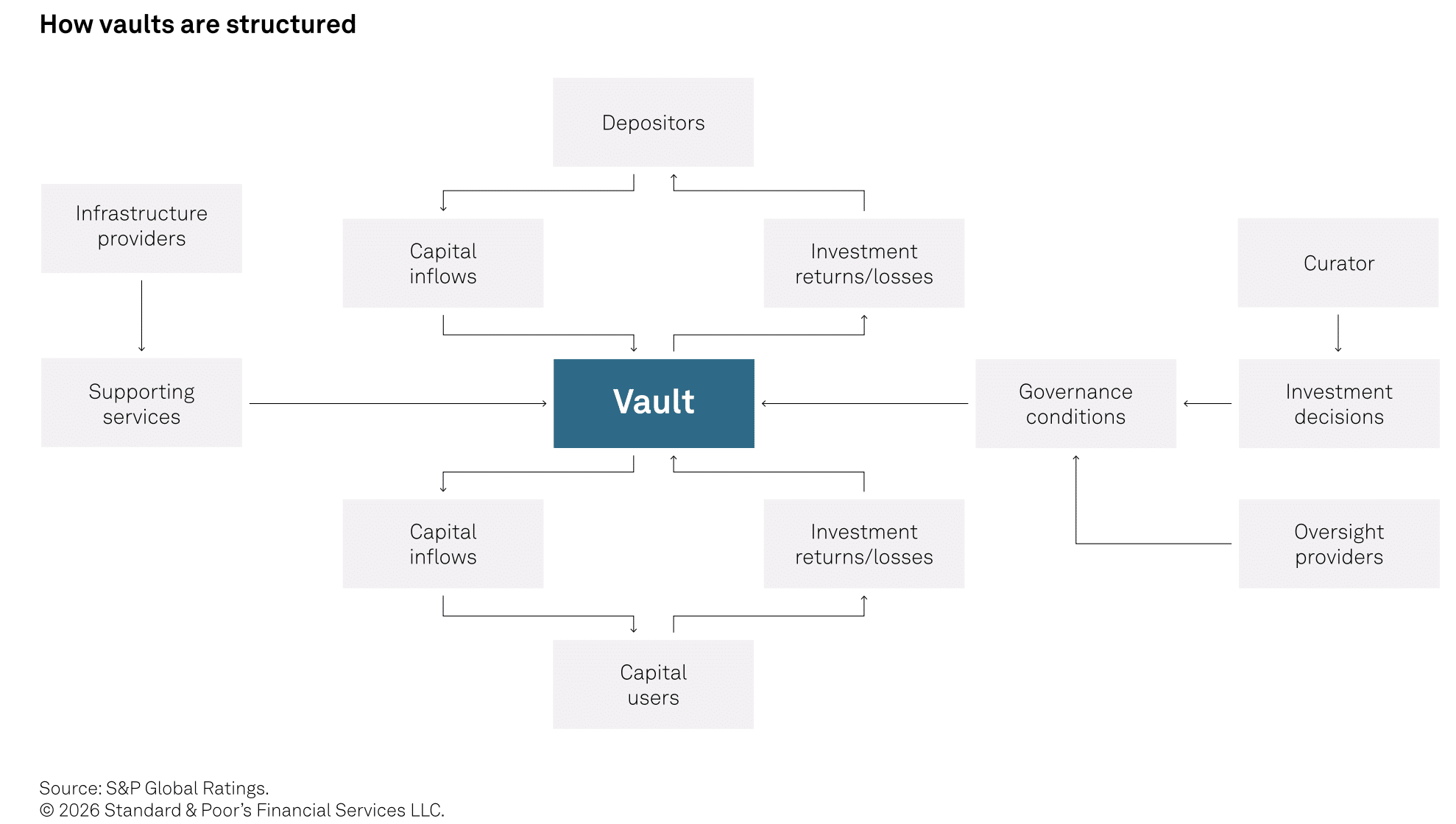
Source: S&P
Zach Pandl, head of research at digital asset investment firm Grayscale said in a blog that the vault structure is highly flexible, but many operate with specific investment parameters and hold yield-generating assets. He compared them to collateralized loan obligations (CLOs) in traditional finance.
“Like CLOs, vaults pool investor capital into professionally managed portfolios designed to maximize risk-adjusted returns and distribute cash flows generated by the underlying assets,” Pandl added.
Pandl estimated that about $7bn in assets are currently invested in more than 3,000 vaults managed by 57 curators, 79% of which focus on stablecoins. In comparison, the CLO market is worth about $1.5 trillion across thousands of vehicles managed by more than 250 firms.
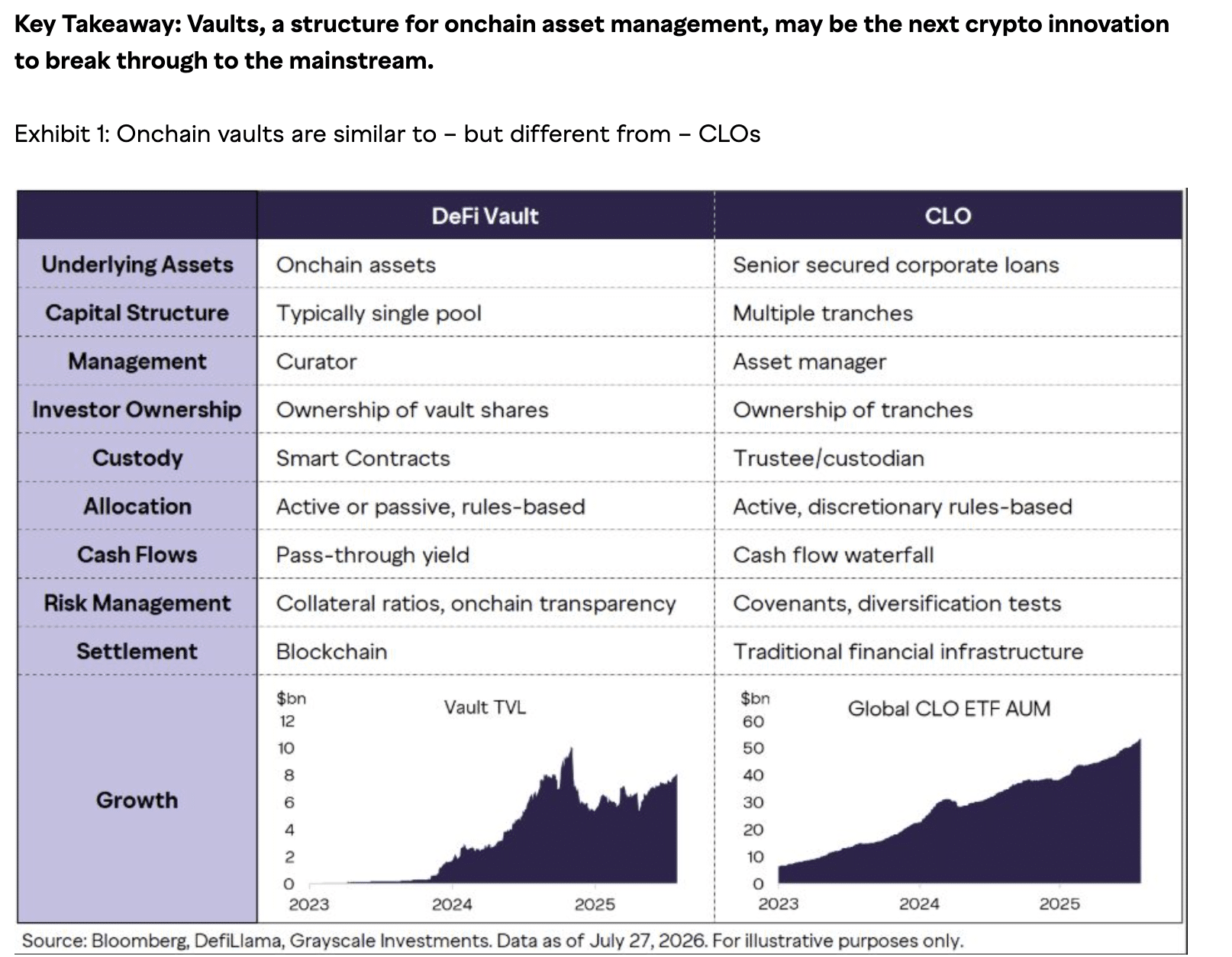
Source: Grayscale
Galaxy
Galaxy aims to add to vault assets and said in a statement on 16 July 2026 that it had launched Galaxy Curator, an institutional vault curation offering. Galaxy Curator launches with two vault configurations designed for different risk and yield objectives. They are built on Morpho’s open, modular architecture for implementing scalable, custom onchain strategies with systematic risk management.
Dennis Bree, head of institutional growth at Morpho, told Markets Media that it is important that Galaxy has become a curator and he hopes other institutions will follow suit.. He said: “The neutral infrastructure that we provide allows Galaxy to solely focus on the strategy and the risk decisions.”
More than 2,400 institutional clients can access Galaxy vaults through Fireblocks Earn, an infrastructure they already use, with the same approval workflows, and transaction signing. They do not need to build or maintain separate decentralized finance (DeFi) infrastructure.

Zane Glauber, Galaxy
Zane Glauber, global head of distribution at Galaxy, said in a statement: “Galaxy Curator applies the same risk discipline we run across our lending and trading businesses to onchain markets, and the Fireblocks integration means clients can access it without changing how they operate.”
In a blog Galaxy stressed that it operates as a vault curator and publisher, not as an investment advisor or portfolio manager. The blog said: “What we provide is infrastructure, curation expertise, and operational discipline – the systematic processes and institutional-grade tooling required to deploy and maintain DeFi vaults responsibly.”
Galaxy said it is responsible for electing which collateral types and markets a vault allocates to, rebalancing vault allocation within pre-established parameters, and monitoring vault health and underlying protocol risk in real time.
“Depositors retain full custody of their assets through the underlying protocol’s native infrastructure,” Galaxy added. “Galaxy’s role is entirely curatorial. This distinction matters.”
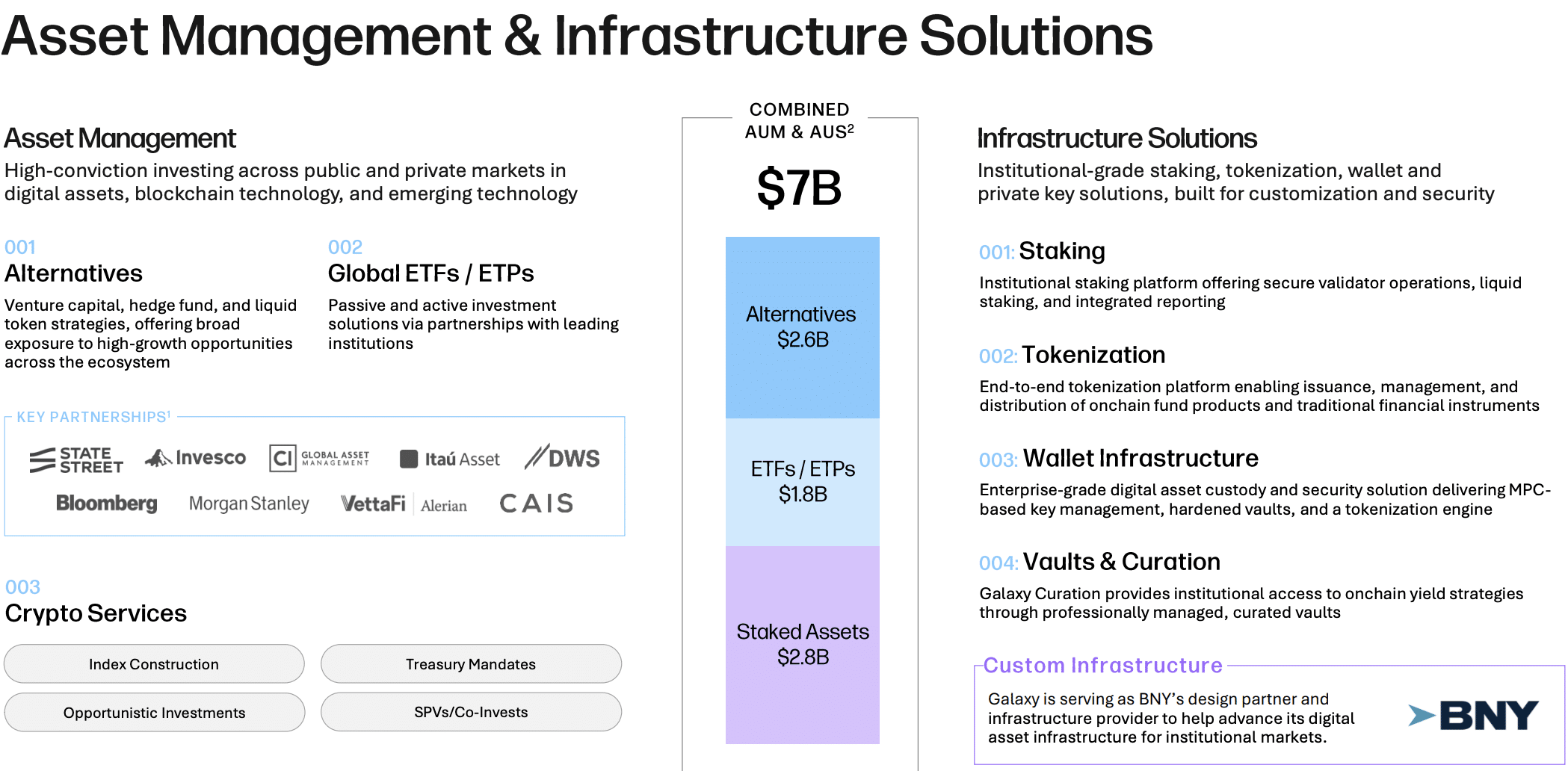
Source: Galaxy
Growth
S&P Global Ratings described digital asset vaults as the onchain equivalent of managed funds that represent an important shift beyond direct ownership of individual digital assets. The ratings agency said vaults of real-world assets could play an integral role in future financial infrastructure. In a report, Digital Assets Primer: How Vaults Can Shape the Capital Markets of Tomorrow, S&P said vaults have broad potential as financial infrastructure capable of supporting a wide range of traditional market functions.
“Improvements in capital efficiency and secondary-market liquidity create strong economic incentives for adoption,” added S&P. “While uptake may be gradual initially, institutional validation could drive rapid acceleration.”
The ratings agency believes rising market standards around vault risk management, disclosure, and operational efficiency will drive further consolidation in curators and vault infrastructure providers as economies of scale become increasingly important. The firm also sees established players from traditional finance and crypto entering the vault market, including Apollo, Wintermute, and Bitwise, and said this will bring a new level of scale and competition.
However, S&P warned that while blockchain-based reporting gives vaults unparalleled transactional transparency, trategy and risk disclosures are typically limited. In addition, the data is difficult to interpret without specialized tools and does not provide a complete picture.
“It shows what a vault has done historically but offers limited insight into how its risk profile may evolve,” added S&P.
Regulation
S&P Global Ratings also said that regulatory ambiguity remains a barrier for vault strategies resembling traditional financial intermediation.
“Experience with stablecoin regulation in the U.S. shows uncertainty restricts institutional participation, and clearer frameworks unlock capital,” added S&P.
Pandl agreed that U.S. securities regulation remains a key source of uncertainty, particularly where investors might rely on a curator to actively manage the vault.
In a speech in July this year Peirce said that although U.S regulators have said securities laws do not apply to all crypto assets and activities, that does not mean that the securities laws do not apply to any crypto assets or activities.

Hester Peirce, SEC
“If you do headstands, backflips, and other gymnastics to read the law so that it does not apply to crypto assets and activities that are well within the scope of the federal securities laws, you will have a painful fall,” she added.
Peirce clarified that this principle holds for vaults as a tool for allowing holders of crypto assets to generate a yield on those assets.
For example, she said parties involved in managing vaults by selecting the yield-generating activities, re-allocating assets among yield-generating assets, or selecting the parties that will make those decisions, may want to analyze whether their activities implicate the federal securities laws.
She acknowledged that vaults and lending strategies hold great promise through enabling people to use the assets they own to generate income efficiently and cheaply. However, she warned that they will only become mainstream tools for managing investment portfolios if the industry grapples with the intersection between these asset deployment tools and the federal securities laws.
For example, a vault that holds securities or allocates assets to investments in securities could be an investment company or involvement in managing vaults may also implicate investment adviser issues.
“Whether a particular vault or lending strategy’s structure and activities are within the scope of the federal securities laws will come down to the specific facts and circumstances,” added Peirce. “Any SEC analysis of these issues requires respect for the limits Congress set on our jurisdiction and an unwavering commitment to protecting developers’ free speech rights.”

NEWSLETTER SIGN UP
And receive exclusive articles on securities markets

🏆 The 2026 Global Markets Choice Awards are here! 🌍 Nominations are officially OPEN for the celebration of excellence in global capital markets trading & technology. Nominate below:
https://www.jotform.com/form/260086385121150

Delaware Life Insurance Company is becoming the first insurance carrier to offer an index that contains cryptocurrency, adding the BlackRock U.S. Equity Bitcoin Balanced Risk 12% Index to its fixed index annuity (FIA) portfolio.
As the digital assets industry pushes toward
Franklin Templeton is expanding its tokenized fund suite, signaling growing institutional demand for blockchain-based fund infrastructure and regulated investment products moving onchain. Read the full article below:
$50 billion in active ETF inflows helped fuel a record year for @BlackRock 's iShares business, as investors continue to lean into active strategies.
Shanny Basar
Senior writer
A Senior Writer at Markets Media who became a financial journalist in 2000 after working in banking for over a decade....
More about this author