




11.13.2026

Barnali Biswal joined Hilbert Capital as chief investment officer in February 2024 to manage and develop the asset management subsidiary of Hilbert Group’s quantitative investment solutions. On 1 January 2025 she was promoted to chief executive of the listed investment group focused on digital assets.
In the three years before joining Hilbert, Barnali was chief investment officer of Atitlan, the quantitative multi-strategy crypto hedge fund based in London. Previously she had been at Goldman Sachs for 14 years as managing director, running its European high-yield credit trading business, including a $1bn+ portfolio.
Hilbert Group was founded in 2018 by two Swedish scientists, Dr. Niclas Sandström and Dr. Magnus Holm. The group was named after mathematician David Hilbert, whose work focused on bringing structure to complex systems. One of his most famous ideas, the Hilbert Curve, shows how seemingly chaotic systems can be mapped into ordered structure. The firm is listed on Nasdaq First North running systematic strategies, financing, and onchain distribution for allocators, family offices and a sovereign wealth fund.
What made you move from Goldman Sachs to the buy side in 2021?
The initial pull was the work itself. After years in the credit business at Goldman Sachs, first in the US and then in Europe, I knew I wanted to stay in financial markets, which I love and thrive in, but in a role where the risk-taking was less headline- and tape-driven. The buy side promised a longer horizon and a process one actually owns.
The timing was partly personal too. After many years at an American investment bank, across several trading desks, it had become hard for me to be a mom alongside running client-facing businesses. I was looking for a challenge that would carry me through the next decade and beyond.
Crypto itself was a happy accident. I joined Atitlan in London as Chief Investment Officer, running quantitative, market-neutral strategies in digital assets. It was an entrepreneurial role, so I could develop that muscle while still being plugged into the market, and in an exciting and developing asset class at that.

Barnali Biswal, Hilbert-Group
Why did you join Hilbert Capital in 2024?
Hilbert first came on my radar during my time at Atitlan, when we invested in their strategies, and the team quickly became one that I admired in the space.
I had seen their work in action from the investor’s side, so I knew what I was walking into. Joining as CIO allowed me to continue to build on that work inside a listed company with the governance that institutions expect. Coming from credit, I look at risk differently from many of the macro traders who moved into crypto. This perspective really matters in an asset class this young. Hilbert was the perfect place for me to put that perspective to work.
What differentiates Hilbert Capital in asset management?
Hilbert Group is a listed investment group focused on digital assets, Hilbert Capital is its asset-management business, and most of our team have had long careers in traditional finance. We are not trying to be a plain vanilla asset manager. We want to be a solutions partner across the client’s investment journey: their first move from fiat into crypto, then finding the level of risk and sources of return that suit them, and later on to structured solutions as their needs mature.
Our products are built for an institutional audience, with the fund structures, auditors, and reporting that such an audience needs. Being listed means we answer to the same disclosure standards our target clients expect, and that is a large part of why they trust us with their capital.
You were promoted from Chief Investment Officer to CEO in 11 months. What has been most challenging about the transition?
As CIO, I was almost solely focused on the portfolio. As CEO, I need to take a much more bird’s-eye view of the entire business. Capital, people, acquisitions, and how the market reads all of this. The hardest shift was taking a step back from investment decisions I used to make myself and trusting the team with them.
The other challenge is particular to our business. Like every public company, we report regularly and are transparent about our strategy. What is different is that the intuitive understanding of a digital asset manager is not widespread. If an investor reads that Bitcoin is at a certain price, what does that mean for Hilbert? Much of my job is education rather than ordinary expectation management.
What do you enjoy most about being CEO?
Building is my favourite aspect, hands down. In under two years, we have grown from a single asset management business to a group with a lending desk, a proprietary trading desk, and our strategies available onchain through Syntetika, the platform we back. I am proud of the work that has brought all these different aspects together.
I also enjoy the people. This industry has an unusual concentration of very smart people, and working alongside them pushes me to keep learning every single day.
How did you become interested in digital assets?
I have been aware of crypto and have personally traded it since about 2018, but not from a professional point of view. I never planned to make a career out of it. When I was looking for my next challenge after Goldman, crypto stood out, and I haven’t looked back since 2021. It is such an engaging and exciting space.
In August 2026 Hilbert Group announced that Syntetika, the platform it backs, had opened deposits for its first strategy: BTC Basis+, a Bitcoin strategy from the asset manager. Why did Hilbert Group decide to launch BTC Basis+ onchain?
The biggest misconception about earning a return on Bitcoin is that the return is earned in Bitcoin. Typically, it is earned in some other asset and converted back, so you take funding risk, gap risk, and a set of secondary risks that are not obvious. Even in DeFi, platform risk is rarely well described.
BTC Basis+ is our answer to that. It is a Bitcoin-based trading strategy designed to be market-neutral, which aims to grow a Bitcoin position in Bitcoin terms, so the source of the return is clear, and the structure around it is one an institution would recognise.
Putting it onchain is about access. We solve the investment problem for traditional allocators who are new to crypto. We also want to bring fund products to crypto holders who do not typically have access to them. Syntetika, the platform we back, does exactly this. Each strategy on Syntetika runs inside a regulated fund with independent custody and third-party NAV attestation.
Why did you launch Hilbert Finance, the business vertical for institutional crypto lending, financial infrastructure and future licensed financial services, in July 2026 ?
Asset management covers only part of what an institutional client needs. Lending and trading sit next to it. Offering all of these under one roof lets clients streamline those processes with a single partner, which makes us a more attractive choice.
Hilbert Finance is the Group’s trading and lending arm. It has filed applications with the Maltese regulator for authorisation as a crypto-asset service provider under MiCA and as a payment institution; neither has been granted yet.
In September this year Hilbert Finance partnered with Ember Protocol, a decentralized, onchain vault and investment infrastructure platform that tokenizes funds, on hLEND. Onboarded parties deposit stablecoins into hLEND and receive a vault share; that capital is lent out as overcollateralised loans that the division’s team originates, underwrites and manages.
Why did Hilbert Finance partner with Ember Protocol on hLEND? How do you see vaults changing asset management?
Our lending desk has always been funded the traditional way, off-chain. Ember gave us a way to open it up to onchain capital without changing how we lend. Ember has the vault infrastructure and the depositors. We have the credit expertise.
With hLEND, depositors fund loans that our own team underwrites and manages, so that part of the loan book grows with depositors’ capital rather than the Group’s balance sheet.
Vaults change distribution more than they change the actual lending. Someone still has to originate, underwrite, and manage the risk. A vault lets onchain capital reach that work directly, with the rules written into the structure. Institutions don’t necessarily fear the asset class, but they are wary of their inability to underwrite the processes, infrastructure, operations, and custody. Those things are unglamorous, but they are absolutely paramount for building trust.
Why did Hilbert Group acquire the Enigma platform in December 2025 ?
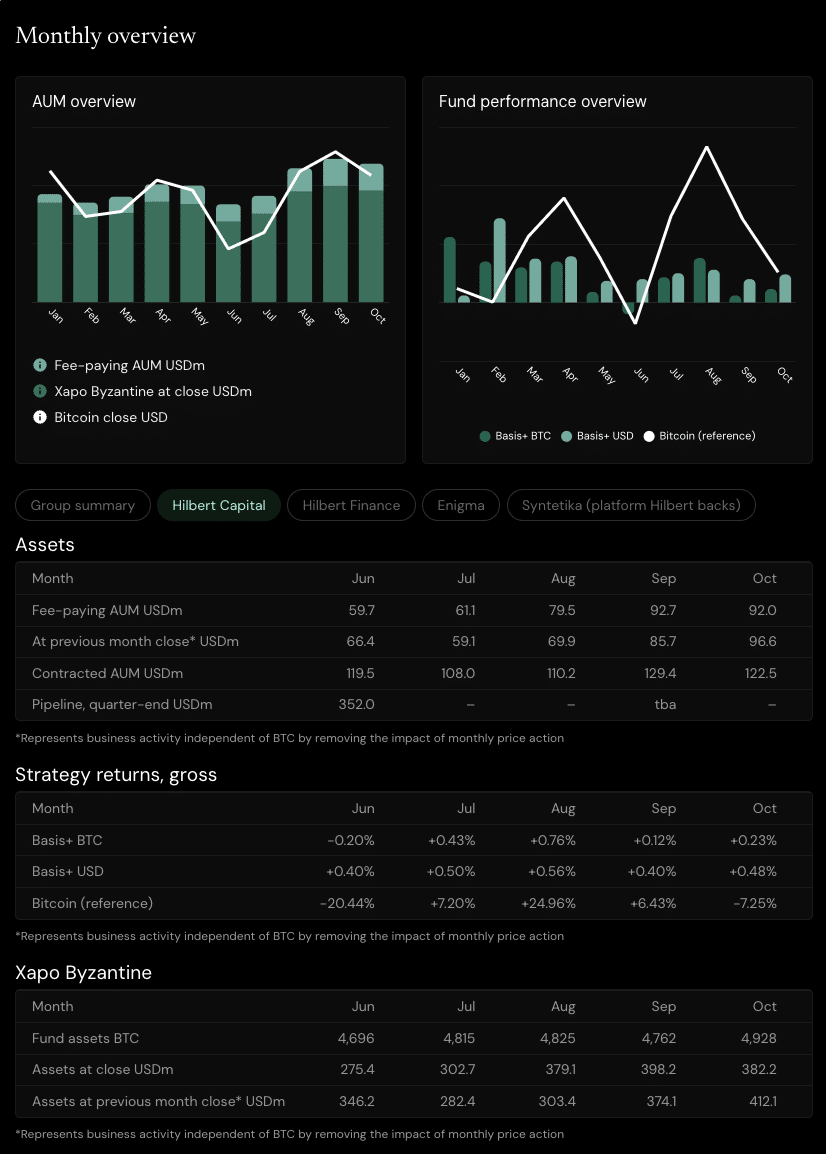
Enigma is a high-frequency trading desk which is now integrated into our Asset Management capabilities alongside proprietary trading. We bought it partly for its technology and algorithmic capability, but the bigger reason is that we see it as our product laboratory. Its first strategy for outside investors, Enigma One, opened to professional investors through Syntetika in October, and the team is developing further strategies.
Source: Hilbert Group
What is the growth strategy for Hilbert Group?
The growth strategy has two elements: monetise what is built, and be positioned for the capital that hasn’t arrived yet.
On the first: the investment phase is behind us. Hilbert Finance and Enigma are live, our strategies are available onchain through Syntetika, the platform Hilbert backs, and our focus now is turning what we have built into revenue. Each piece complements the others, so a client who comes to us for one product has more reason to stay for the next, and each mandate validates the platform in front of the next allocator.
On the second: the market is still highly fragmented, with capital sitting on the sidelines because standards, custody and structure are not yet fully mature. Standardisation will follow, and when it does, hesitant long-term investors will come in size. Everything we are doing now, the licences, the audited track record, the governance work our own shareholders pushed for, is preparation to be the manager that capital lands with when it moves.
You studied at the Birla Institute of Technology and Science. What attracted you to a career in finance?
I went to the Birla Institute of Technology and Science (BITS) for my undergraduate studies. BITS trained me to think in systems: break a problem down, build a model of it, test the model against reality. That way of thinking has a particular application in the financial markets. I discovered early on that I loved them, that they are puzzles with real consequences, quantifiable but never fully predictable, and that quantitative rigour is an edge.
What advice would you give to women in finance?
Stop waiting to feel ready, because nobody in this industry ever fully does. And dream bigger than you currently are: the barriers that shaped this industry are receding fast, and in today’s environment, bold and strategic action pays off disproportionately. Finally, become the mentor you needed, and keep the ladder down for the next one.
How do you relax outside work?
My ten-year-old daughter is my built-in stress-relief programme. It is very hard to ruminate about Bitcoin price or the Board meeting when someone is narrating her football match or is asking me to settle whether Pluto counts as a planet. She does not let me take myself too seriously. Beyond that, I am lucky to have family and friends who keep me grounded and have an unfailing ability to talk about absolutely anything except markets. And when all else fails, there is always a long walk or a workout, the two places where my phone is not invited.

NEWSLETTER SIGN UP
And receive exclusive articles on securities markets

🏆 The 2026 Global Markets Choice Awards are here! 🌍 Nominations are officially OPEN for the celebration of excellence in global capital markets trading & technology. Nominate below:
https://www.jotform.com/form/260086385121150

Delaware Life Insurance Company is becoming the first insurance carrier to offer an index that contains cryptocurrency, adding the BlackRock U.S. Equity Bitcoin Balanced Risk 12% Index to its fixed index annuity (FIA) portfolio.
As the digital assets industry pushes toward
Franklin Templeton is expanding its tokenized fund suite, signaling growing institutional demand for blockchain-based fund infrastructure and regulated investment products moving onchain. Read the full article below:
$50 billion in active ETF inflows helped fuel a record year for @BlackRock 's iShares business, as investors continue to lean into active strategies.
Shanny Basar
Senior writer
A Senior Writer at Markets Media who became a financial journalist in 2000 after working in banking for over a decade....
More about this authorRelated articles
-

This gives common clients a seamless T+0 solution for exchange-traded derivatives and listed options.
-

The Dubai office will serve as a hub for Blackstone’s Private Wealth business in the region.
-

The active ETF platform has grown to over $2bn in AUM since its debut in April 2025.
-

The future of private markets will be shaped by better data, greater connectivity and smarter workflow.
-

The European fund manager is extending tokenisation beyond cash management solutions.