






03.23.2026

S&P Dow Jones Indices said this month that it has licensed the S&P 500 to Trade[XYZ] to launch the first and only officially licensed perpetual derivatives contract based on the benchmark S&P 500 index on Hyperliquid, a decentralized trading-focused blockchain. This extends Hyperliquid’s trading of tokenized real world assets as it aims to become the “the blockchain to house all finance,” according to the Hyper Foundation.
SmartestXYZ, a crypto research entity, said in a report: “This is not mere marketing rhetoric. The strategic trajectory of the protocol—from perpetual futures dominance to spot token markets (HIP-1), automated liquidity provision (HIP-2), permissionless derivatives deployment (HIP-3), and institutional stablecoin integration—reveals a coherent roadmap toward becoming the global settlement infrastructure for all asset classes: cryptocurrencies, commodities, equities, fixed income, and exotic derivatives.”
After chatting with many teams about their development and the current state of their projects, the next @HyperliquidX House of all Finance paper is finally here.
(https://t.co/jqH8HwcyG4) pic.twitter.com/q1p9l1CigX
— G (@smartestxyz) March 15, 2026
The collaboration between S&P Dow Jones Indices and XYZ represents the first time eligible, non-US investors can gain leveraged exposure to the S&P 500 through an officially licensed, digitally native product designed for 24/7 trading on a decentralized platform. XYZ is the first and largest real world asset (RWA) market on Hyperliquid.
Collins Belton, chief operating officer and general counsel of Trade[XYZ]’s parent company, said in a statement that the firm was launched to bring the world’s most important markets onchain.
“The S&P 500 is a natural starting point,” said Belton. “Through our collaboration with S&P DJI, an S&P 500 perpetual contract is now accessible 24/7 on Hyperliquid, bringing us one step closer to that vision.”
I think S&P500 perp is the first real test of whether #Hyperliquid becomes the onchain CME for global traders or just stays a really good crypto-native venue.
right now CME S&P ADV is what, ~$200–400B notional/day.
HL doesn’t need to beat that. it just needs a tiny slice added… https://t.co/qMStiNlU0O pic.twitter.com/zfC54XvfKg
— Kaff 📊 (@Kaffchad) March 24, 2026
@Kaffchad said on X: “HL doesn’t need to beat that. it just needs a tiny slice added to the ~$100M/day it’s already doing.
even 0.5% flow = ~$1–2B daily volume
at 0.035% fee = ~$350K–700K/day
→ that’s ~$128M–255M extra annual revenue from one market and the product actually has a real MOAT with 24/7 markets, no custody risk, instant execution, global access and officially licensed S&P DJI data (not a synthetic).
#CME is closed ~40% of the year. that means every weekend macro shock, every geopolitical event, every earnings leak outside hours… HL is the only place to hedge.”
Equities add to the perpetual futures on Hyperliquid in exotic assets and commodities, including gold, silver and oil. A perpetual future is a derivative contract that allows a trader to bet with leverage on the future price of an asset without owning the asset itself, without an expiration date and that settles continuously via a stablecoin.
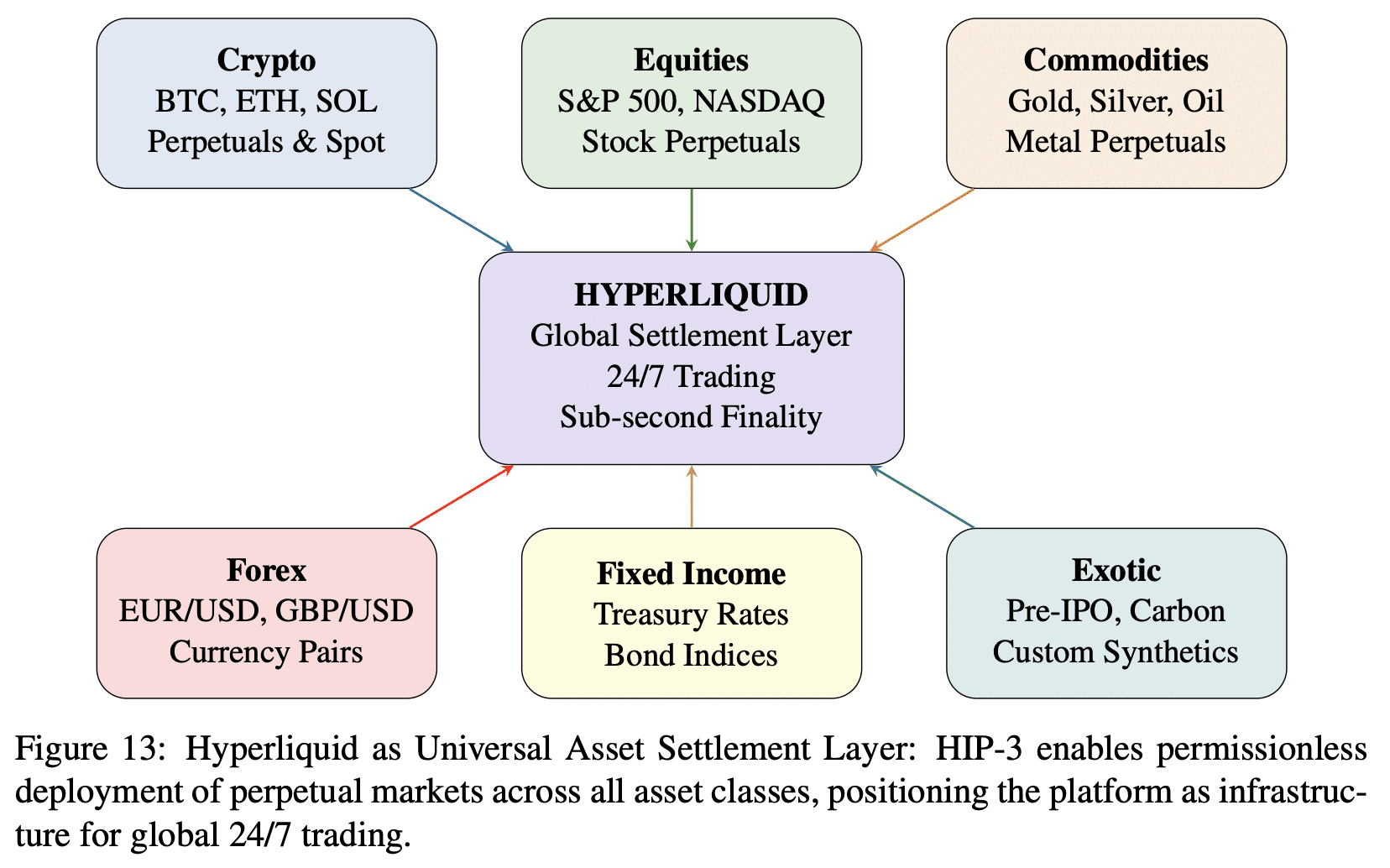
Source:SmartestXYZ
The commodities complex has risen in prominence since the US and Israel launched strikes on Iran over weekends when traditional exchanges are closed, but trading onchain is available 24/7 every day of the year. SmartestXYZ said: “The March 2026 Iran–Israel military escalation provided an unprecedented real-world validation of HIP-3’s utility. When COMEX gold and oil futures closed for the weekend, Hyperliquid became one of the only venues globally for real-time leveraged commodity price discovery.”
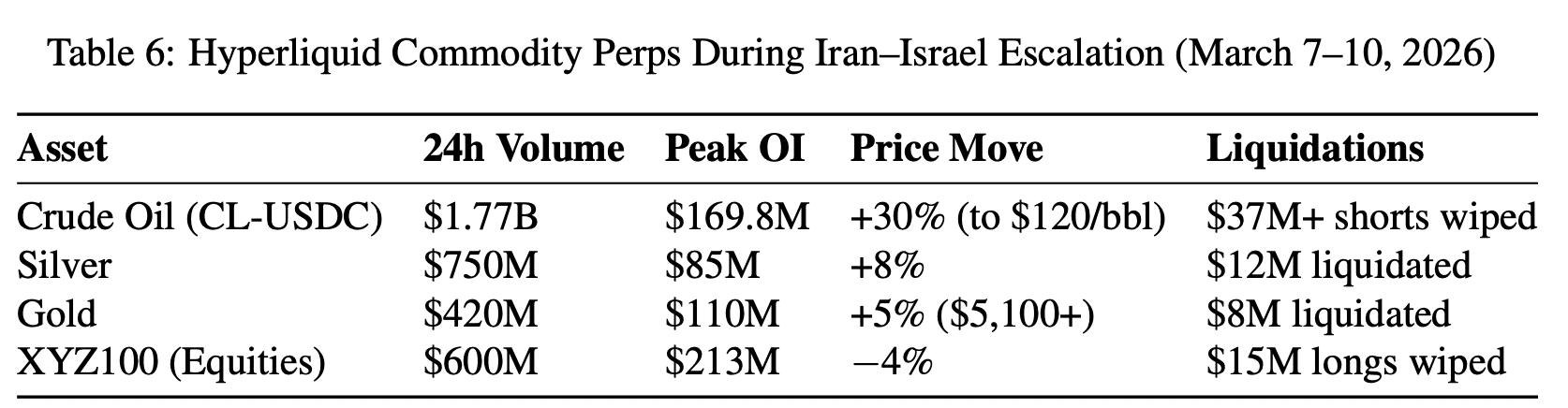
Source:SmartestXYZ
Other examples of perpetual futures on Hyperliquid include the first tradeable bond/rate perpetual onchain, which references the iShares 20+ Year Treasury Bond ETF, a basket of long-duration U.S. Treasury bonds; the first perpetual futures market for a defense sector equity as well as the imminent launch of VIX volatility perpetuals, according to SmartestXYZ.
The report said: “As of March 2026, perpetual futures account for approximately 90% of all cryptocurrency derivatives volume, with Hyperliquid alone processing over $200bn monthly.”
Hyperliquid has more than $4 trillion in cumulative perpetual futures volume, annualized revenue exceeding $1bn, and a market architecture expanding from crypto derivatives into real-world asset perpetuals, prediction markets (HIP-4), and institutional settlement infrastructure, according to the report. Last year marked a definitive inflection point in the evolution of decentralized financial infrastructure, said SmartestXYZ, as decentralized perpetual futures exchanges processed over $12 trillion in cumulative trading volume.
“This extraordinary acceleration was not merely a function of market speculation; it represented the maturation of onchain derivatives infrastructure to the point where it could credibly compete with—and in many dimensions surpass—the performance characteristics of centralized venues,” added the report.
Market structure
The report argued that Hyperliquid is at the epicenter of this transformation as it was founded by veterans of Hudson River Trading and quantitative finance who built a sovereign blockchain specifically optimized for institutional-grade trading.
For example, Hyperliquid has a fully onchain central limit order book (CLOB) with sub-second finality and institutional-grade throughput exceeding 200,000 orders per second, with architectural capacity to scale beyond 1 million orders per second. A central limit order book is the same price discovery mechanism used by traditional exchanges such as NYSE and Nasdaq, through matching bid and ask orders. Every fill, liquidation, and funding rate payment is verifiable on Hyperliquid’s public ledger and the protocol implements a cross-margining system that allows traders to increase capital efficiency, according to the report.
Risks
SmartestXYZ concluded that whether Hyperliquid achieves its full potential as the global settlement layer for 24/7 financial markets depends on execution against competitive threats, regulatory navigation, and continued technical innovation.
“However, the foundation has been laid for what could become the most significant infrastructure development in financial market history: the creation of a unified, permissionless, globally accessible system for the trading and settlement of all assets,” said the report.
Hyperliquid has experienced the HIGHEST HIP-3 24h volume day EVER
Almost $6 Billion has been traded in the last 24 hours
HIP3 markets accounted for more than 50% of Today’s Hyperliquid overall volume
Without the growth mode ON, estimated daily fees from the HIP3 markets alone… pic.twitter.com/8OxEdc894R
— x256.hl (@x256xx) March 23, 2026
The Hyperliquid Research Collective, a research hub for Hyperliquid initiated by GLC Research and Four Pillars, released the Hyperliquid 2025 Annual Report on 23 March 2026. The annual report said Hyperliquid is financially remarkable as the firm is an 11-person team with no external funding and nearly $1bn in free cash flow. However, regulatory clarity on permissionless perpetual derivatives is the single largest variable for the future.
“The road ahead is long and uncertain,” said the annual report. “Regulation will be a defining variable. Competition will intensify. The expansion into real-world assets, prediction markets, and eventually the broader financial system will test the protocol in ways 2025 could not.”
Other risks are that Hyperliquid currently operates without know your customer (KYC) requirements which restricts the platform from operating in significant jurisdictions, including the U.S. and prevents institutional adoption.
“Beyond compliance, institutions also require infrastructure that Hyperliquid does not yet fully provide: institutional-grade custody solutions, multi-signature wallet support, and the risk management tooling that asset managers and trading desks depend on to hold and trade assets at scale,” added the annual report.
We just released our Hyperliquid 2025 Annual Report.
This piece means so much to me and everyone who contributed to it. It is the best work we've ever produced, one of the most comprehensive Annual Reports a blockchain has ever had, in my opinion. I'm so proud of it and of… https://t.co/wq6nvWgL7A
— GLC (@GLC_Research) March 23, 2026
The annual report said Hyperliquid processed over $3 trillion in total trading volume and generated $907m in gross revenue in 2025, with perpetual derivatives contributing 93% of that revenue. Hyperliquid had over 50% of onchain perpetuals market share for most of the year, with open interest share more than doubling year over year. The research collective argued that the differentiator for Hyperliquid is how it scales this revenue.
“Rather than expanding headcount or vertically integrating every product, Hyperliquid functions as a liquidity and execution layer that external teams can permissionlessly plug into,” added the annual report. “This allows Hyperliquid to expand into spot trading, equity perps, RWAs, and new distribution channels without meaningfully increasing operating costs.”

NEWSLETTER SIGN UP
And receive exclusive articles on securities markets

🏆 The 2026 Global Markets Choice Awards are here! 🌍 Nominations are officially OPEN for the celebration of excellence in global capital markets trading & technology. Nominate below:
https://www.jotform.com/form/260086385121150

Delaware Life Insurance Company is becoming the first insurance carrier to offer an index that contains cryptocurrency, adding the BlackRock U.S. Equity Bitcoin Balanced Risk 12% Index to its fixed index annuity (FIA) portfolio.
As the digital assets industry pushes toward
Franklin Templeton is expanding its tokenized fund suite, signaling growing institutional demand for blockchain-based fund infrastructure and regulated investment products moving onchain. Read the full article below:
$50 billion in active ETF inflows helped fuel a record year for @BlackRock 's iShares business, as investors continue to lean into active strategies.
Shanny Basar
Senior writer
A Senior Writer at Markets Media who became a financial journalist in 2000 after working in banking for over a decade....
More about this authorRelated articles
-

The manager will expand the reach of tokenized securities via Prometheum’s regulated broker-dealer.
-

The deal represents the first OTC derivative to reference a fully tokenized index on DLT.
-

DLX gives clients a front-to-back platform for integrating tokenized assets.
-

They will bring tokenized real-world assets to NUVA, the Animoca Brands-backed vault marketplace.
-

Legal and regulatory certainty is needed for adoption to scale.