






03.18.2026

ICE has expanded its data business with the launch of a signals and sentiment tool for prediction market Polymarket and private credit intelligence with alternatives managers Apollo.
ICE said in a statement in February this year that it had launched the Polymarket Signals and Sentiment tool and will become the exclusive provider of this data for institutional capital markets. This follows ICE announcing in October 2025 that it would invest up to $2bn in prediction market Polymarket, reflecting a valuation of approximately $8bn pre-investment.
Polymarket allows users to express their views on events by buying and selling shares of potential outcomes, with every trade matched peer-to-peer through smart contracts. Markets grow in size and scale based on the number of users participating, and include financial and commodity markets.
Michael Blaugrund, strategic initiatives at Intercontinental Exchange, told Markets Media that Polymarket is the world’s largest prediction market and the most significant prediction market outside sports. The majority of activity is in economics and cultural, political events that have a significant correlation with more traditional financial markets. He said ICE was “really excited” to invest in Polymarket, not just because of the opportunity to participate in the growth of prediction markets, but also to help the prediction market bring its signals into institutional clientele.
“The smartest people on the street recognize that they will need to incorporate these signals into their investment process,” he added.

Shayne Coplan, Polymarket
Shayne Coplan, founder and chief executive of Polymarket, said in a statement that prediction markets reflect collective expectations on market-moving events in near real time and have quickly emerged as a credible input alongside traditional data sources. Coplan added: “Working with ICE helps ensure that those signals can be accessed, interpreted, and applied in a way that can be used as a resource for institutional market participants.”
Blaugrund explained that while the Polymarket team recognized the value of their data, they also recognized they did not have the right infrastructure to commercialize and distribute it globally. He said: “ICE’s data services business is able to bring this to bear very efficiently.”
The data in prediction markets is more idiosyncratic than traditional financial data, according to Blaugrund. For example, data may only last for minutes in some cases, or it may last for many years for an election that may take place in 2028. Although the data organization problem is very different from traditional financial markets, Blaugrund added that ICE’s technology framework is very flexible and allowed the data to be incorporated “quite swiftly.” ICE consumes all the Polymarket trade data, which relates to about 20,000 active markets each day, which Blaugrund said is large compared to U.S. equities, but small compared to U.S. options.
ICE has coded to Polymarket’s available APIs, normalized the content and brought it into the ICE Consolidated Feed, which Blaugrund described as bringing hundreds of global markets into a single consumable framework. He said: “Thousands of ICE data clients can code to our pipe once and get all the different markets in which they are interested.”
Near real-time access is available through the ICE Consolidated Feed, and historical time-series data can be accessed through ICE Consolidated History to support backtesting and quantitative analysis.
AI was used to aggregate, normalize and structure the data from Polymarket. It will be used to map signals either directly to specific securities or companies, or infer a relationship, which Blaugrund said is a crucial part of training the models. He gave the example of Polymarket trades last year on whether OpenAI would launch its own web browser, and Google shares dropped in price when Polymarket reached a high probability.

Michael Blaugrund, ICE
“That is something that human intelligence might predict, but we will build an automated AI signal,” said Blaugrund.
The Polymarket data is part of ICE’s recently launched Signals & Sentiment service, which also includes data and analytics from social network Reddit and news provider Dow Jones. Blaugrund said the Reddit data has only recently come to market but there is “tremendous” interest and quantitative teams at a range of investment management firms are evaluating the data.
ICE said in a blog that analysis suggested that Reddit discussions may have preceded severe price declines in gold and silver exchange-traded funds in late January and early February 2026, before the U.S and Israel made strikes on Iran. The analysis examined the correlation between social media sentiment, discussion volume, and price movements, in which signals and sentiment data was made available to clients via a stream on an ICE Feed. Sentiment is expressed as a score of between -1, extremely negative sentiment among Reddit users, and 1, which represents extremely positive sentiment.
“The sentiment data suggests Reddit discussions may have preceded the most severe price declines,” said the blog. “The sentiment deterioration appears to have begun (around January 27) before prices reached their highs (on January 31), indicating that negative shifts in retail investor psychology may have been an early warning signal of the impending sell-off.”
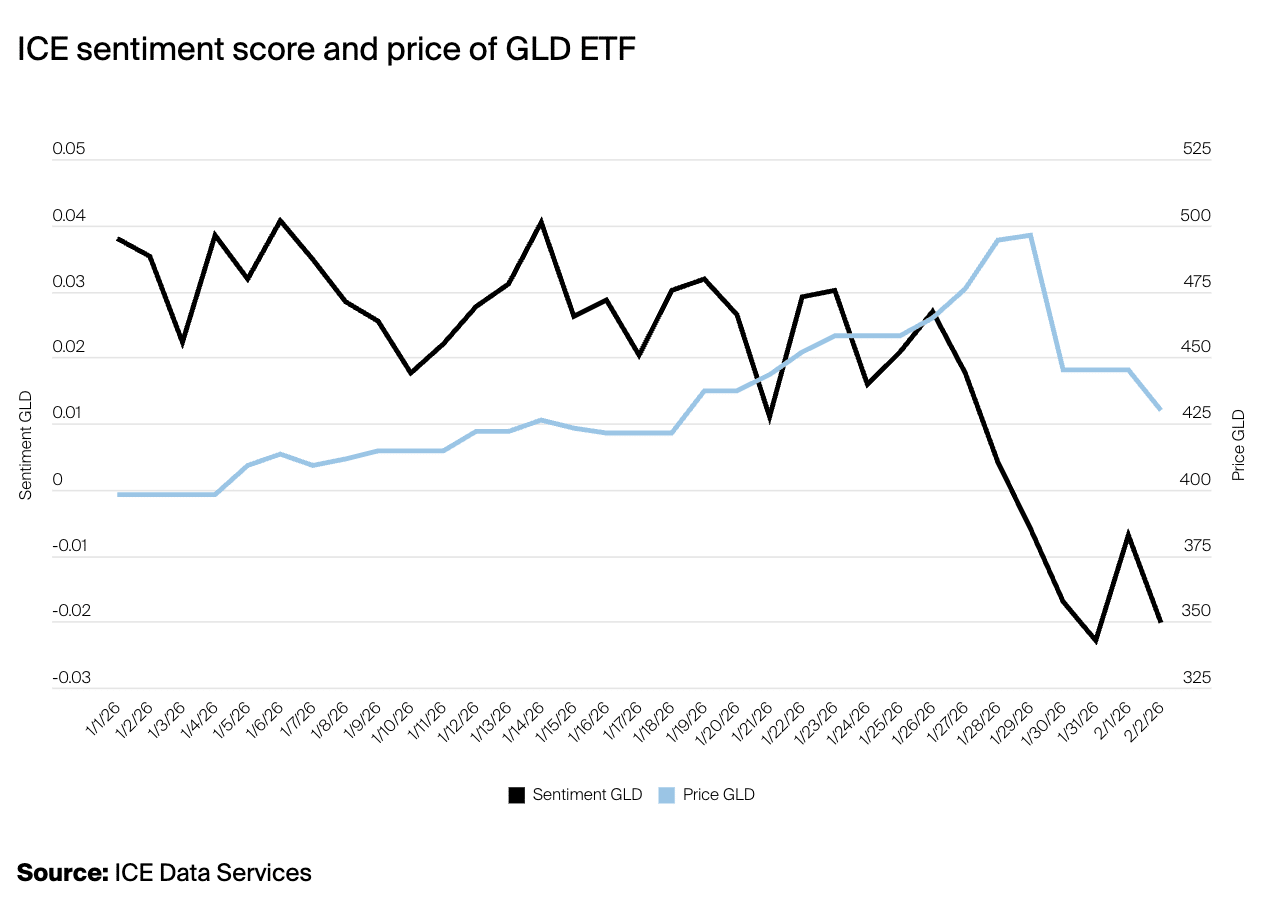
Blaugrund said: “We are always looking for new, high-impact data that we can incorporate into the broader ICE ecosystem.”
In addition, ICE is also exploring new data and analytics in its existing businesses, including the mortgage business, and weather events.
Private Credit Intelligence
On 17 March 2026 ICE said in a statement that it is launching ICE Private Credit Intelligence with alternatives manager Apollo as an anchor partner. ICE expects to onboard additional originators, asset managers and capital markets participants over the coming months.
The $40 trillion private credit market has experienced rapid growth over the last decade, but there have been concerns about the lack of transparency and a potential increase in defaults. For example, investors have been attempting to withdraw from private credit funds and there have been reports that BlackRock’s HPS Corporate Lending Fund hit its 5% redemption cap and that Blue Owl Capital has halted quarterly redemptions. JPMorgan Chase has also reportedly told private credit lenders that it has marked down the value of some loans in their portfolios.
The data infrastructure supporting private markets has not kept pace, creating a need for greater transparency, standardized data and clearer information for investors, according to ICE. The firm said ICE Private Credit Intelligence establishes a private credit data infrastructure layer that is largely consistent with the experience of public credit markets including a standardized reference data set that enables the flow of deal-level information with authorized counterparties; without exposing proprietary data broadly and scalable data distribution; and extraction from deal documents. Capabilities will be expanded over time to include performance analytics and pricing insights.

Eric Needleman, Apollo
Eric Needleman, partner and head of Apollo Capital Solutions, said in a statement: “Working with Intercontinental Exchange to develop the foundational data layer that the market has historically lacked is an important step toward improving transparency, enabling more efficient market activity and supporting the continued maturation of private credit.”
Apollo said it is also beginning to transition to more frequent pricing reporting across its credit business, as private credit increasingly serves as a core fixed income allocation replacement in investor portfolios.
Blue Owl: gating redemptions, selling assets to affiliates, quarterly marks with a two-month lag.
— junkbondinvestor (@junkbondinvest) March 17, 2026
Apollo: monthly marks, $10B in trading volume, partnering with ICE to build market data infrastructure
Two VERY different responses to the same crisis pic.twitter.com/Mm4v5DnnjY
.

NEWSLETTER SIGN UP
And receive exclusive articles on securities markets

🏆 The 2026 Global Markets Choice Awards are here! 🌍 Nominations are officially OPEN for the celebration of excellence in global capital markets trading & technology. Nominate below:
https://www.jotform.com/form/260086385121150

Delaware Life Insurance Company is becoming the first insurance carrier to offer an index that contains cryptocurrency, adding the BlackRock U.S. Equity Bitcoin Balanced Risk 12% Index to its fixed index annuity (FIA) portfolio.
As the digital assets industry pushes toward
Franklin Templeton is expanding its tokenized fund suite, signaling growing institutional demand for blockchain-based fund infrastructure and regulated investment products moving onchain. Read the full article below:
$50 billion in active ETF inflows helped fuel a record year for @BlackRock 's iShares business, as investors continue to lean into active strategies.
Shanny Basar
Senior writer
A Senior Writer at Markets Media who became a financial journalist in 2000 after working in banking for over a decade....
More about this authorRelated articles
-

The vendor partnership program is designed to expand access to direct IEX Exchange market data.
-
Global dataset provides daily, item-level pricing data to help understand the drivers of inflation.
-

ICE is actively launching AI-based tools within fixed income.
-

Apollo now applies ICE IDs to its originated credit assets.
-
Understanding whether a market move is being driven by institutions or retail is critical.