






04.01.2026

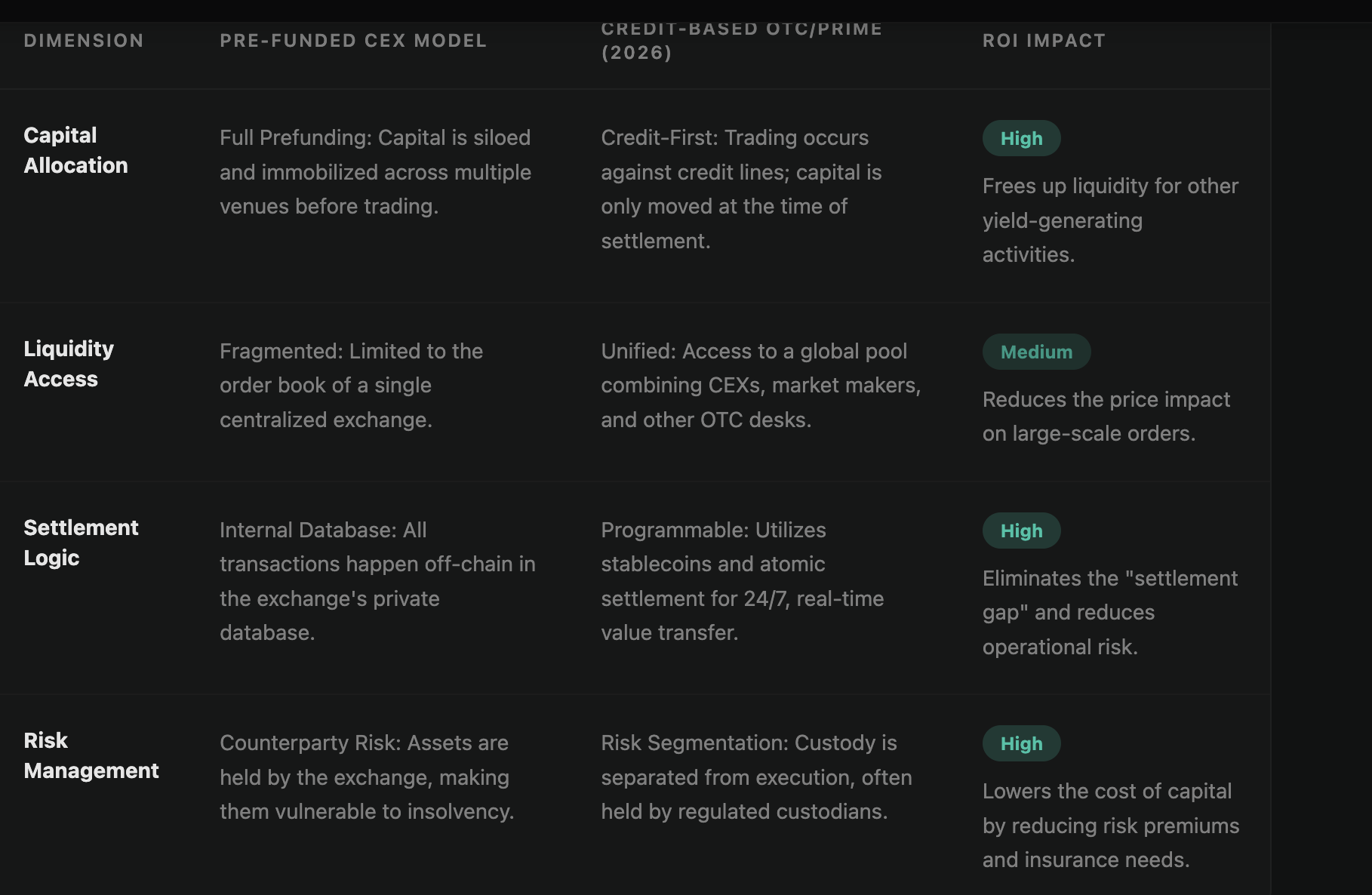
Crypto trading has traditionally relied on pre-funding transactions, which traps capital across venues. To restore capital efficiency, institutions are migrating toward credit-first execution models and T+0 atomic settlement on trade date, according to a report from Finery Markets, a crypto electronic communication network (ECN).
The report, Would Anyone Miss Banking Rails? : The Next Institutional Crypto Cycle, 2026–2030, said 2026 could be the trigger for a new institutional cycle.
“Regulation is in place, and major industry participation is real, not projected,” added the report. “Speculative growth driven by price momentum no longer delivers actual adoption; instead, use cases and infrastructure provide the scalable foundation igniting the transition to mature capital markets.”
The historical “pure” exchange model, where a customer custodies assets into an exchange’s omnibus wallet, is being rapidly dismantled, according to Finery Markets. Instead execution has been separated from custody, driven by events such as the failure of crypto exchange FTX and the institutional demands of traditional finance (tradFi).
“This forced a migration toward off-exchange custody and settlement networks,” added Finery. “Today, tier one institutions are aggressively migrating away from ‘pre-funding’ models in favor of capital-neutral execution.”
ECNs act solely as an execution layer to connect liquidity takers and market makers, while settlement happens bilaterally or via a third-party clearing or settlement layer, according to Finery. The report added: “In this new ecosystem, the venue that wins is not the one that hoards the most assets, but the one that connects the most efficiently to the rest of the stack.”
Source: Finery Markets
Finery argued there is a ‘fragmentation tax’ as prefunding requirements lock up capital at venues. In contrast, in tradFi there are sophisticated credit-check frameworks for trading with custody, clearing, and execution operating independently. Finery said this ‘Chinese Wall’ approach prevents localized defaults from causing systemic contagion.
“We believe that in 2026, the search for profitability in institutional crypto may shift from “spread-chasing” to a sophisticated focus on capital efficiency,” added Finery. “As the market matures and regulatory clarity solidifies, the reduction of the cost of capital will emerge as the most viable path to sustainable return on investment for large-scale players.”
Digital asset custody
Nearly all, 89%, of banks and asset managers exploring the tokenization of financial assets said digital asset storage and custody is a top priority, according to a survey from Ripple, the financial technology company that offers crypto solutions for businesses.
Ripple surveyed 1,000+ global finance leaders in 2026. A few things stood out: https://t.co/414dTO9Qit
→ 72% say digital assets are now table stakes to stay competitive
→ 74% see stablecoins as a cash-flow tool, not just a payment rail
→ 89% of those surveyed say digital…— Ripple (@Ripple) March 19, 2026
Ripple said early three quarters of respondents, 72%, said finance leaders must offer a digital asset solution to remain competitive. Token servicing/lifecycle management also ranks highly for banks at 82%, while asset managers place greater emphasis on primary distribution at 80%.
“This emphasis on custody extends into crypto-enabled payments adoption,” added Ripple. “Among respondents actively exploring stablecoin collections (accepting stablecoins on behalf of customers) or payments, 57% want a partner that offers integrated custody, orchestration and compliance services so they can avoid holding stablecoin balances directly.”
The Ripple survey also found that more than half of fintechs and financial institutions want a provider that offers a one-stop-shop solution, which rises to 71% among corporates. Ripple argued that managing multiple vendors across support areas introduces complexity at a time when governance standards are tightening.
“Institutions want partners capable of delivering cohesive systems that reduce integration overhead while maintaining high security and compliance standards,” said Ripple.
Post-trade
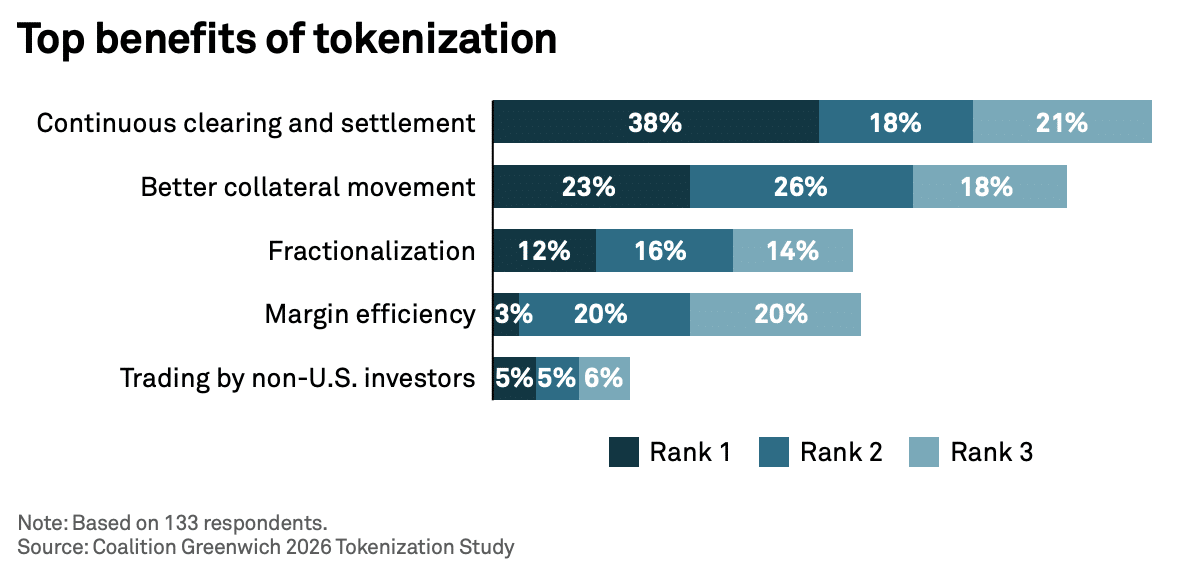
Market participants view the most powerful innovations of tokenization in post-trade operations. More than half, 55%, of respondents said continuous clearing and settlement was the biggest benefit of tokenization due to the increase in capital efficiency, according to a survey from consultancy Crisil Coalition Greenwich.
Source: Crisil Coalition Greenwich
For example, digital assets can be used 24/7 so if a firm receives a margin call over a weekend when the banking system is closed, tokenized assets can be used as collateral immediately.The report, How the capital markets feel about tokenization, cited Tradeweb recently moving U.S. Treasuries and U.K. gilts a collateral outside traditional market hours via the Canton network for repo transactions.

David Easthope, Crisil Coalition Greenwich
David Easthope, senior analyst in the market structure & technology practice at Crisil Coalition Greenwich, said in a statement: “The ability to tokenize stocks, bonds and other traditional assets, transfer them instantaneously and post them as collateral is going to be a potent force for positive change.”
The survey said fixed income will lead tokenization and one third of study participants believe the asset class will benefit the most from tokenization.
Finery Markets said in its report that adapting to a 24/7/365 infrastructure requires solving highly fragmented price discovery and a “strategic infrastructure policy” to drive back-office efficiencies.
“By integrating automated, onchain compliance, institutions can dismantle fragmented silos and radically reduce the bloated $2,598 average cost per client onboarded,” said Finery.

NEWSLETTER SIGN UP
And receive exclusive articles on securities markets

🏆 The 2026 Global Markets Choice Awards are here! 🌍 Nominations are officially OPEN for the celebration of excellence in global capital markets trading & technology. Nominate below:
https://www.jotform.com/form/260086385121150

Delaware Life Insurance Company is becoming the first insurance carrier to offer an index that contains cryptocurrency, adding the BlackRock U.S. Equity Bitcoin Balanced Risk 12% Index to its fixed index annuity (FIA) portfolio.
As the digital assets industry pushes toward
Franklin Templeton is expanding its tokenized fund suite, signaling growing institutional demand for blockchain-based fund infrastructure and regulated investment products moving onchain. Read the full article below:
$50 billion in active ETF inflows helped fuel a record year for @BlackRock 's iShares business, as investors continue to lean into active strategies.
Shanny Basar
Senior writer
A Senior Writer at Markets Media who became a financial journalist in 2000 after working in banking for over a decade....
More about this authorRelated articles
-

The firm will soon connect U.S. and global crypto derivatives into a single regulated liquidity pool.
-

The rules could codify a new designated contract market registration, a crypto asset market.
-

Crypto firms operating in the UK will be brought into full FCA regulation for the first time.
-
There is demand for institutional-grade risk management tools across high-liquidity altcoin markets.
-

Standard Chartered, Cumberland DRW were counterparties for inaugural spot crypto trade.