





04.24.2026

Ambre Soubiran is chief executive of Kaiko, which was founded in Paris in 2014 to provide institutional-grade data, analytics, and data infrastructure across centralized and decentralized digital asset markets, covering spot and derivatives trading venues globally.
Kaiko said in a statement on 23 April 2026 that it had joined ISDA, the derivatives markets association, which Soubiran said reflects the increasing integration of digital asset markets in capital markets and financial market infrastructure.
In March this year S&P Dow Jones Indices and Kaiko announced the tokenization of the iBoxx U.S. Treasuries Index, which marked the first time that a major index provider made a financial benchmark available as a native digital asset on a blockchain, with embedded index data distribution, licensing and permissioning. The two firms aim to potentially bring other indices onchain.
– Why did you leave HSBC to join Kaiko back in 2014?
My crypto journey began in 2012, while working at HSBC in Equity Derivatives and Financing Solutions. I stumbled across the Bitcoin whitepaper while reading a blog (about maths and money), which led me down a rabbit hole: first meetup, first Bitcoin, and my curiosity was piqued.
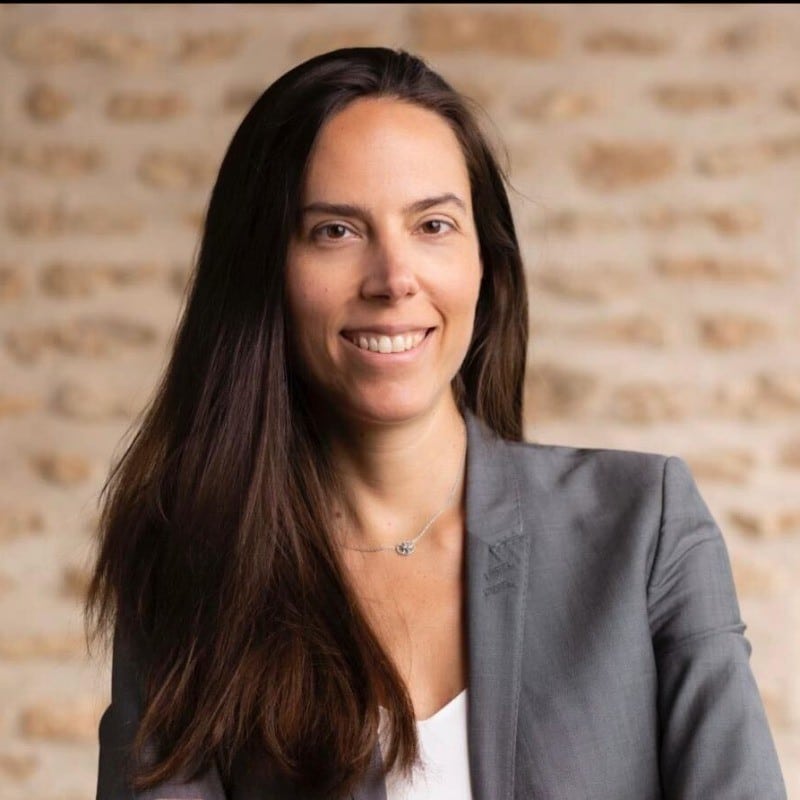
Ambre Soubiran, Kaiko
What originally hooked me was the concept of digital scarcity. When you send Bitcoin, you no longer have it. Simple, but revolutionary in the world of “digital assets”. For the first time in financial engineering, we had technology enabling true digital ownership (hard to have true ownership without scarcity). At the same time, the LIBOR scandal unfolded, which enabled me to witness first-hand the consequences of data manipulation. This event deepened my conviction that data and transparency is foundational for markets to function.
Two years later, Ethereum was launched, and I found the combination of smart contract logic with the digital scarcity and a single ‘source of truth’ database to reconcile into to be extremely powerful, and so relevant to my world of collateralized lending solutions and equity derivatives.
I believed that blockchain technology would eventually become the underlying infrastructure for capital markets to move collateral and execute contracts more efficiently. In such a future “capital markets onchain” state of the world, where smart contracts orchestrate financial workflows, my conviction was that reliable data would be absolutely critical to enable disintermediated contract execution.
In 2016, I resigned from HSBC’s Global Equity and Capital Markets team and moved back to Paris to grow and scale Kaiko. In the early years, we had no clients, no team, limited market interest, and an enormous amount of hard work. Nearly 12 years later, Kaiko has grown into the leading independent provider of cryptocurrency market data and analytics.
– What has been useful in your current role from your banking career?
Over the first decade, Kaiko acted as a trusted data provider, enabling financial institutions to understand and interact with the digital assets (originally, crypto) markets, by delivering clean and accountable market data and analytics solutions. Today, Kaiko also delivers critical data (Kaiko Indices) and infrastructure (Kaiko on/-off-ramps) to bridge traditional and digital asset markets – connecting the established global financial system with the emerging world of tokenized assets, stablecoins, and financial innovation.
Having worked in banking gave me the ability to see the potential of digital asset technology, but also to be realistic about what needs improving and what doesn’t. Seeing both sides of the coin has made it possible for me to shape Kaiko into an infrastructure that bridges legacy systems and the digital world. Without an in-depth understanding of market structure, workflows, and how investors and traders actually think, it would have been very difficult to position ourselves the way we do today.
– Why did you want to bring the iBoxx US Treasuries Index onchain? What are the benefits of putting the index onchain?
U.S. Treasuries are increasingly being brought natively onchain, with initiatives like DTCC’s move onto the Canton network being a prime example. As the underlying securities become available on blockchain infrastructure, there’s a natural opportunity to bring the index layer on top. Tokenizing the iBoxx U.S. Treasuries Index was the logical next step: making an institutional-grade benchmark available onchain so developers and counterparties can build financial products with both the index and its underlying assets on the same infrastructure.
Importantly, this isn’t just about publishing the price of the benchmark onchain. S&P Dow Jones Indices and Kaiko have tokenized the iBoxx U.S. Treasuries Index as a programmable, permissioned data asset that encapsulates index data, licensing rights, and access controls simultaneously. Licensed participants receive a token that supports the distribution of the index for integration into digital-native financial products.
The benefits are significant. Onchain distribution gives S&P DJI better auditability and instantaneous reporting on how their IP is used, compared to TradFi’s delayed volume reporting and months-long settlement cycles. The token-plus-smart-contract architecture is also composable and reusable: the wrapping can be tailored to each use case without renegotiating a new licensing schedule, which massively speeds up time-to-market. AUM and turnover tracking, which is heavily manual in traditional markets, can be verified onchain, enabling new commercial models such as daily fee collection. And with Canton specifically, reporting stays private for institutional use cases like swaps while remaining public where appropriate, simplifying distribution across both product types.
– Do you expect onchain products to be built using this index?
Absolutely. The whole purpose of tokenizing a benchmark like this is to support financial products and protocols that reference institutional-quality data directly onchain. The token itself isn’t an investable product, but it enables developers and issuers to build index-linked products – tokenized bonds, structured products, collateral systems, DeFi derivatives – that rely on a trusted benchmark accessible on distributed ledgers.
– What other indexes are you looking to bring onchain?
The iBoxx tokenized index is a proof point for what’s possible when you design a fully tokenized index that accounts for IP protection, data distribution, and fee management natively onchain. That infrastructure is extensible – it can be applied to tokenize additional indices across any asset class. Once the foundation is in place, it becomes significantly easier to move collateral from one money market fund to another, use it to refinance debt, or make a payment on time. The plumbing is what matters, and we’ve built it to scale.
– Are you seeing an increase in demand from TradFi firms for crypto market data?
Very much so, and it’s at the core of what drives Kaiko’s growth. As institutional investors and traditional finance firms explore exposure to digital assets, they face a critical need for reliable, transparent, and fully regulated market data – high-quality pricing, trading volumes, order book data, and reference benchmarks. All of this is essential for accurate valuation, regulatory compliance, risk management, market surveillance, and integration with existing trading and reporting systems.
But the demand goes beyond data itself. As traditional finance players transform their capital markets frameworks through blockchain technology and tokenization, they also need standardized data infrastructure to support these efforts. Tokenized products require the same level of pricing rigor and benchmark quality that traditional instruments demand, but delivered in formats native to onchain environments. That’s where Kaiko’s role extends beyond market data into building the foundational data infrastructure that makes institutional-grade tokenized finance possible.
– What do you see as Kaiko’s role as traditional finance and digital assets increasingly converge?
Kaiko is positioning itself as the critical bridge between traditional finance and digital asset markets. This goes beyond simply providing market data – it means delivering institutional-grade datasets, pricing feeds, analytics, and benchmarks, along with onchain data infrastructure that meets the stringent quality, compliance, and operational standards expected in regulated financial markets. At the same time, we ensure these tools are designed for the unique needs of blockchain-native finance, where smart contracts, decentralized protocols, and tokenized products require real-time, reliable, and verifiable information.
Our long-term vision is to enable a new generation of onchain financial products by supplying the data and infrastructure necessary to power smart contract based execution, settlement, and risk management directly on blockchain networks.
– What advice would you give to women who want to work in finance?
I have always been curious and passionate about the ways technology can enhance industries, especially in the fields of finance, agriculture, and medicine.
Once you find what you are passionate about, learn as much as possible. I’m an avid reader, and after graduating I kept attending courses (MOOCs) to deepen my understanding of technology, which turned out to be invaluable in seeing the potential of Kaiko while I was working at HSBC.
As my career and personal life have evolved, I’ve also learned that organisation and the ability to delegate are not just nice-to-haves; they are essential. You cannot sustain high performance without a strict routine and organisation.
– How do you relax outside work?
Since moving to New York, I’ve taken up running and swimming. But my great passion is sailing. A few years ago, I competed in a transatlantic race with my father, which was one of the most memorable experiences of my life.
Otherwise, I’m a sister to 3 brothers and 2 sisters, and a mom to three young children, so when we’re together my focus is entirely on family.
Finally, there’s nothing better than a long dinner with the people I love!

NEWSLETTER SIGN UP
And receive exclusive articles on securities markets

🏆 The 2026 Global Markets Choice Awards are here! 🌍 Nominations are officially OPEN for the celebration of excellence in global capital markets trading & technology. Nominate below:
https://www.jotform.com/form/260086385121150

Delaware Life Insurance Company is becoming the first insurance carrier to offer an index that contains cryptocurrency, adding the BlackRock U.S. Equity Bitcoin Balanced Risk 12% Index to its fixed index annuity (FIA) portfolio.
As the digital assets industry pushes toward
Franklin Templeton is expanding its tokenized fund suite, signaling growing institutional demand for blockchain-based fund infrastructure and regulated investment products moving onchain. Read the full article below:
$50 billion in active ETF inflows helped fuel a record year for @BlackRock 's iShares business, as investors continue to lean into active strategies.
Shanny Basar
Senior writer
A Senior Writer at Markets Media who became a financial journalist in 2000 after working in banking for over a decade....
More about this authorRelated articles
-

Private credit is evolving toward the pricing, data & market making infrastructure in established markets.
-

This builds on recently launched ICE IDs for private credit instruments.
-

There is growing interest in prediction markets from quant research teams, macro & systematic hedge funds.
-

Financial institutions are funding the provider of data services for 24/7 onchain finance.
-

Braid offers an AI-native data transformation platform.