






10.07.2026

Man Group, the alternative investment management firm, has released its own multi-model AI harness, the software infrastructure around large language models that connects them to the tools, systems, memory and execution environments needed for AI agents to act.
Robyn Grew, chief executive of Man Group, said in the results statement: “In today’s markets, clients are consolidating their relationships with a smaller number of highly capable, strategic partners who can help them manage complex risk and growing macroeconomic uncertainty,” added Grew. “The quality of our people and our technology means we are well placed to capture that shift.”
The fund manager reported record assets under management of $253.6bn in its half year results as at 30 June 2026. The UK-listed hedge fund said it will continue to invest in scaling credit, quant equity, and multi-strat capabilities.

Robyn Grew, Man Group
In its results Man Group also said it would accelerate its AI transformation by embedding cross-functional agentic workflows across the firm that drive tangible value for clients and shareholders. In February this year Man Group announced a partnership with AI company Anthropic to work collaboratively on the design and application of AI at the fund manager. The primary focus of the partnership is to harness AI for alpha generation by unlocking potential new investment insights from data.
Antoine Forterre, chief financial officer and chief operating officer at Man Group, said there are around 450 engineers in the business and over 200 quants.
“Almost half of our population is very quant savvy, and over the years that DNA has seeped through our entire organization,” he added. “Demand for engineering talent is as strong as it has been and we see AI as a way to enhance our talent.”
Forterre spoke at Bloomberg’s Enterprise Data & Technology Summit in London on 29 September 2026. He continued that the fund manager started with machine learning techniques years ago, and then developed its own GPT tool, a type of artificial intelligence model three to four years ago, which was then anchored on OpenAI’s GPT model.
Last month Man Group released its own multi-model AI harness.
“The benefits, first and foremost, are that as a leading alternative investment manager we have to deliver quality alpha for clients,” said Forterre. “Secondly, we have to do this in the most efficient way, and make sure that all our resources are diverted to the first objective.”
It took years of work to build a front end that enables safe, agentic work across an individual and team level, according to Forterre. Users can build agents that are permissioned for teams, with permissions lastingh from a few days for simple tasks to infinite days, and schedule actions and data flow.
Data is critical to this process and Forterre said the firm ensures its data is as ready as possible for AI. He stressed that being able to use the unstructured metadata of the firm has a large impact, such as the 30- 40 year research history that Man. Group has in France. He said: “If you have that available, you can then train the engines as a way to supplement human judgment.”
Some of the more advanced discretionary portfolio managers in Man Group are reinventing their processes with agentic means, which gives them the ability to cover more names, access more data and be more active, according to Forterre. Quant teams are also reinventing their research and evaluation processes, and operations is testing agent-to-agent workflow with an external administrator and an external custodian to allow more automation.
For example, a discretionary manager who covers European mid-cap stocks has codified all the decisions that he has made over the last five years. Every time he met a new company he would write notes, key questions, assumptions, and the feedback would then be fed into his thesis. The manager has built an agentic process, which pulls structured and unstructured data, and suggests questions to ask management.

Antoine Forterre, Man Group
“This has enabled him to cover double the amount of stocks and he has had the best performance for the last year,” added Forterre. “This sample is too small to be completely definite, and this may not be purely because of AI, but it is a concrete example of how someone has advanced their workflow and processes in a way that benefits clients.”
In another example, a discretionary credit team uncovered a change to a credit facility using AI tools they built, and which Forterre said a human might not have spotted because the information was in the footnotes of an annual report. He added: “That got them digging and they uncovered important new information they should have got from management.”
As chief financial officer, Forterre has also asked AI models to analyse Man Group’s results and ask questions. He said: “We eat our own cooking. The questions that I got from the AI tools that our teams have developed are really detailed and relevant.”
Forterre stressed that guardrails are critical and Man Group spends a lot of time thinking about safety through governance and education, and controlling access through its Gen AI policy. He argued that AI can elevate human judgment.
“We are trying to capture the best judgement for our clients, so we can generate more profits and resources to redeploy in the business,” said Forterre. “We will invest more, rather than less, because we are a growing business and we have to invest to support that growth.”
Source: Citi/CREATE-Research
Innovation
A report from Citi/CREATE-Research, Upping the Innovation Game in the Asset Management Industry, said AI and GenAI are emerging as new drivers of productivity and value creation with promising use cases emerging in front, middle and back offices, as fee compression has intensified the need for developing new revenue streams. A quote in the report from an interview said: “Innovation is about harnessing corporate memory by promoting an ideas-sharing culture.”
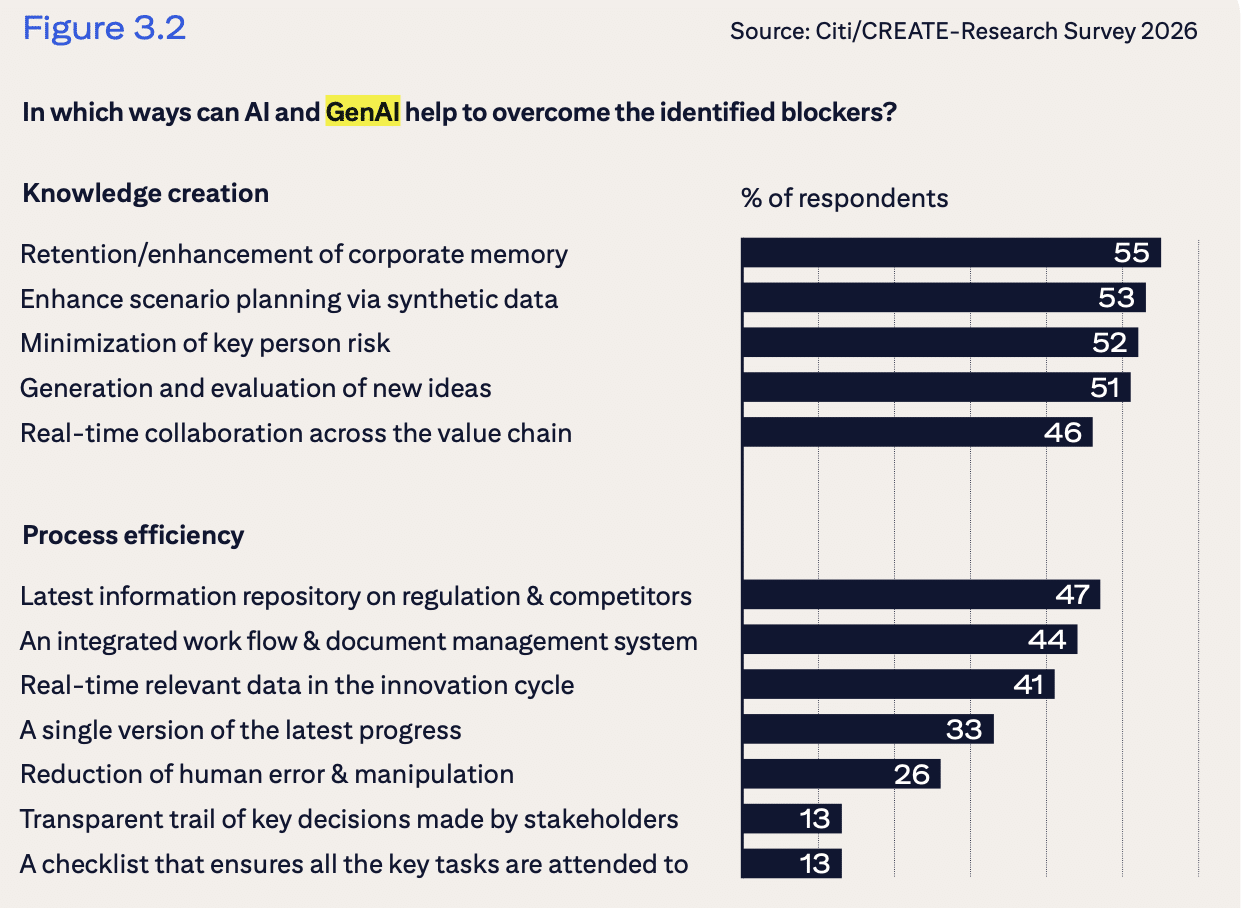
The report found that the most widely cited benefit from the use of AI and GenAI is the retention and enhancement of corporate memory (55%) – the accumulated body of knowledge, experience, data, and documentation that an organization accumulates over time, covering its history, decisions, and culture.
“It acts as a collective brain, allowing companies to learn from past successes and failures, and ensuring continuity and progress,” added the report.
The study said this process of continuous learning enables asset managers to generate and evaluate new ideas (51%), promotes real-time person-to-person collaboration across the value chain (46%) and minimizes key person risk, which was all too prevalent in the star culture of the past (52%).
Source: Citi/CREATE-Research
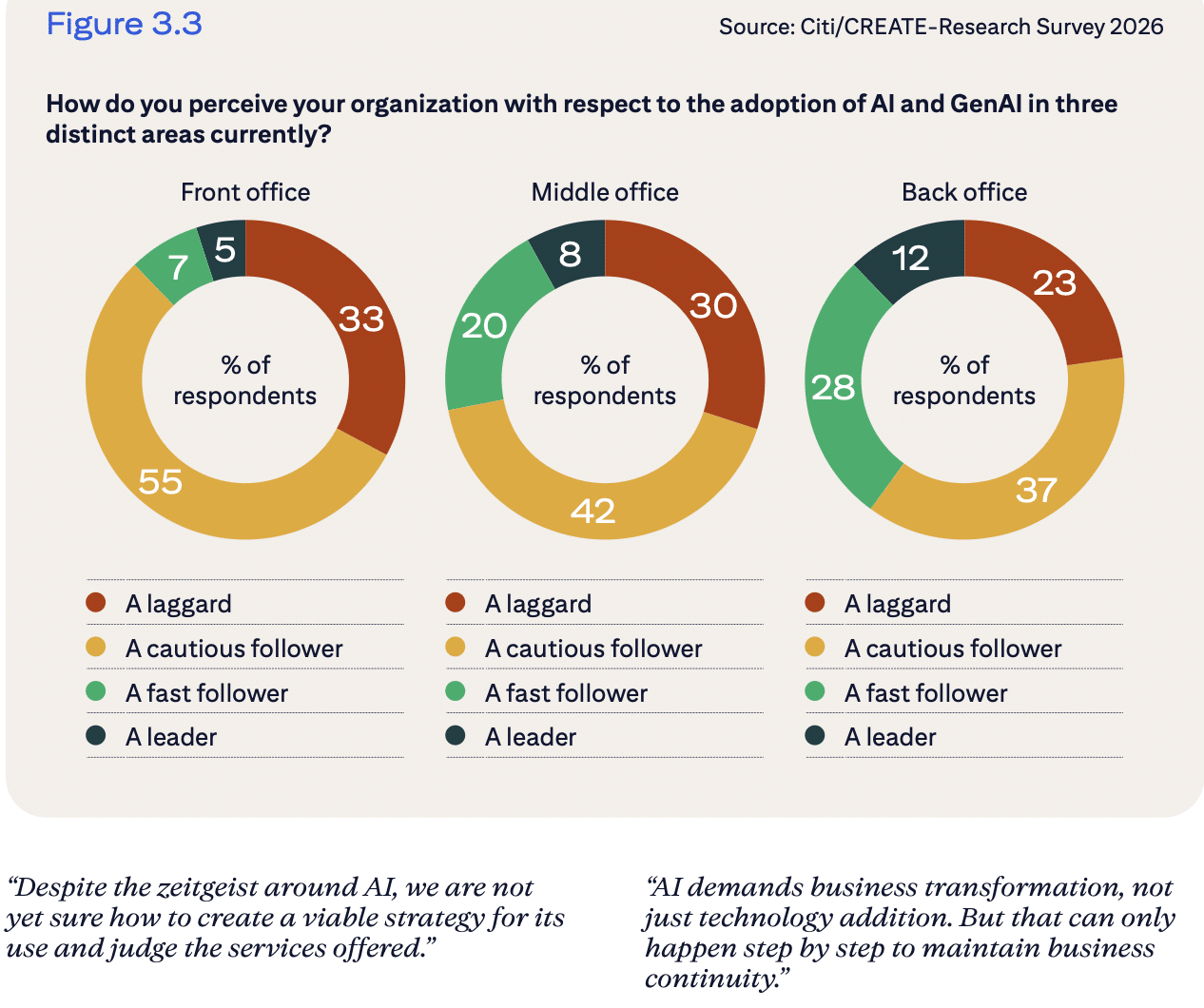
However, the report also said the asset industry, as a whole, is still at an early stage of adoption of AI and GenAI and adoption is more advanced in back-office routine activities.
“The use in front office activities is far more gradual – in portfolio management, research, trading and client relations,” said the report. “These vital activities have hitherto constituted managers’ core competency delivering maximum added value.”

NEWSLETTER SIGN UP
And receive exclusive articles on securities markets

🏆 The 2026 Global Markets Choice Awards are here! 🌍 Nominations are officially OPEN for the celebration of excellence in global capital markets trading & technology. Nominate below:
https://www.jotform.com/form/260086385121150

Delaware Life Insurance Company is becoming the first insurance carrier to offer an index that contains cryptocurrency, adding the BlackRock U.S. Equity Bitcoin Balanced Risk 12% Index to its fixed index annuity (FIA) portfolio.
As the digital assets industry pushes toward
Franklin Templeton is expanding its tokenized fund suite, signaling growing institutional demand for blockchain-based fund infrastructure and regulated investment products moving onchain. Read the full article below:
$50 billion in active ETF inflows helped fuel a record year for @BlackRock 's iShares business, as investors continue to lean into active strategies.
Shanny Basar
Senior writer
A Senior Writer at Markets Media who became a financial journalist in 2000 after working in banking for over a decade....
More about this authorRelated articles
-

The efficiently of pricing will matter for the credibility of pre-IPO perpetual futures.
-

There is an opportunity to fund the next phase of growth, but it will not stay open indefinitely.
-

Financial institutions are increasingly using AI in specialized workflows.
-

Years of LSEG tick history can be analysed in seconds rather hours.
-

FSB highlighted risks including volatility in sovereign bonds, private credit and AI.