






01.29.2026

Adena Friedman, chair and chief executive of Nasdaq, said the firm aims to launch trading for 23 hours from Monday to Friday on its stock exchange in the second half of 2026, subject to regulatory approval.
Nasdaq announced plans to launch 23×5 stock trading in 2025. Friedman said on the results call on 29 January 2026 that the firm will be ready to launch the capability in the second half of this year, subject to regulatory approval.

Adena Friedman, Nasdaq
“Pending SEC approval, the launch of 23×5 trading on the Nasdaq stock market will broaden the investor base even further around the world,” she added. “It’s an exciting time to be in the markets business, no doubt about it.”
Friedman continued that Nasdaq is also driving industry efforts to realize the potential of digital assets across multiple initiatives, including its application to trade tokenized securities.
The purpose of Nasdaq’s regulatory filing is to ensure that tokenized equities are integrated into existing infrastructure and to maintain resiliency. She argued that resiliency is critical as the U.S. has the deepest, most liquid markets in the world which operate at enormous scale. Nasdaq manages between three and five million messages per second ,and from 80 to 100 billion messages every day, with an average latency of less than 20 microseconds. Friedman said blockchain technology cannot currently match these characteristics.
Nasdaq believes tokenization is a good technology that will eventually transform the ability to move money around the world and to manage collateral more flexibly. At the same time, the industry should focus on investor protection, issuer choice and maintaining the integrity of markets.
“Our tokenization filing is meant to be working with the infrastructure providers like DTCC, other transfer agencies, and our market participants to allow for equities be tokenized at the CUSIP,” said Friedman.
A CUSIP is a unique nine-character code that identifies North American financial securities. Using the same CUSIP gives investors the choice of whether to settle the same stock in a tokenized or a traditional form, which allows for fungibility and interoperability.
“We have a mandate to focus on bringing liquidity together,” Friedman added. “We care about making sure that investors have a complete view of the trading of any sort of equity, whether it is tokenized or not, and that they completely understand the risks and benefits of what they are trading.”
Therefore she argued that the NMS (national market system), which currently regulates U.S. equities trading, should be maintained. ln addition, there is a lot of netting in equities markets which makes trading affordable for market participants and she said this efficiency needs to be preserved.
“The one area that we are focused on is capital efficiency is collateral movement as assets are trapped in clearing houses and clearing brokers,” she added. “We see a real opportunity, and in five years time money could be moving across the world in tokenized form.”
Market Services
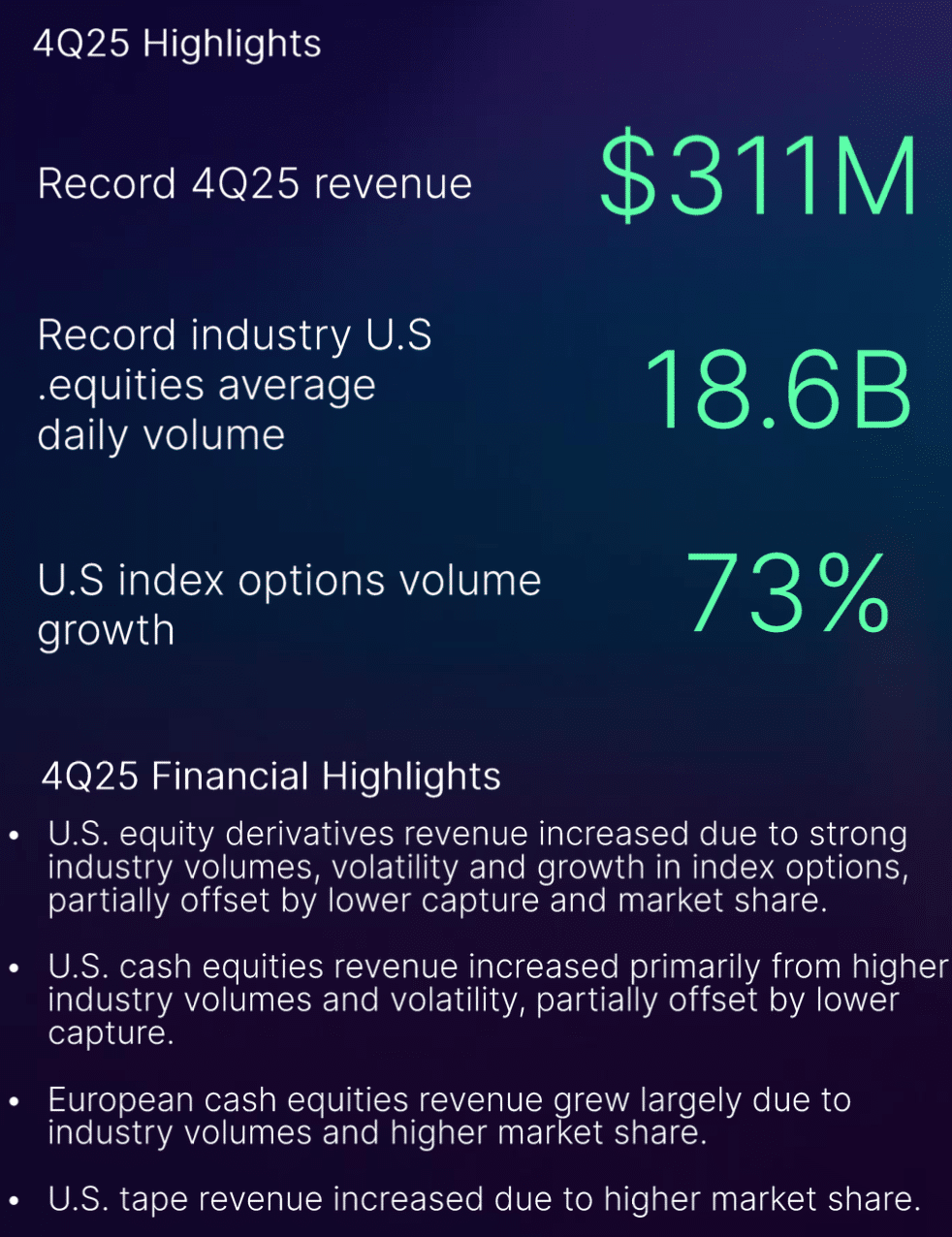
Market Services reported record annual net revenue of $1.2 billion, up 17% year-over-year. This was fueled by elevated volumes in the U.S. equities and U.S. equity options, according to Friedman, and robust performance in European cash equities and equity derivatives. In particular, there has been an increase in ETFs with an options overlay.
Source: Nasdaq
“There is a broadening of the investor base in retail for equities markets, and of retail and institutional in the options markets,” she added. “This is reflective of a structural shift in the interest that investors have for public equities, which is terrific.”
Despite the increase in equities trading revenues, the share of off-exchange trading has been growing in the U.S. Regulations do not currently allow Nasdaq to buy an alternative trading system (ATS) because it is an exchange.
“Allowing us to have the flexibility to have an ATS as part of our solution for our clients, and being able to tap into more of the off-exchange trading is a real interest of ours,” said Friedman. “We believe the SEC is going to provide a more flexible framework for that.”
In the fourth quarter index options revenue more than doubled year-over-year for a second consecutive quarter, according to Friedman, and Nasdaq grew market share in European equities.
The U.S Securities and Exchange Commission recently approved expanded options expirations in some of the MAG 7 names for Monday, Wednesday, Friday, which Friedman said had been launched this month
“Clients are very happy that they have more choice to manage risk more precisely and more accurately,” she added. “We see early uptick, and that is really exciting.”
Capital access platforms had 10% revenue growth for the year, which Friedman said driven by record index inflows, new IPOs and strong growth in data and analytics.
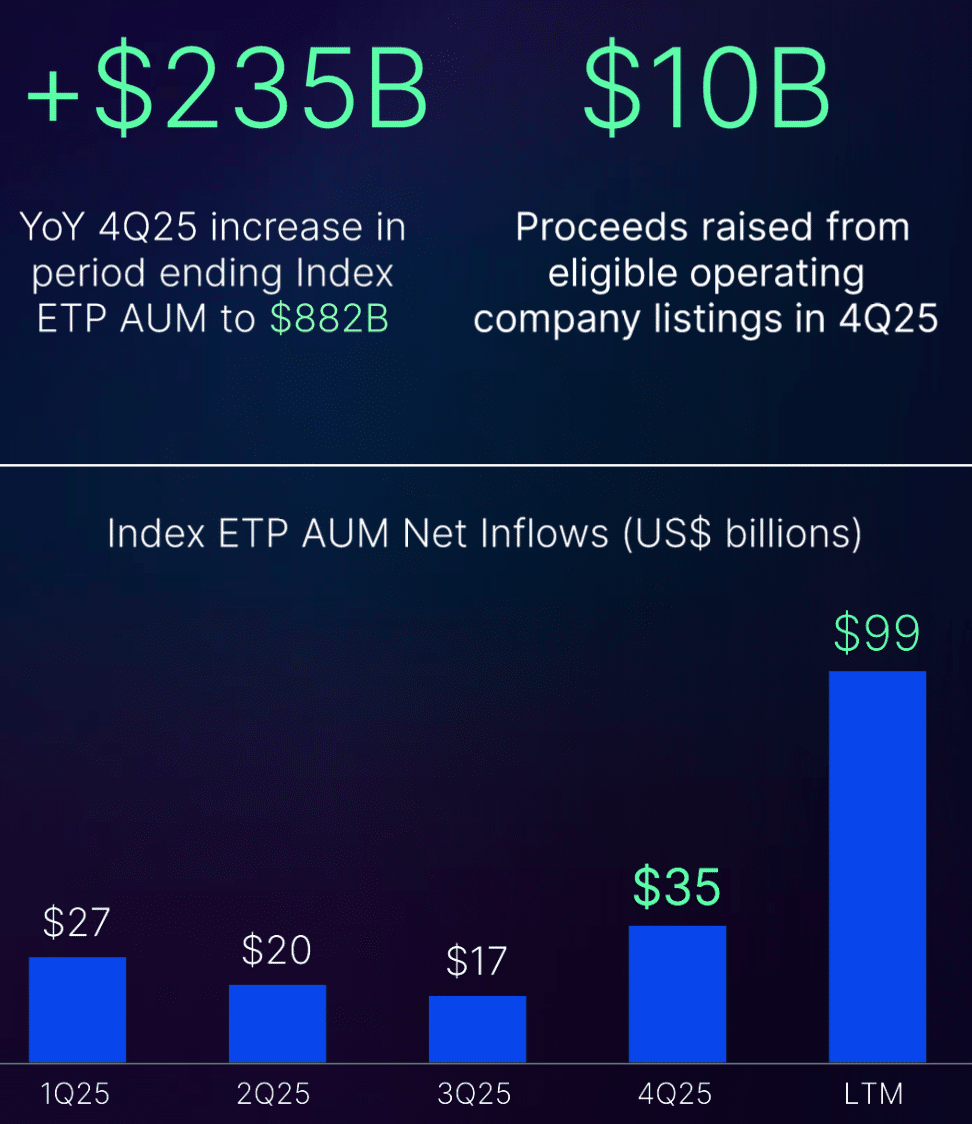
Nasdaq had “industry-leading” new listings performance and a record $1.2 trillion in listing transfers, the strongest year ever for its switch program, according to Friedman. The listings business had the strongest IPO year since 2021 with eligible operating companies raising over $24bn, including over $10bn in just the fourth quarter.
“Looking ahead to 2026 we see signs of accelerating capital markets activity, further supported by recent Fed cuts and a very healthy pipeline of late stage private companies,” added Friedman. “Based on the current market dynamics, we look forward to an active new issuance year.”
Nasdaq also expanded the distribution of its private market data. In a partnership with London Stock Exchange Group, Nasdaq will provide eVestment private markets datasets for delivery through the LSEG platform. Another partnership with Juniper Square will make eVestment institutional intelligence available through Juniper Square’s fundraising platform which reaches more than 2,000 private market general partners.
Source: Nasdaq
Index business
Friedman said the index franchise is an “exceptional growth engine” as it reached record average assets under management. The business had its second consecutive year of record inflows and introduced the highest number of new index products in its history.
The index business had a record $99bn in net inflows over the last 12 months, including a record $35bn in the fourth quarter. At the end of 2025, assets under management of exchange-traded products reached an all-time high of $882bn.
In new products, the business launched 122 new products in 2025 including 60 international products and 32 in the institutional insurance annuity space.
Financials

Sarah Youngwood, Nasdaq
Sarah Youngwood, chief financial officer at Nasdaq, said on the results call that the firm delivered over $5bn in annual revenue for the first time. She said: “This reflected strength across the business and performance that met or exceeded our outlook expectations in every division.”
Net revenue for 2025 was $5.2bn, a 12% year-on-year increase, and operating income grew 16% to $2.9bn over the same period.
In financial technology Youngblood said Nasdaq remains on track to surpass $100m in run rate revenue from cross sells by the end of 2027.

NEWSLETTER SIGN UP
And receive exclusive articles on securities markets

🏆 The 2026 Global Markets Choice Awards are here! 🌍 Nominations are officially OPEN for the celebration of excellence in global capital markets trading & technology. Nominate below:
https://www.jotform.com/form/260086385121150

Delaware Life Insurance Company is becoming the first insurance carrier to offer an index that contains cryptocurrency, adding the BlackRock U.S. Equity Bitcoin Balanced Risk 12% Index to its fixed index annuity (FIA) portfolio.
As the digital assets industry pushes toward
Franklin Templeton is expanding its tokenized fund suite, signaling growing institutional demand for blockchain-based fund infrastructure and regulated investment products moving onchain. Read the full article below:
$50 billion in active ETF inflows helped fuel a record year for @BlackRock 's iShares business, as investors continue to lean into active strategies.
Shanny Basar
Senior writer
A Senior Writer at Markets Media who became a financial journalist in 2000 after working in banking for over a decade....
More about this authorRelated articles
-

This combines Citadel Securities’ deep liquidity and execution with Wolfe’s research.
-

ICE acquired a stake in OKX in March.
-

National Stock Exchange of Australia is aiming to roll out a new technology platform from Aquis Exchange.
-

The SEC issued an innovation exemption allowing new venues, TSVs, to trade tokenized NMS stocks.
-

Issuer Sponsored Token Coalition believes the issuer & shareholder relationship should be preserved.