






03.09.2026
Nasdaq’s First Private Market Index Suite is ‘Milestone’
03.09.2026
Nasdaq launched its first suite of private capital indexes as there is increased demand for data and transparency in the asset class.
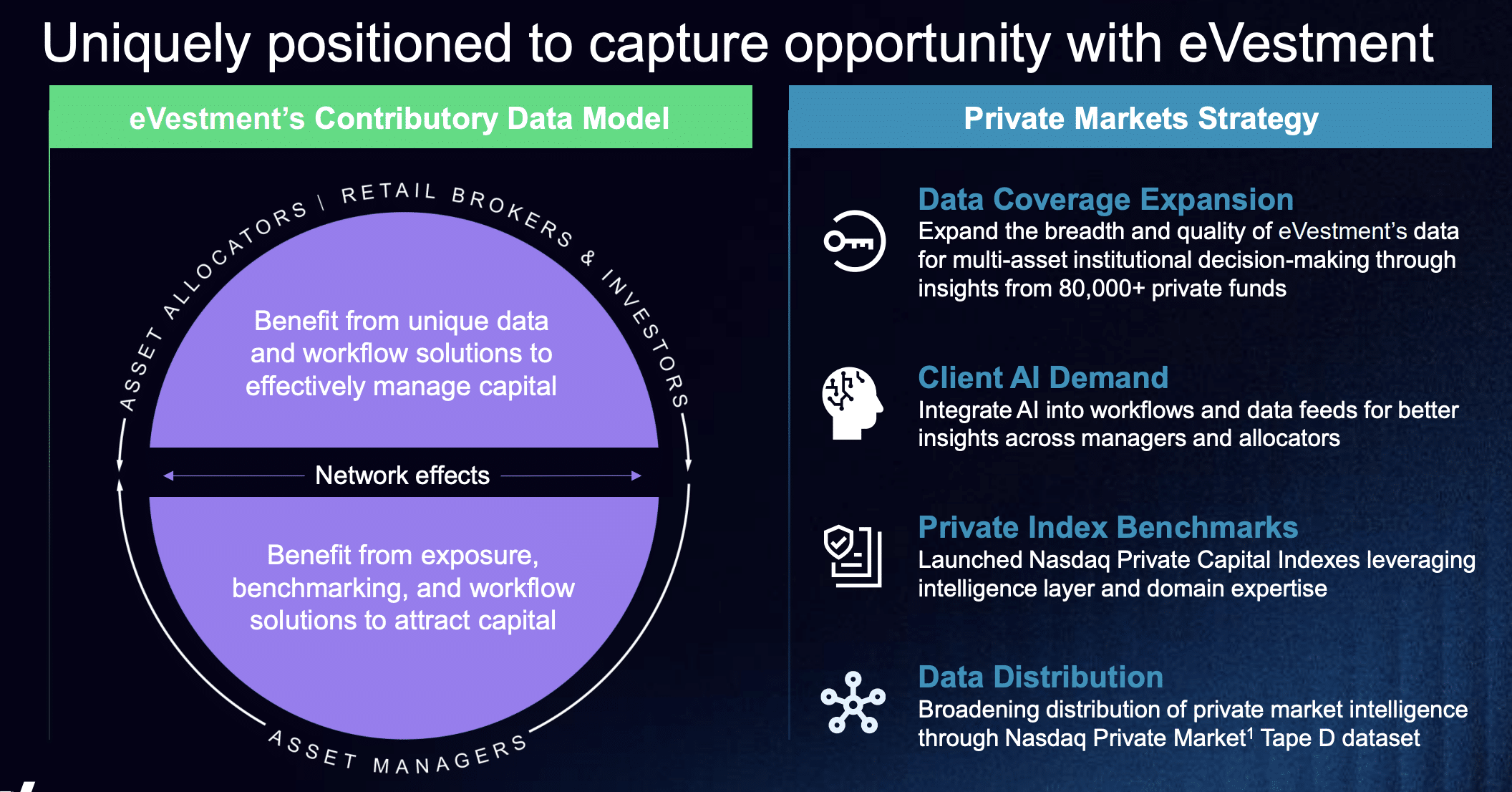
The group said the launch of the index suite marks the next phase in the evolution of Nasdaq Private Capital Solutions, the platform which unifies private capital indexes, eVestment fund and deal benchmarking, and the eVestment TopQ+ Analytics platform. Oliver Albers, chief product Officer, capital access platforms at Nasdaq, said in an email to Markets Media that the group’s first dedicated suite of private capital indexes represent an important milestone in its broader private markets strategy.
Albers argued that Nasdaq has a long history of building trusted benchmarks and market infrastructure across public markets and the launch reflects the reality that private markets have matured into a core allocation for institutional investors, without the same level of standardized measurement and transparency. The Nasdaq Private Capital Indexes are designed to address that gap by bringing institutional‑grade index construction, governance, and methodology into an asset class that has historically relied on fragmented benchmarks.

Oliver Albers, Nasdaq
“Importantly, we see this as more than a standalone index launch,” Albers added. “It’s a foundational step in the continued expansion of Nasdaq Private Capital Solutions, connecting data, transparent benchmarks, analytics, and workflow integration into a unified platform.”
The indexes are constructed from more than 14,000 institutional private market funds that represent more than $11.4 trillion in global assets under management sourced from Nasdaq eVestment’s limited partner (LP) reported dataset, including public‑sector and institutional disclosures where applicable. LPs are institutional or high-net-worth investors who invest in private asset funds. The suite spans aggregate private capital as well as private equity, buyout, venture capital, private debt, fund of funds and real estate strategies.
“That distinction is important,” said Albers. “By grounding our indexes in limited partner-reported data, we deliver unbiased, representative coverage and consistent insight into how institutional capital is deployed across private markets.”
Source: Nasdaq
Demand
As private equity, private credit, and real assets have grown in scale and importance, asset owners and consultants have been asking for better tools to measure, compare, and govern private market exposure. Many institutions have been forced to rely on public proxies, narrow peer groups, or bespoke datasets that do not fully reflect private market realities such as vintage effects, dispersion, or strategy‑level differences, according to Albers.
Data has also become increasingly important as there have been signs of distress in certain private credit funds. For example, there have been reports of redemption requests from the Blackstone Private Credit Fund (BCRED) and thay BlackRock has limited redemptions in its HPS Corporate Lending Fund.
Nasdaq has been consistently hearing that there is a need for decision‑ready intelligence, benchmarks that are representative, transparent in how they are built, and usable within existing investment and reporting workflows.
“The launch of these indexes is a direct response to that demand, providing a more consistent and defensible way to evaluate private capital performance across strategies and regions,” added Albers.

Source: Nasdaq
The private market been pushing to attract retail investors and the U.S. administration has signed as executive order to allow 410k retirement plans to include private assets. This is a tectonic shift that will require greater data availability, clearer reporting, and more robust transparency which creates an increased revenue opportunity for private markets data and benchmark providers, according to research provider Cerulli Associates.
Tayfun Icten, senior analyst at Cerulli, said in a statement: “As asset classes and strategies mature from niche offerings into mainstream investment options, investors increasingly demand stronger transparency, better benchmarking, and more robust data to support their decisions.”
Icten continued that in this rapidly shifting landscape, the race is not merely about who has the data, but who can integrate it, interpret it, and transform it into actionable investment products. He said: “As private markets continue their march toward retail, the firms that succeed will be those that best connect these pieces into a seamless, transparent, and scalable ecosystem.”
Growth
Albers argued that rather than offering a point solution, Nasdaq is building an ecosystem where private market data and benchmarks can be used consistently across research, portfolio construction, governance, and client reporting.
“Nasdaq’s role in the ecosystem is fundamentally different,” said Albers. “We focus on data, benchmarks, analytics, and market infrastructure, delivering institutionally governed tools that investors and consultants rely on to make informed decisions.”
The index launch is one step in a longer‑term strategy, according to Albers. Nadaq’s focus is on expanding coverage, analytics, and integrated workflows, while maintaining rigorous standards around data quality, transparent methodology, and governance.
“That includes broadening index coverage across strategies, vintages, and regions; enhancing analytics that support real investment and governance decisions; and deepening integration across Nasdaq Private Capital Solutions,” he added.
A key part of the strategy is delivering workflow‑enabled solutions that reduce friction between general partners (GPs) who manage funds and LPs, improving data consistency, transparency, and efficiency across reporting, benchmarking, and analysis. By embedding private market data and benchmarks directly into institutional workflows, Nasdaq aims to help make these markets more efficient for all participants.
“Delivery through platforms such as Nasdaq eVestment TopQ+, Nasdaq Global Index Watch, and our broader data licensing channels ensures clients can access benchmarks and insights directly within the tools and processes they already use,” he added.

Gianluca Biagini, LSEG
For example, in November last year Nasdaq licensed Nasdaq eVestment private markets datasets to the London Stock Exchange Group. LSEG will distribute the dats through LSEG Workspace and datafeeds.
The combination brings together LSEG’s editorial and transactional data on private companies with Nasdaq’s fund performance and LP insights, creating a comprehensive solution for GPs, LPa and advisors.
Gianluca Biagini, group co-head, data & analytics at LSEG, said in a statement: “By integrating Nasdaq’s datasets with LSEG’s existing capabilities, we are creating a best-in-class solution that serves the entire private market ecosystem. Together, we will provide richer content, deeper data coverage, and tools that empower our clients to make informed decisions.”

NEWSLETTER SIGN UP
And receive exclusive articles on securities markets

🏆 The 2026 Global Markets Choice Awards are here! 🌍 Nominations are officially OPEN for the celebration of excellence in global capital markets trading & technology. Nominate below:
https://www.jotform.com/form/260086385121150

Delaware Life Insurance Company is becoming the first insurance carrier to offer an index that contains cryptocurrency, adding the BlackRock U.S. Equity Bitcoin Balanced Risk 12% Index to its fixed index annuity (FIA) portfolio.
As the digital assets industry pushes toward
Franklin Templeton is expanding its tokenized fund suite, signaling growing institutional demand for blockchain-based fund infrastructure and regulated investment products moving onchain. Read the full article below:
$50 billion in active ETF inflows helped fuel a record year for @BlackRock 's iShares business, as investors continue to lean into active strategies.
Shanny Basar
Senior writer
A Senior Writer at Markets Media who became a financial journalist in 2000 after working in banking for over a decade....
More about this authorRelated articles
-

Pyth Data Marketplace adds a channel built for software and blockchain-native destinations.
-

The vendor partnership program is designed to expand access to direct IEX Exchange market data.
-
Global dataset provides daily, item-level pricing data to help understand the drivers of inflation.
-

ICE is actively launching AI-based tools within fixed income.
-

Apollo now applies ICE IDs to its originated credit assets.