






03.30.2026

Northern Trust is aiming to launch servicing for exchange-traded funds this year as the growth of ETFs is expected to continue and more mutual funds are looking to enter the space
Phil Nanof, head of ETF Services, Americas at Northern Trust joined the firm in December 2024 to build the new capability. Northern Trust already services ETFs in Europe and Asia Pacific so Nanof told Markets Media that this is an extension of what the firm does “very well” today.

Phil Nanof, Northern Trust
He told Markets Media: “We are investing significantly in the build out of proprietary infrastructure to support the unique aspects of U.S. ETFs.”
Nanof said ETFs continue to benefit from some very powerful structural and regulatory tailwinds. Assets invested in U.S. ETFs reached a record $14.3 trillion at the end of February this year, surpassing the previous high of $13.9 trillion in January 2026, according to ETFGI, the independent research and consultancy firm. In February this year net inflows were $192.3bn, bringing year‑to‑date net inflows to a record $359bn.
“There is a lot of innovation with over 1,000 ETFs launched last year in the U.S. and there is no indication this will slow down,” Nanof added.
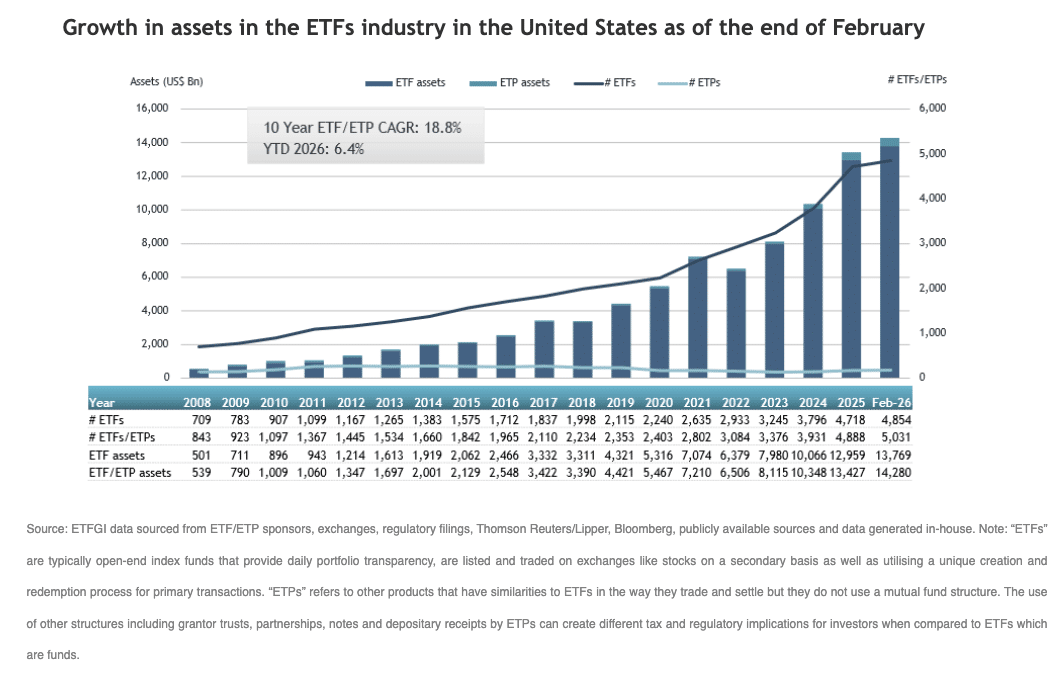
Source: ETFGI
Northern Trust’s strategy of launching U.S. ETF servicing is fundamentally about supporting existing mutual fund clients as they expand into ETFs. They want to use the same service model and operational discipline they trust, according to Nanof. He said the business is having a number of conversations with existing asset management clients who are not yet in the ETF space.
“Our timeline, in terms of going live, depends upon our clients’ ability to get themselves ready,” said Nanof. “I am optimistic that we will be live in the U.S. in the third quarter.”
ICE ETF Hub
In March this year Northern Trust said in a statement it had entered into an agreement with Intercontinental Exchange to use the ICE ETF Hub as the order‑taking platform for its U.S. ETFservicing capability.
ICE ETF Hub provides a secure, scalable technology infrastructure that streamlines ETF primary market workflows and connects directly with authorized participants, market makers, distributors, and other essential participants in the ETF ecosystem.
Creating and redeeming ETFs requires the negotiation of large baskets of securities between issuers, authorized participants and market makers. Historically, the processes for custom negotiations were extremely manual with market participants using a combination of phone, email, chat or spreadsheets to agree to baskets. The need to manually copy and paste data led to errors and made the process take much longer.

Peter Borstelmann, ICE
Peter Borstelmann, president of ICE Bonds, said in a statement: “Following a playbook that ICE has used since its founding of moving markets from analog to digital, the ICE ETF Hub, with over $5 trillion in order notional processed since inception, was designed to standardize and automate the ETF creation and redemption process to provide workflow efficiencies and connectivity that ETF issuers and service providers can rely on,”
Nanof described integrating ICE ETF Hub as a key component of the U.S. ETF servicing strategy. He said the collaboration is an important step in deploying Northern Trust’s end‑to‑end, fully automated ETF servicing solution that spans fund administration, custody, and transfer agency.
“Partnering with ICE gives us immediate scale, credibility and connectivity across the ecosystem,” he added. “This would not have been an option 10 years ago but ICE did a great job partnering with other ETF service providers, particularly authorized participants to develop a central utility relatively quickly.”
Growth prospects
Northern Trust’s asset manager clients are listening to their investors who want to access their strategies, particularly active strategies, via ETFs. Nanof said: “More than 80% of ETFs launched last year were actively managed, so there is no better time to do this.”
The 2026 Global ETF Investor Survey from financial services group BBH found that two thirds, 66%, of investors prefer active management over passive in the next 12 months. Nearly all, 94%, think active ETFs will reach $10 trillion in assets within 10 years, equating to an expected annual growth rate of 20%.
In March this year Dimensional Fund Advisors launched the US Micro Cap ETF, the first actively managed share class ETF in the U.S. The ETF is a share class of the firm’s first fund, the US Micro Cap Portfolio, which launched as a mutual fund in 1981 to use a systematic approach to investing in the smallest stocks in the U.S.
“The launch of the ETF share class for mutual funds in the U.S. also means we are very well positioned to meet and anticipate client needs,” added Nanof. “We are doing this at a time when mutual funds and ETFs are coming together so we can build a support model that suits this convergence.”
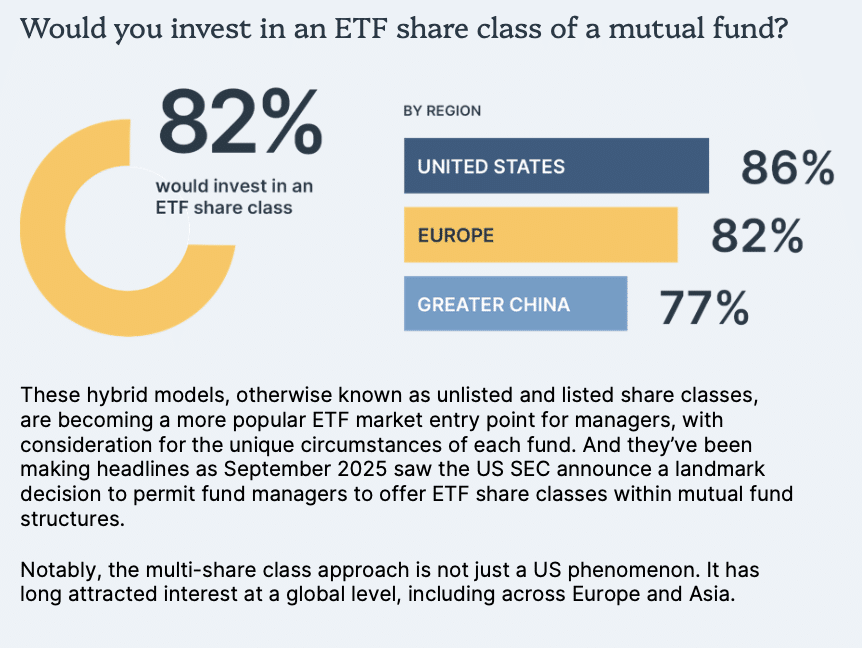
Source: BBH
Nanof acknowledged that Northern Trust is entering a competitive market for U.S. ETF servicing. For example, State Street was appointed as service provider for Dimensional Fund Advisors’ ETF share class structure. He argued that Northern Trust’s differentiator is its client-centric approach.
“There is a tried and true playbook for those coming late to a space, which is making a significant capital investment, hiring experience and building something that clients are asking for, and that is what we are doing,” he said.
Northern Trust is establishing a team in Boston, which Nanof said has significant ETF experience that complements the existing servicing teams and relationships as clients are looking for common practices, simplification, governance and oversight. He added: “We are a bolt-on SWAT team of ETF experts.”
The business believes there are opportunities with asset managers in the $2bn to $20bn range who may be looking for differentiation and a better client experience. Although the team is focused on the U.S., Northern Trust will look at ways to harmonize its global operating models and technology.
“This was a great opportunity to build something new to handle the scale and the complexity of the U.S. ETF market,” added Nanof. “Once we demonstrate our expertise with clients we will be able to compete for more global, and more complex, mandates from managers looking for a single service provider.”

NEWSLETTER SIGN UP
And receive exclusive articles on securities markets

🏆 The 2026 Global Markets Choice Awards are here! 🌍 Nominations are officially OPEN for the celebration of excellence in global capital markets trading & technology. Nominate below:
https://www.jotform.com/form/260086385121150

Delaware Life Insurance Company is becoming the first insurance carrier to offer an index that contains cryptocurrency, adding the BlackRock U.S. Equity Bitcoin Balanced Risk 12% Index to its fixed index annuity (FIA) portfolio.
As the digital assets industry pushes toward
Franklin Templeton is expanding its tokenized fund suite, signaling growing institutional demand for blockchain-based fund infrastructure and regulated investment products moving onchain. Read the full article below:
$50 billion in active ETF inflows helped fuel a record year for @BlackRock 's iShares business, as investors continue to lean into active strategies.
Shanny Basar
Senior writer
A Senior Writer at Markets Media who became a financial journalist in 2000 after working in banking for over a decade....
More about this authorRelated articles
-

This is the investor's first allocation to a tokenised financial asset.
-

Clients get automated access to real-time banking data and payment capabilities.
-

Asset managers are looking for a single partner to deliver services across both mutual funds and ETFs.
-

This helps shift onboarding from days to hours, and in some workflows, minutes.
-

BNY's Global Head of Asset Servicing said the sector is central to the future of finance.