






03.02.2026
‘Onchain Venues Stepped In’ When TradFi Venues Were Closed
03.02.2026
The United States and Israel launched joint strikes on Iran on Saturday 28 February when traditional exchanges were closed over the weekend, but onchain markets continued to trade.
Tom Wan, head of data at Entropy Advisors, which advises on crypto rail architectures, said on X: “That’s a $104 premium the market couldn’t see until Monday. That’s why we need tokenization, and more assets will be moved onchain.”
US-Iran war breaks out on a Saturday. CME is closed.
$120M traded in tokenized gold on Ethereum that weekend. Gold held $5,400 onchain, while in TradFi, Gold price stayed the market close price, $5,296.
That's a $104 premium the market couldn't see until Monday. That's why we… pic.twitter.com/jKTkoZBZJN
— Tom Wan (@tomwanhh) March 2, 2026
OxResearch, a newsletter from Blockworks, highlighted that safe-haven assets reacted immediately to news of the military action over the weekend and “onchain venues stepped in while Comex slept.” Comex is the futures and options venue owned by CME Group for trading metals including gold, silver, and copper.
Perpetual futures in silver and gold also trade on onchain exchanges, Hyperliquid and Binance. Perpetual futures are derivatives that have no expiration date and have contributed to asset price discovery across crypto spot and derivatives markets, with funding rates indicating market sentiment.
Under normal conditions perpetual futures trade on Hyperliquid and Binance at a slight discount to Comex, according to OxResearch.
“This is structural: Comex prices reflect front-month futures with the cost of carry embedded, while perps track closer to spot,” added the newsletter. “Against that backdrop, the weekend divergence becomes more telling.”
When news of the attacks on Iran broke, both exchanges reacted sharply but OxResearch said Hyperliquid consistently priced metals higher than Binance. Gold and silver traded at median premiums of 75 basis points and 78 basis points on Hyperliquid versus Binance. The divergence suggests traders on Hyperliquid were pricing in significantly more geopolitical risk than those on Binance, according to the research.
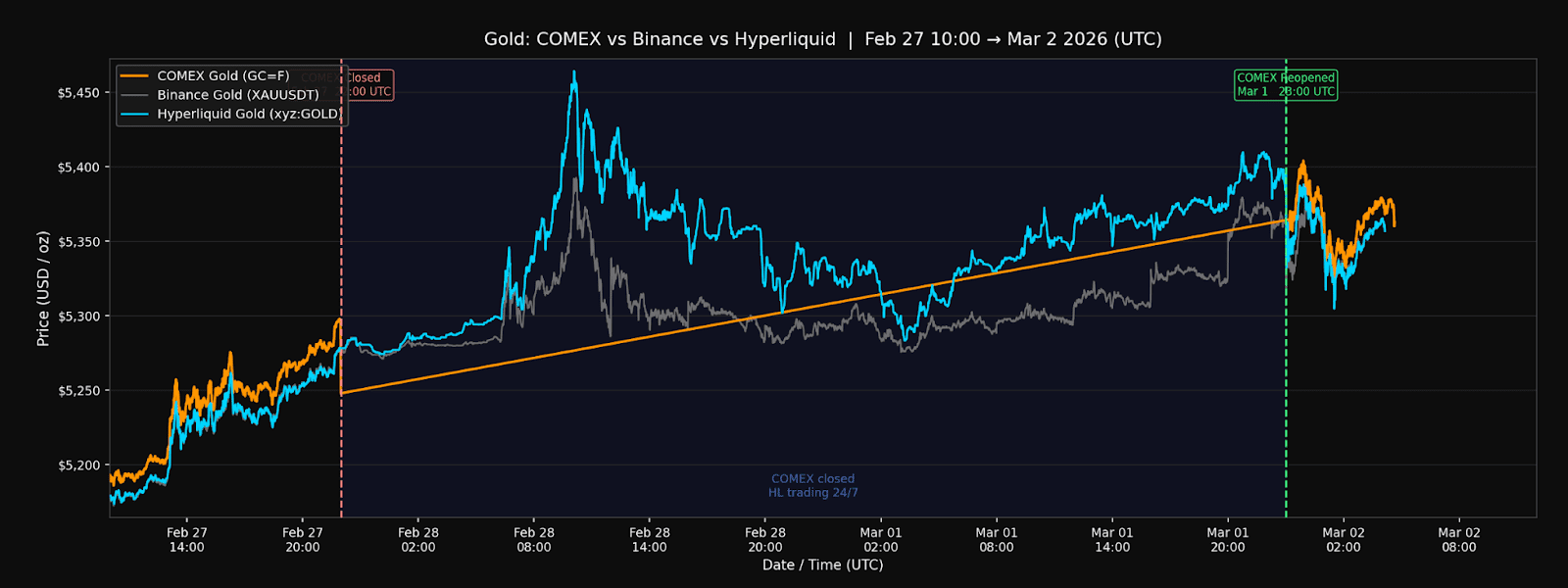
Source: OxResearch
When Comex reopened on Monday 2 March, gold and silver prices on Hyperliquid were closer to Comex by 22 basis points and 31 basis points despite Binance having more volume, according to OxResearch.
“In other words, Hyperliquid’s weekend pricing proved to be the more accurate predictor of where traditional markets would reopen,” added the newsletter. “With comparable open interest and closer alignment to Comex reopen levels, Hyperliquid is increasingly proving to be the venue where real risk gets priced first.”
Sam Gaer, chief investment officer of Monarq Asset Management and former chief information officer at Nymex, said on X: “Price discovery and risk transfer — two of the most important functions an exchange performs — for gold, silver, and oil during the most consequential geopolitical event of 2026 did not occur on the CME, NYMEX, or ICE. They occurred on Hyperliquid. A permissionless, on-chain perpetual futures exchange priced risk and facilitated hedging in real time while every traditional venue with a market cap above $20 billion was dark.”
Gaer said that at Nymex, the world’s largest physical commodity exchange, he led the team that implemented the migration from open outcry to electronic trading, was instrumental in Nymex’s 2006 IPO and the subsequent $9bn sale to CME in 2008. He described Nymex’s migration to electronic trading as “one of the most consequential infrastructure projects in the history of derivatives markets,” and argued that onchain transition is the same structural story.
With this weekend's events — U.S. strikes on Iran, oil spiking, gold repricing — I published a note internally to our team and clients that I think captures something important about where exchange infrastructure is headed.
The thesis is simple: while hundred-year old TradFi… https://t.co/PG5HBb57q6
— Sam Gaer (@samg67) March 2, 2026
“Permissionless access democratizes participation beyond the gatekept membership model,” he added. “24/7 operation eliminates the temporal constraints that leave trillions in assets unhedgeable for 37% of every week.”
In addition, Gaer argued that onchain transparency replaces opaque benchmarks with auditable order books.
“And just as electronic trading drove volume and profitability explosions for the exchanges that embraced it, on-chain infrastructure is already generating nearly $1 billion in annualized fees for Hyperliquid — at margins that exceed anything in traditional exchange economics,” said Gaer.
Days like today make you wonder why finance isn’t open on weekends
I’m sitting next to a macro guy discussing Iran strikes. While he’s speculating what markets will do on Monday I pull up Hyperliquid’s oil perp
+5% @ $86
Brain melted. Yeah – 24/7/365 tokenized commodity… pic.twitter.com/L6rUDT1flD
— Santiago R Santos (@santiagoroel) February 28, 2026
Santiago R Santos, founder and managing partner of Inversion Capital, which acquires and transforms traditional businesses with blockchain, said on X: “Brain melted. Yeah – 24/7/365 tokenized commodity trading is going to explode.”
Bloomberg just used on-chain oil prices as the reference for their iran risk coverage.
Not CME. Not NYMEX. But Hyperliquid.
Price discovery doesn't wait for Monday open anymore. https://t.co/r7x2ZLncQC
— Magnus.hype (@0xmagnus) March 2, 2026

NEWSLETTER SIGN UP
And receive exclusive articles on securities markets

🏆 The 2026 Global Markets Choice Awards are here! 🌍 Nominations are officially OPEN for the celebration of excellence in global capital markets trading & technology. Nominate below:
https://www.jotform.com/form/260086385121150

Delaware Life Insurance Company is becoming the first insurance carrier to offer an index that contains cryptocurrency, adding the BlackRock U.S. Equity Bitcoin Balanced Risk 12% Index to its fixed index annuity (FIA) portfolio.
As the digital assets industry pushes toward
Franklin Templeton is expanding its tokenized fund suite, signaling growing institutional demand for blockchain-based fund infrastructure and regulated investment products moving onchain. Read the full article below:
$50 billion in active ETF inflows helped fuel a record year for @BlackRock 's iShares business, as investors continue to lean into active strategies.
Shanny Basar
Senior writer
A Senior Writer at Markets Media who became a financial journalist in 2000 after working in banking for over a decade....
More about this authorRelated articles
-

100% of open interest from Nasdaq Clearing has migrated to Euronext Clearing.
-
One-third of the interdealer broker's clients actively traded energy transition products last year.
-

This transforms BGC into the world’s premier energy, commodities and shipping broker.
-
It is the first traditional interdealer broker to integrate physical & derivatives trading in the segment.
-
In August the LME made its new trading platform available in the production environment for testing.