




11.04.2026
Perpetuals Could Increasingly Set Prices in Underlying Market
11.04.2026
The high leverage, hedging activity and automatic liquidations of perpetual futures could increasingly influence underlying prices and amplify volatility, according to TD Bank, as the Commodity Futures Trading Commission allowed these contracts on individual equity securities to begin trading for the first time on CFTC-registered exchanges.

Michael Selig, CFTC
Perpetual futures are contracts without an expiration date that track the spot rate of the underlying asset through a floating funding rate. Earlier this year, the CFTC approved the listing of the first true bitcoin perpetual futures contract on a CFTC-regulated exchange. On 3 November 2026 Mike Selig, chairman of the CFTC, said in a statement that this approval was extended into traditional securities, in particular, individual equities.
TD Bank said in its Global Market Structure Commentary for October 2026 that market makers commonly hedge their perpetual positions in the underlying markets and collect funding as a risk-free premium. Therefore, the Canadian bank argued that perpetuals and the leverage they offer will affect institutional investors by impacting prices and increasing volatility.
Perpetuals are heavily traded by retail investors, who make up about 20% of U.S. equity volumes, especially in more leveraged products, according to TD Bank. In addition, all major contracts available today automatically liquidate positions when margin falls below the required level.
“Given the billions in notional traded overseas, the arrival of these products onshore could lead to dramatic price moves and feedback loops around major news events,” added TD Bank. “Lastly, there is significant potential for a tail-wagging-the-dog effect, with these derivatives increasingly setting prices in the underlying market.”
As perpetuals expand across equity indexes and single stocks, TD Bank expects institutions and portfolio managers to increasingly address their implications for trading and portfolio management.

Jamie Selway, SEC
The report highlighted that Jamie Selway, trading and markets director at the Securities and Exchange Commission, discussed that multiple venues want to offer single stock perpetuals in the U.S. and said he expects them to launch in this quarter. The bank also noted that while issuers can object to their stock being tokenized by third parties, they do not appear to have a similar right to opt out of perpetuals, as is also the case with leveraged single stock ETFs.
The CFTC approval of U.S perpetual contracts comes as Intercontinental Exchange has announced plans to build a new regulated market and clearing structure on the Hyperliquid blockchain with TradeXYZ, the largest provider of perpetual contracts on real world assets on Hyperliquid.
TD Bank highlighted that the details and operations of this new venue remain unclear. For example, ICE could establish a new regulated venue for U.S. participants or it could act as a gatekeeper, conducting know-your-customer and anti-money laundering checks for U.S. participants seeking access to certain overseas markets.
“We are skeptical of this gatekeeper approach because it would give retail investors direct access to participants who have not undergone KYC or AML checks,” added TD Bank. “Major reports have described substantial market manipulation, spoofing and wash trading on Hyperliquid, with no meaningful protections or recourse.”
Equity index perpetual futures
In October Kalshi launched two U.S. equity-index perpetuals modeled on the S&P 500 and Nasdaq-100, although the prediction market cannot use the official index names because of licensing issues, according to TD Bank. The report said maximum leverage available on these products rose quickly and now exceeds 25x, with no real limit in sight.
“However, leverage is set at the account level and could theoretically be higher, as disclosures remain unclear,” added TD Bank. “This also raises questions given that Kalshi operates its own proprietary trading unit on their own platform.”
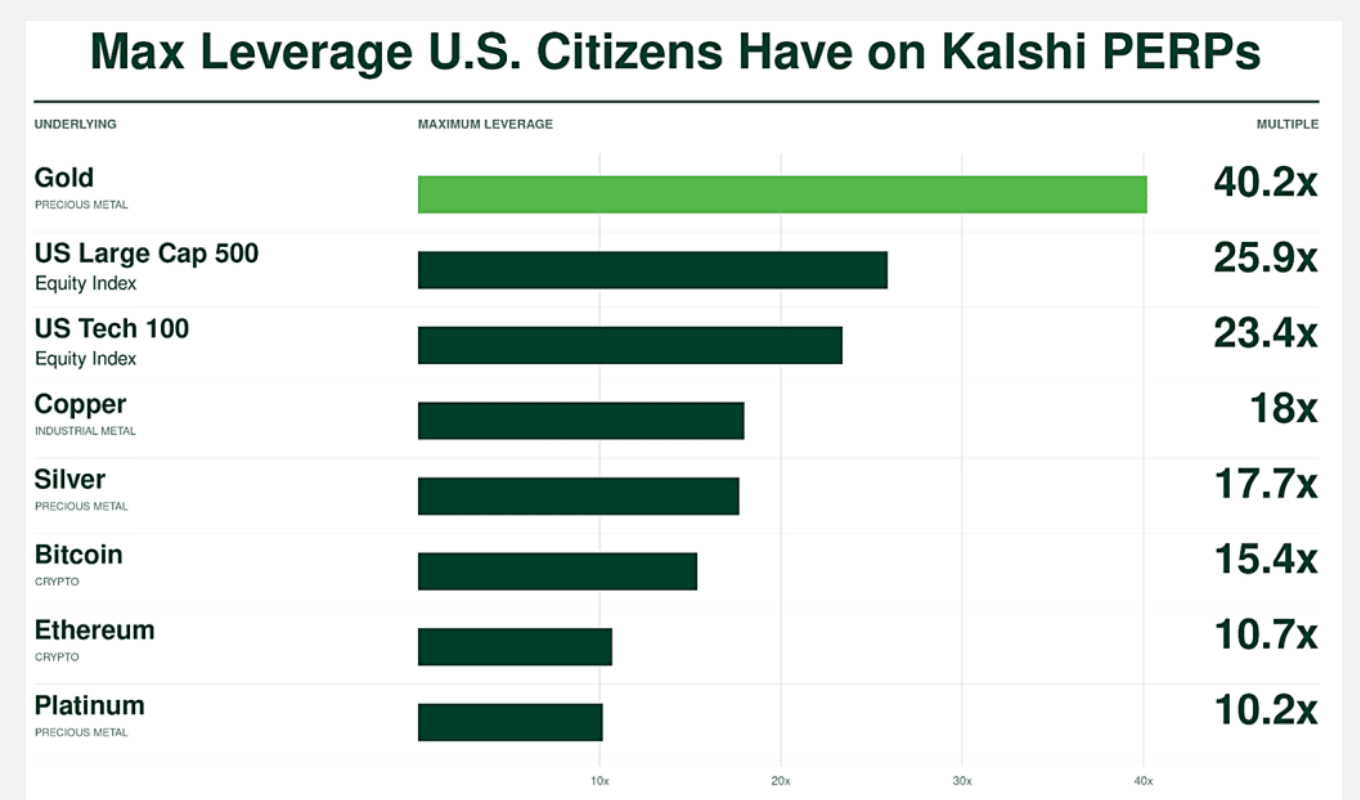
Source: TD Bank
Legal action
CME Group, the derivatives exchange operator, filed a lawsuit against the CFTC’s initial approval of perpetual futures in July, arguing that the contracts should be regulated as swaps rather than futures.
TD Bank said the outcome of CME’s challenge to the CFTC’s treatment of perpetuals remains important as the definition materially affects capital efficiency advantages. The report said: “We see perpetuals rapidly expanding amongst U.S. retail in the upcoming months, with the CME lawsuit outcome occurring somewhere around 2027.”
On 3 November 2026 the Capital Markets Alliance (CMA), which includes derivatives exchnage Cboe Global Markets, market maker Citadel Securities and the Healthy Markets Association, filed legal action challenging approval of perpetual derivatives on U.S. stocks and ETFs.

Craig Donohue, Cboe Global Markets
Craig Donohue, chief executive of Cboe Global Markets, said in a statement that single-stock perpetual derivatives are the latest example of a troubling trend in which securities products are being offered on CFTC platforms – outside the appropriate regulatory framework and customer protection regime established by Congress.
“For more than 50 years, Cboe has competed successfully in some of the world’s most competitive markets and we welcome new entrants and innovation,” added Donohue. “When securities products are permitted to trade outside that framework, it creates regulatory arbitrage, bypasses both federal and state laws, and undermines the integrity of those markets.”
U.S. District Judge Caproni has denied the CMA’s request for a temporary restraining order but set an expedited briefing schedule for the preliminary-injunction motion. Caproni said in a filing that the “plaintiff is likely to succeed on the merits of its claim that the CFTC’s action in approving the trading of single stock perpetual derivatives as security futures exceeded its statutory authority.”

NEWSLETTER SIGN UP
And receive exclusive articles on securities markets

🏆 The 2026 Global Markets Choice Awards are here! 🌍 Nominations are officially OPEN for the celebration of excellence in global capital markets trading & technology. Nominate below:
https://www.jotform.com/form/260086385121150

Delaware Life Insurance Company is becoming the first insurance carrier to offer an index that contains cryptocurrency, adding the BlackRock U.S. Equity Bitcoin Balanced Risk 12% Index to its fixed index annuity (FIA) portfolio.
As the digital assets industry pushes toward
Franklin Templeton is expanding its tokenized fund suite, signaling growing institutional demand for blockchain-based fund infrastructure and regulated investment products moving onchain. Read the full article below:
$50 billion in active ETF inflows helped fuel a record year for @BlackRock 's iShares business, as investors continue to lean into active strategies.
Shanny Basar
Senior writer
A Senior Writer at Markets Media who became a financial journalist in 2000 after working in banking for over a decade....
More about this authorRelated articles
-

There were records in interest rate, equity index, energy and agricultural products.
-
Equity perpetual futures can trade for the first time on CFTC-registered exchanges.
-

The roundtable on December 15 will discuss the viability of derivatives moving to 24/7 trading.
-

Donohue said the SEC should regulate event contracts based on securities indices or certain corporate performa...
-

Bloomberg index futures are available on NinjaTrader & fertilizer futures contracts recently launched.