






08.17.2016
Perhaps the biggest trend in wealth management is ‘robo’-advisors — the automated, algorithm-based portfolio overseers that conventional wisdom says will put human financial advisors out of work.
Not so fast, say industry professionals who have their fingers on the pulse of the customer. Technology is transformative, but it does have its limitations — when a client calls amid a market swoon or with a pressing account question, s/he doesn’t want to speak to a bot.
 “Even the most successful, tech-savvy millennial or very advanced investor needs human interaction and trust, and wants a personal relationship with their advisor,” said Sarah Gosler, senior vice president and head of marketing at Wedbush Securities. “What can be exceedingly successful in this space is a hybrid between advisors and their supportive technology — think of it as the convergence of art and science. ”
Wealth management is one of the least tech-literate sectors within financial services, PwC said in a recent report. Nearly seven of every 10 high net worth individuals use online or mobile banking, but only a quarter of wealth managers offer digital channels beyond e-mail, according to the consultancy.
Among HNWIs under 45 who don’t use robo-services, 47% would consider using them in the future. “Ignoring this state of affairs is not an option,” PwC said, citing an “opportunity for wealth managers that combine the very best of technological and human capital.”
Financial technology has advanced dramatically over the past couple decades, and wealth management has gone along for the ride. When Doug Pryor started as an financial advisor at Dean Witter in 1994, trades were processed manually, and a paper ticket was physically sent to the back office via a ‘whooshing’ tube, similar to a drive-thru window at a bank.
Now, FAs can buy and sell a stock via a few mouse clicks, which frees them from paperwork and enables them to manage more clients. But that’s not the main value-added of fintech.
“For us it’s more the efficiency of being able to manage client information,” said Pryor, who’s now senior vice president and branch manager at Wedbush Securities in Los Angeles. “If a client calls and asks about the performance of their portfolio, not long ago that was something that a broker had to manually figure out, either using an Excel spreadsheet or a normal calculators. Now the technology has that data for you instantly. That’s a powerful tool.”
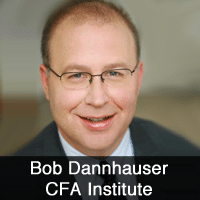 Wealth management remains largely relationship-driven, and technology is more of a tomorrow story than a today story for the business, according to Robert Dannhauser, CFA, head of private wealth management at investment-industry association CFA Institute. “There’s a lot of potential down the road to have technology be part of the quality of relationship, without supplanting the necessary interaction between the people on both sides of the desk,” he said.
“Access to information is something that a lot of people are talking about, particularly for second and third generations of clients that they’re dealing with,” Dannhauser told Markets Media. “There’s a cultural expectation among millennials to have real-time access, or as close to real-time as possible. That differs from the service delivery model that’s been typical of the space over the last five or ten years, where a monthly or quarterly sit-down based around reports has been the standard model.”
“Beyond that, integration is probably one of the other big unfulfilled potentials,” Dannhauser continued. “Clients appreciate a comprehensive view of their financial picture, and operationally that’s always been a bit challenging as there are data security and privacy issues that go with that. It’s reasonable to expect that clients will put some value around a seamless view of their entire financial picture, both parts that are subject to advisement and other parts that perhaps are outside the wealth manager’s purview.”
Technology has advanced wealth management specifically via Customer Relationship Management (CRM) platforms, noted Gosler of Wedbush. This is both in terms of prompting advisors to stay on top of communication with clients, and for empowering clients with an array of current information.
Fintech in wealth management “is very user-experience-driven,” Gosler said. “I think it speaks to the hybrid model of an advisor with the technology platform as support. There’s a lot of transparency there, which lends itself to making clients feel comfortable with their advisors because they’re actively participating in how their wealth is managed.”
Previously in this article series:

NEWSLETTER SIGN UP
And receive exclusive articles on securities markets

🏆 The 2026 Global Markets Choice Awards are here! 🌍 Nominations are officially OPEN for the celebration of excellence in global capital markets trading & technology. Nominate below:
https://www.jotform.com/form/260086385121150

Delaware Life Insurance Company is becoming the first insurance carrier to offer an index that contains cryptocurrency, adding the BlackRock U.S. Equity Bitcoin Balanced Risk 12% Index to its fixed index annuity (FIA) portfolio.
As the digital assets industry pushes toward
Franklin Templeton is expanding its tokenized fund suite, signaling growing institutional demand for blockchain-based fund infrastructure and regulated investment products moving onchain. Read the full article below:
$50 billion in active ETF inflows helped fuel a record year for @BlackRock 's iShares business, as investors continue to lean into active strategies.
Terry Flanagan
Managing Editor
Terry Flanagan is Managing Director at Markets Media Group, where he oversees the Markets Media, Traders Magazine, and GlobalTrading platforms....
More about this authorRelated articles
-

The acquisition marks Plus500’s entry into the SEC-regulated segment of the US market.
-

Individual investors may be given additional ways to qualify as an accredited investor.
-

Starting with Oura’s IPO, eligible customers can request shares at the offer price before trading starts.
-
Investors will be able to trade E-nano equity index futures.
-

Retail traders were ready for always-on, regulated, right-sized products to manage their gold exposure.