






07.17.2026

The acquisition of prime broker Hidden Road by Ripple, the fintech that offers blockchain solutions to business, has led to increasing revenues from gaining access to Ripple’s balance sheet and synergies from access to RLUSD, Ripple’s Genius-compliant U.S. dollar-backed stablecoin and potential cost savings from using XRP Ledger, the blockchain used by Ripple.
Michael Higgins, international chief executive of Ripple Prime, told Markets Media: “Ripple has the infrastructure to enable institutional adoption of digital assets and a very large balance sheet, which made them a natural partner.”
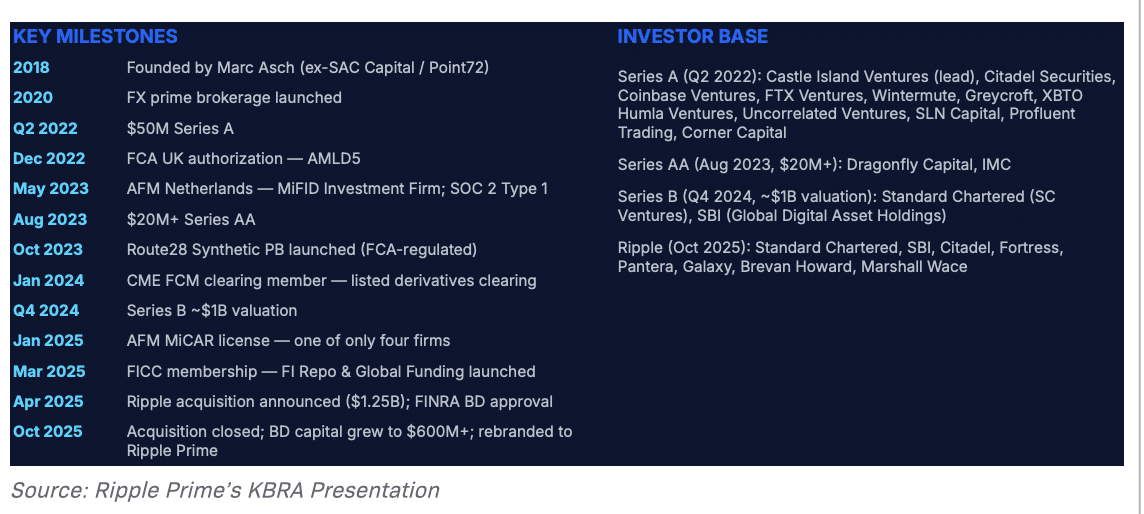
In October 2025 Ripple completed its $1.25bn acquisition of Hidden Road, which it described as one of the fastest growing non-bank prime brokers in the world. Ripple said at the time that this was one of the largest deals in the digital assets space and that it became the first crypto company to own and operate a global, multi-asset prime broker. Following completion, the business was renamed Ripple Prime and revenues have since tripled year-over-year.
Source: Kroll
Hidden Road offered institutions a one-stop-shop for services including prime brokerage, and financing across foreign exchange, digital assets, derivatives, swaps, and fixed income. In addition, the prime broker cleared $3 trillion annually across markets with more than 300 institutions. The firm was deliberately built as a multi-asset prime brokerage and clearing firm because traditional markets can boom when there are crypto winters and vice versa, according to Higgins. Ripple also believes the these two worlds are converging over the long-term and the value of everything will tokenize over time.
Higgins helped set up Hidden Road, which was founded in 2018 by Marc Asch, formerly at hedge funds SAC Capital and Point72. He previously spent 20 years in electronic trading in multiple asset classes, but especially FX, where Higgins believes a lot of market structure can be applied to digital assets.
Hidden Road was initially looking to raise funds because the firm needed access to a larger balance sheet to meet “insatiable” client demand for prime brokerage, clearing, and financing services, according to Higgins. Both Ripple and its chief executive Brad Garlinghouse were well known to Hidden Road as an investor and client, and an organic conversation took place which led to discussions about an acquisition.
When Hidden Road was set up, the prime broker originally set out to tap buy-side capital in order to meet growing demand. In May this year Ripple closed a $200m debt facility from Neuberger Specialty Finance, the dedicated asset-based investment team within asset manager Neuberger. Ripple said the facility will support the continued growth of Ripple Prime amid rising client demand for institutional-grade prime services and margin financing solutions.

Peter Sterling, Neuberger Specialty Finance
Proceeds will be used to extend financing to clients engaging in traditional and digital markets, increasing Ripple Prime’s lending capacity and enhancing its ability to serve new and existing institutional relationships. Peter Sterling, head of Neuberger Specialty Finance, said in a statement that the facility is a testament to Ripple Prime’s “unique” position at the nexus of traditional and expanding markets.
Higgins added: “In a world that’s shifting to 24/7, we are the first mover in increasing Ripple’s balance sheet with other partners, like Neuberger.”
Collateral management
In November 2025 Ripple Prime launched digital asset spot prime brokerage capabilities for U.S.-based institutions to execute over-the-counter (OTC) spot transactions across dozens of the most prominent digital assets. These included XRP, the native token of the open-source XRP Ledger used by Ripple, and RLUSD, Ripple’s stablecoin. Ripple Prime’s U.S.-based clients could now cross-margin OTC spot transactions and holdings with the rest of their digital asset portfolio, including OTC swaps and CME futures and options, improving capital efficiency.
Clients can post collateral and receive payments in stablecoins, In contrast in traditional markets, participants can only post U.S. dollars as collateral, and only when the banks are open, so they need a capital buffer to manage risk outside of those hours and over the weekends. Higgins said that margins can be topped up 24/7 when using stablecoins, and that efficiency is passed on to the client, especially when using RLUSD.
The firm said Ripple Prime will significantly enhance the utility and reach of RLUSD, as it is being used as collateral for a number of prime brokerage products. Certain derivatives customers have already opted to hold their balances in RLUSD, which is expected to grow substantially in the coming months, according to Ripple Prime.
“As of now, funding is needed on Friday to support what clients will do over the weekend,” added Higgins. “If the next step is GENIUS Act-compliant stablecoins, RLUSD is likely to be in the mix.”

Michael Higgins, Ripple Prime
Higgins gave the example that derivatives marketplace CME Group is likely to adopt stablecoins to help enable its recent move to 24/7 trading. Since 29 May 2026 CME’s regulated cryptocurrency futures and options have been available for trading 24 hours a day, seven days a week. He stressed that this is not just a discussion about CME, but also a broader discussion across major equities and derivatives exchanges.
“They will support multiple chains and multiple coins over time, and as a prime broker, we can lean in,” Higgins added.
Ripple Prime also benefits from accepting a zero haircut when RLUSD is used as collateral according to Higgins, because its reserves are audited and regulated. A haircut refers to a reduction applied to the value of an asset to cover the risk of not being able to sell the asset at its current market value at a later date.
Higgins said the industry is in the very early innings of clients using tokenized collateral. Ripple Prime supports many forms of tokenized collateral and expects the universe of eligible collateral to keep expanding.
“Optimizing collateral, liquidity, and settlement is really important as traditional markets shift from bank payment rails to 24/7 blockchain rails,” added Higgins. “This is Wall Street 2.0.”
Connectivity
As a prime broker, Ripple Prime needs to provide connectivity to venues where clients choose to trade. In May this year Ripple Prime integrated with EDX Markets and EDXM International allowing clients to access EDX’s spot and perpetual futures liquidity.

Tony Acuña-Rohter, EDX
Tony Acuña-Rohter, chief executive of EDX Markets, said in a statement: “Institutions are demanding market infrastructure that combines the operational rigor of traditional finance with the innovation and efficiency of digital assets. Together, we’re helping accelerate the maturation of digital assets and setting a higher standard for market participants.”
The partnership also lays the groundwork for the future integration of RLUSD as a settlement and collateral asset on EDX for enhanced cross-collateralization and margin efficiencies across spot crypto and perpetual futures trading.
In February this year, Ripple Prime enabled support for Hyperliquid, a decentralized derivatives protocol, to enable institutional clients to access onchain derivatives liquidity while cross-margining decentralized finance (DeFi) exposures with all other asset classes supported by the prime broker. As institutional participation in DeFi accelerates, Ripple Prime aims to provide clients with scalable access to next-generation trading infrastructure while preserving the controls and capital efficiency expected of a global prime broker.
Higgins said venues like EDX and Hyperliquid are unique liquidity pools.
“We look at a combination of client demand, where the puck is moving, and regulatory standing when evaluating the venues we support,” he added. “If all these criteria are met, we can move forward.”
Ripple Prime will continue leading the way in merging DeFi with traditional prime brokerage services, offering direct support to trading, yield generation and a wider range of digital assets, said Higgins.
Using XRPL
When the acquisition was completed, Ripple said the prime broker would migrate its post-trade activity across XRPL to streamline operations and lower costs, which it said demonstrated XRPL’s potential as the “go-to blockchain for institutional decentralized finance (DeFi).” In addition, the firm sees the potential to optimize costs and liquidity in its cross-border payments solution, Ripple Payments, and provide bank-grade digital asset custody to customers.
Higgins said Ripple Prime is in the early stages of migrating post-trade activities onto the XRP ledger, and that will meaningfully drive down costs as it scales. For example, the firm leverages the RLUSD stablecoin on XRPL.
“The XRP ledger is built with robustness, reliability, speed and low-cost transactions in mind,” he added. “While it is still the early days for institutional adoption, the network is designed to be extremely efficient as transaction volumes continue to grow.”
There is interoperability across different chains, and all the major custodians are either integrated or are in the process of integrating XRPL, according to Higgins. He said XRPL is also being integrated with traditional financial market infrastructure.
Competition
There are other crypto-native firms providing prime brokerage and it is likely that traditional prime brokers will enter the digital asset market, once regulations allow them to do so.
“The largest market makers in US equities and foreign exchange are not banks anymore,” said Higgins. “In a world where markets move 24/7, bank prime brokers will need to upgrade their technology and shift to a follow-the-sun staffing model, and that is going to take time. We are purpose-built for this environment.”
Higgins argued that a core differentiator of Ripple Prime is its modern, unified technology stack. For example, adding support for a new venue – whether it is in digital assets, foreign exchange, listed derivatives or equities – follows the same workflow.
“This enables us to move quickly and integrate and capitalize on market innovations faster than incumbent prime brokers,” said Higgins.
The proprietary technology stack also enables seamless risk modelling across digital and traditional assets according to Higgins.
In April 2026 a Ripple Prime legal entity received a BBB investment-grade rating from Kroll. The rating applies to a legal entity that is effectively a tri-registered futures commission merchant (FCM) broker-dealer. Higgins said that operating as a rated entity backed by Ripple’s balance sheet makes it easier to raise capital as needed, and that certain institutions are only able to face regulated, rated counterparties.
Kroll said in a report that Ripple Prime’s balance sheet has grown significantly over the past twelve months, and the firm achieved profitability in 2025, supported by substantial capital injections (~$500m) from its parent. However, Kroll also warned that the rating is dependent on parent’s strong financial backing, which is driven by digital asset activity, including XRP sales, and may be sensitive to price volatility and liquidity conditions, particularly during a prolonged digital asset downturn.
The ratings report said the fixed income repo platform, launched in March 2025, scaled to approximately $38bn of gross notional within its first year, while FCM segregated balances increased from effectively zero in 2023 to $766m at year-end 2025, which reflects increasing client adoption across both repo and exchange-traded derivatives clearing activities.
“Notwithstanding these strengths, Ripple Prime US remains earlier-stage and smaller in scale relative to established mid- and large-cap broker-dealers,” said Kroll. “While the platform’s breadth is expanding, earnings remain concentrated in financing-driven activities and brand recognition does not yet reflect the entrenched national presence of more seasoned competitors. As such, the firm’s competitive position is considered average overall, with upside contingent upon continued execution across Delta1 equity financing, equity prime brokerage, expanded repo collateral, and broader clearing connectivity.”
Higgins said Ripple Prime welcomes competition, as having more credit providers for end users forces the market to become more efficient, which ultimate benefits the end investor because they get better and faster pricing.
“Even in a crypto winter, our business continues to thrive,” he added. “The direction is clear: institutions continue to employ more sophisticated, less speculative approaches to digital assets, and they need partners such as Ripple Prime that can support these activities in up markets and down.”
He continued that the largest asset managers are tokenizing money market funds, putting them onchain, and using them in a repo leg with a stablecoin.
“The world is inexorably moving in this direction,” said Higgins. “The current crypto winter is not a digital asset winter.”

NEWSLETTER SIGN UP
And receive exclusive articles on securities markets

🏆 The 2026 Global Markets Choice Awards are here! 🌍 Nominations are officially OPEN for the celebration of excellence in global capital markets trading & technology. Nominate below:
https://www.jotform.com/form/260086385121150

Delaware Life Insurance Company is becoming the first insurance carrier to offer an index that contains cryptocurrency, adding the BlackRock U.S. Equity Bitcoin Balanced Risk 12% Index to its fixed index annuity (FIA) portfolio.
As the digital assets industry pushes toward
Franklin Templeton is expanding its tokenized fund suite, signaling growing institutional demand for blockchain-based fund infrastructure and regulated investment products moving onchain. Read the full article below:
$50 billion in active ETF inflows helped fuel a record year for @BlackRock 's iShares business, as investors continue to lean into active strategies.
Shanny Basar
Senior writer
A Senior Writer at Markets Media who became a financial journalist in 2000 after working in banking for over a decade....
More about this authorRelated articles
-

They will bring tokenized real-world assets to NUVA, the Animoca Brands-backed vault marketplace.
-

Legal and regulatory certainty is needed for adoption to scale.
-

Fund managers want prime brokerage across traditional and digital markets in a regulated framework.
-

J.P. Morgan provided Solana Foundation with input on institutional settlement practices and requirements.
-

The future of financial services will require greater interoperability, trust, and collaboration.