






09.03.2026
Vanguard Nears BlackRock for Top Spot in U.S. ETF Assets
09.03.2026
Vanguard is closing the gap with BlackRock for assets under management in U.S.-domiciled exchange-traded funds, according to Morningstar. The data provider said in a report that the gap between the two ETF issuers was nearly $200bn in assets in 2024 but this is the first year that it has shrunk to less than $100bn.
“Although these are still enormous sums of money, Vanguard briefly overtook BlackRock earlier this year before slipping back into second place by the end of June,” added Morningstar. “These two are likely to continue jockeying for first place depending on market moves, trading activity, and product development, considering the significant overlap between their lineups.”
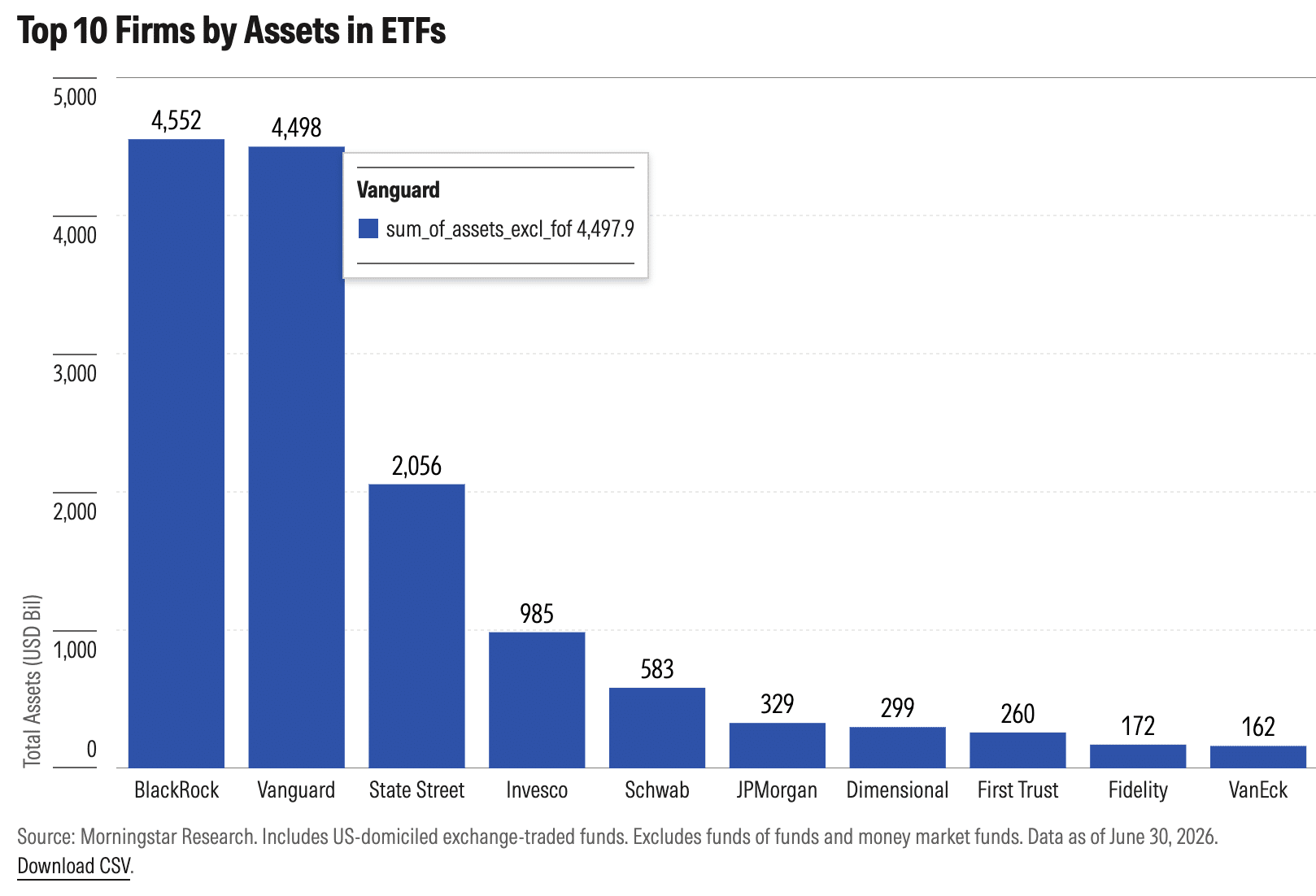
Source: Morningstar
The U.S. ETF industry is highly concentrated with the three largest providers accounting for 70.6% of total assets under management, according to ETFGI, the independent research and consultancy firm.
ETFGI said in a report that at the end of July this year BlackRock’s iShares led the market with $4.53 trillion in assets and a 28.8% market share, followed by Vanguard with $4.51 trillion and a 28.7% share. State Street SPDR ETFs were in third place with $2.08 trillion and a 13.2% market share. The remaining 490 providers made-up less than 7% of total industry assets.
“Substantial inflows can be attributed to the top 20 ETFs by net new assets, which collectively gathered $111.10bn in July, the Vanguard S&P 500 ETF (VOO US) gathered $19.66bn alone,” added ETFGI.
Total assets of $15.74 trillion were invested in U.S ETFs at the end of July, below the record high of $15.78 trillion in June 2026, according to ETFGI. Year-to-date net inflows of $1.23 trillion until the end of July are the highest on record.
In active ETFs, Morningstar said Dimensional and JPMorgan stand out as two of the largest providers of active ETFs and both have converted mutual funds to ETFs in addition to launching new ETFs.
“JPMorgan Equity Premium Income ETF, JEPI, has garnered significant investor demand and ranks as the firm’s third largest fund as of June 2026,” added Morningstar. “Both Dimensional and JPMorgan have just over one-third of their fund AUM in ETFs.”
🚀 Active ETFs continue to break records.
— Deborah Fuhr, ETFGI (@deborahfuhr) August 24, 2026
📈Active ETF assets reached a new all-time high of US$2.59 trillion at the end of July 2026, while year-to-date net inflows climbed to a record US$590.46 billion, according to the latest @etfgi report.https://t.co/pqIVFdZU3w
Assets invested in global actively managed ETFs reached a record $2.59 trillion at the end of July 2026, according to ETFGI.
Dimensional and J.P. Morgan were the largest providers of actively managed ETFs globally at the end of July, said ETFGI. Each managed approximately $309bn in assets and hold an 11.9% share of the global active ETF market.
Consolidation
Morningstar highlighted that Vanguard, BlackRock, and Fidelity manage about half of assets under management in the U.S.
“Larger firms can spread costs across a broader asset base, supporting greater investment in technology, distribution, and operations while keeping fees low,” added Morningstar. “As such, industry consolidation remains a key theme.”
On 2 September 2026 CoinShares, the digital asset fund manager, announced that it has completed the acquisition of Bastion Asset Management Limited, which now operates as CoinShares Alternatives.
CoinShares said the acquisition means the group can provide investors with access to digital assets through both passive and actively managed strategies, spanning listed products, funds and managed accounts, within a single institutional platform.

JM Mognetti, CoinShares
Jean-Marie Mognetti, co-founder, president and chief executive of CoinShares, said in a statement that Bastion brings an experienced team, a differentiated systematic investment process and an established strategy with a strong track record and institutional investor base. Mognetti added: “By combining these capabilities with CoinShares’ infrastructure, market access and global distribution, we believe we have a strong platform from which to scale our alternatives business and capture the growing institutional demand for differentiated sources of return within digital assets.”
In August this year Goldman Sachs announced it has agreed to acquire NEOS Investments, a specialized provider of systematic options-based income ETFs, which managed $30bn in assets across 19 ETFs as of 30 June 2026, including a $1bn bitcoin premium income ETF. Goldman Sachs also closed the acquisition of another ETF issuer, Innovator Capital Management, which specializes in defined outcome funds in April this year.
The group said the combination of Goldman Sachs Asset Management, NEOS Investments and Innovator Capital Management creates a broad options-based ETF franchise. The combined platform will position it as a top eight active ETF provider with $80bn in active ETFs across a $130bn global ETF platform as of 30 June 2026, according to the bank.

David Solomon, Goldman Sachs
David Solomon, chairman and chief executive of Goldman Sachs, said in a statement: “As investor demand for active ETFs grows, NEOS’ disciplined investment approach is highly complementary to our capabilities across buffer, managed outcome and income strategies.”
T. Rowe Price also announced the acquisition of F/m Investments, a fixed-income manager with expertise in ETFs and $19bn in assets under management, in August this year.
Arif Husain, head, global fixed income and CIO, said in a statement: “F/m brings unique ETF product development capabilities that will complement T. Rowe Price’s active fixed income lineup across our intermediary, institutional, Rretirement, and wealth platforms.”
In the same month Victory Capital Holdings announced that it has agreed to acquire First Eagle Investments, an independent, privately held fund manager with approximately $222bn in assets under management as of 31 July 2026. Upon closing, the combined company is expected to have approximately $571bn in total client assets, positioning Victory Capital as one of the largest publicly traded traditional asset managers in the U.S.
David Brown, chairman and chief executive of Victory Capital, described the deal as “transformational” as First Eagle has a diversified product lineup spanning global multi-asset, equities, fixed income, and a scaled alternatives platform that includes CLOs and alternative credit.

David Brown, Victory Capital
“This transaction enriches Victory Capital’s talent pool, gives us additional scale to invest even more in our overall platform, and amplifies our distribution depth and breadth in the U.S., as well as outside the U.S. through our strategic partnership with Amundi,” added Brown. “It makes our company better, more competitive and more resilient through all market cycles.”
Morningstar highlighted that other upcoming combinations include Nuveen’s purchase of Schroders and Wellington Management’s acquisition of Hartford Funds.
Consultancy Oliver Wyman said in a report that one of the trends shaping asset management in 2026 is that fund managers with more than $2 trillion of assets under management have average margins of 45% and those with less than $500bn have average margins of 36%. However, those in the middle are caught in a “Valley of Death” with average margins of 26% as they are squeezed between scale and simplicity.
Oliver Wyman expects private equity and other activist sources of capital to increasingly start showing up in the asset management space. The report said: “The barbarians are moving toward asset managers’ gates.”

NEWSLETTER SIGN UP
And receive exclusive articles on securities markets

🏆 The 2026 Global Markets Choice Awards are here! 🌍 Nominations are officially OPEN for the celebration of excellence in global capital markets trading & technology. Nominate below:
https://www.jotform.com/form/260086385121150

Delaware Life Insurance Company is becoming the first insurance carrier to offer an index that contains cryptocurrency, adding the BlackRock U.S. Equity Bitcoin Balanced Risk 12% Index to its fixed index annuity (FIA) portfolio.
As the digital assets industry pushes toward
Franklin Templeton is expanding its tokenized fund suite, signaling growing institutional demand for blockchain-based fund infrastructure and regulated investment products moving onchain. Read the full article below:
$50 billion in active ETF inflows helped fuel a record year for @BlackRock 's iShares business, as investors continue to lean into active strategies.
Shanny Basar
Senior writer
A Senior Writer at Markets Media who became a financial journalist in 2000 after working in banking for over a decade....
More about this authorRelated articles
-

BlackRock has developed three investment model portfolios that have been tokenized by Ondo Finance.
-

SEI’s U.S. quantitative investment management (QiM)-related active ETF range has $7bn in assets.
-

They will bring tokenized real-world assets to NUVA, the Animoca Brands-backed vault marketplace.
-

Institutions in South Africa can access IG’s trading platform under the Investec Prime Services brand.
-

This is the investor's first allocation to a tokenised financial asset.