






04.16.2026

State Street Investment Management has built a dedicated Sector ETF global team of 18 sales specialists and strategists after bringing the distribution and marketing of 11 Select Sector SPDR ETFs in-house.
Anna Paglia, chief business officer at State Street Investment Management, told Markets Media by email that the Sector ETF board appointed State Street Investment Management’s broker-dealer affiliate as distributor from 1 December 2025 following a “rigorous independent” board-led process. Previously, ALPS Portfolio Solutions Distributor had been performing this role. State Street Investment Management has been the investment adviser to the suite of sector ETFs since its inception in 1998.
Paglia added that the shift was focused on strengthening the Sector ETF platform by expanding global distribution, modernizing marketing and digital tools, and enhancing research and thought leadership. The asset manager stressed that the change does not impact the funds’ investment objective or strategy.

Anna Paglia, State Street Investment Management
“These efforts are designed to improve how investors access and use sector insights, and to ensure the franchise remains resilient, competitive, and investor-focused for the long term,” she added.
She argued that the ETF marketplace and distribution models have evolved significantly over the past two decades so scale, breadth of platform, global reach, integrated research, digital engagement, and operational resilience are increasingly important to serving investors effectively.
“Aligning advisory and distribution functions on one platform is consistent with how large ETF sponsors operate and reflects a broader industry practice of an integrated operating model for larger ETF complexes,” said Paglia.
There has been an increase in flows into active ETFs but she said demand for the passive Select Sector SPDR ETFs has held up in aggregate. The suite of Select Sector SPDR ETFs had $6.5bn of inflows between 1 December 2025 and the 31 March 2026, according to Paglia. As a result, the total assets under management for the suite was $342bn at the end of March this year.
In July last year State Street Investment Management had added 11 Premium Income Sector ETFs. Paglia said: “While it’s early days, we are seeing strong interest particularly in the adviser space (total AUM $78m since launch through 3/31/26).”
Global assets in actively managed ETFs reached a record $2.2 trillion at the end of February this year, according to ETFGI, an independent research and consultancy firm.
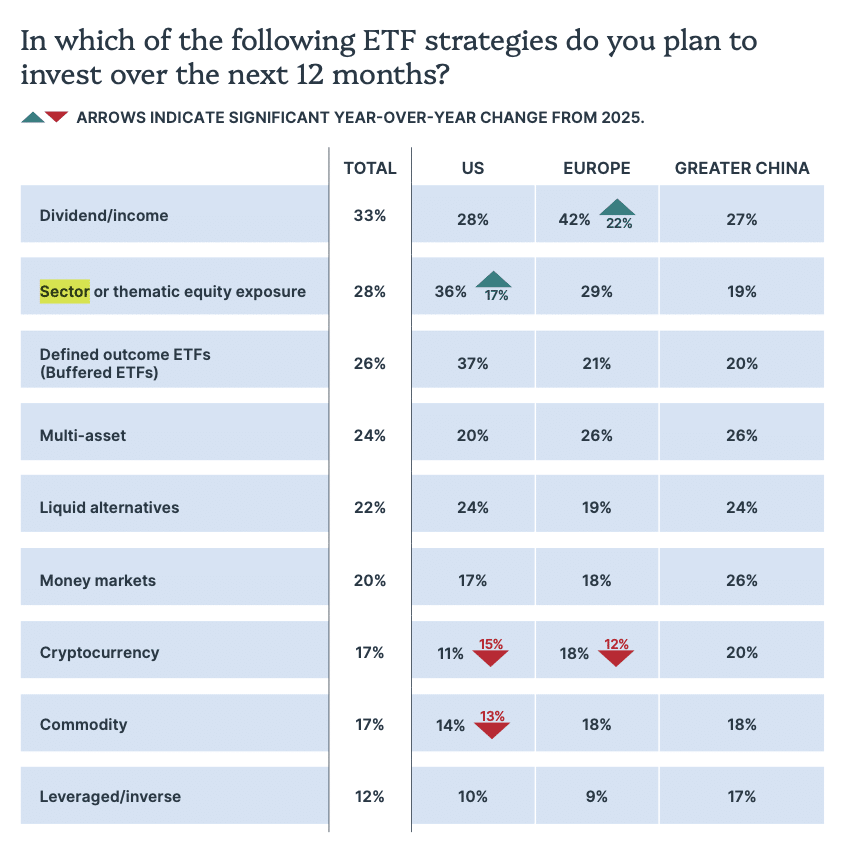
BBH, the financial services group, said in its Global ETF Survey 2026: Uncharted Opportunity that most investors plan to invest in dividend/income strategies (33%) over the next 12 months, followed by sector or thematic equity exposure (28%).
Source: BBH
Trends
Beyond the sectors landscape, Paglia said the asset manager is seeing growing interest in alternatives ETFs given their important role in building diversified portfolios. She argued that volatility may remain elevated and leadership may continue to rotate, but portfolios built around balance, diversification, and resilience are best-positioned to navigate ongoing uncertainty.
For example, the firm offers the State Street IG Public & Private Credit ETF (PRIV), a core-plus bond solution that combines investment-grade public credit with private credit exposure, which Paglia said helps improve overall yield and resiliency. The issuer has also launched the State Street Bridgewater All Weather ETF (ALLW), an actively managed, diversified global multi-asset allocation ETF with an investment approach designed to generate consistent returns across different economic environments.
Source: Citi
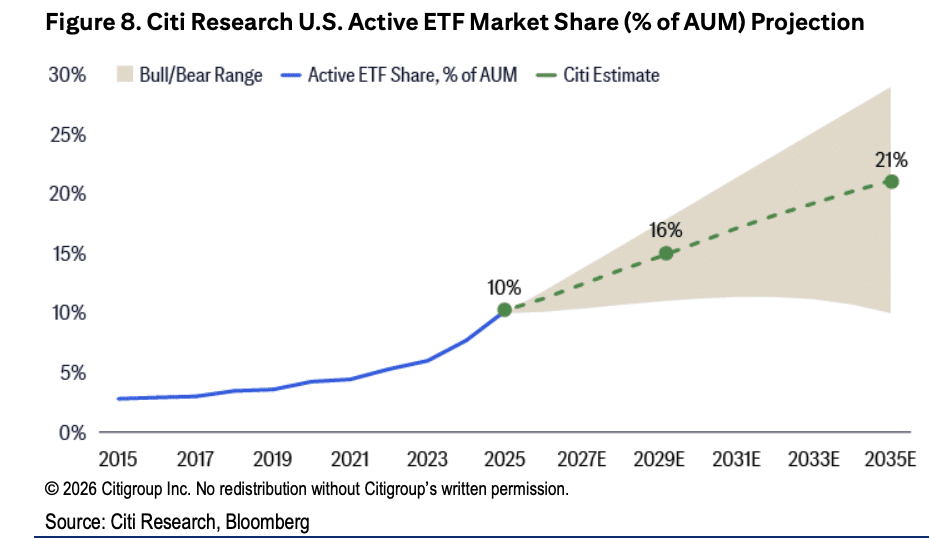
The share of active ETFs is expected to double from 10% to 21% over the next decade, according to the report, Sizing the ETF Opportunity: Active ETFs Move to Center Stage. The bank predicted that U.S ETF assets will reach $25 trillion in assets by the end of this decade, with total industry assets under management reaching more than $40 trillion in ten years, which is more optimistic than the bank’s prior estimates.

Drew Pettit, Citi
Drew Pettit, U.S. equity and ETF strategy at Citi research, said in the report: “This will not fully offset losses to index/passive strategies in mutual funds but will be a new growth driver for active which has been under pressure more broadly. Importantly, the dual theme of growing active ETF ownership plus increased trading use of index/passive products for portfolio adjustments highlight the longer-term growth opportunity for U.S.-listed ETFs overall.”
Citi’s report said active ETFs control 22% of U.S. ETF industry revenue on 10% of assets under management on an annual run rate basis. As the market share of active ETFs grows to 21%, they could be responsible for 40% of revenue according to Citi’s base case.
Paglia said there is also continued appetite for low-cost core building block funds, such as State Street SPDR Portfolio ETFs.
“Our SPDR Portfolio S&P 500 ETF (SPYM) generated the most inflows of any ETF in the first quarter of 2026,” she added. “We’re excited to offer investors that core market exposure with intense fee efficiency at only 2 basis points.”
.

NEWSLETTER SIGN UP
And receive exclusive articles on securities markets

🏆 The 2026 Global Markets Choice Awards are here! 🌍 Nominations are officially OPEN for the celebration of excellence in global capital markets trading & technology. Nominate below:
https://www.jotform.com/form/260086385121150

Delaware Life Insurance Company is becoming the first insurance carrier to offer an index that contains cryptocurrency, adding the BlackRock U.S. Equity Bitcoin Balanced Risk 12% Index to its fixed index annuity (FIA) portfolio.
As the digital assets industry pushes toward
Franklin Templeton is expanding its tokenized fund suite, signaling growing institutional demand for blockchain-based fund infrastructure and regulated investment products moving onchain. Read the full article below:
$50 billion in active ETF inflows helped fuel a record year for @BlackRock 's iShares business, as investors continue to lean into active strategies.
Shanny Basar
Senior writer
A Senior Writer at Markets Media who became a financial journalist in 2000 after working in banking for over a decade....
More about this authorRelated articles
-

Commissioner Peirce said moving activities onchain does not take them outside the scope of securities laws.
-

Eligible investors will have simplified access to portfolios combining public and private markets.
-

Sebastian Pulido can connect market structure, tokenization, and DeFI with the expectations of institutions.
-

Prediction markets provide price signals and atomise risk in a way that did not exist before.
-

The UCITS framework allows CoinShares to address Europe's largest institutional allocators.