






09.17.2026

Tokenization, prediction markets, perpetuals and extended trading hours could expand the market for incumbent exchanges rather than take business away from them even as competition is grows from venues such as Kalshi, Polymarket, and Hyperliquid according to a report from Ashish Sabadra, business and information services equity analyst at RBC Capital Markets.
“Critically, we view these disruptions as addressable market expanders rather than cannibalization risks to existing products,” he added. “Traditional exchanges that lean into these trends are, in our view, well positioned to capture a meaningful share of this broader opportunity.
In the U.S. Sabadra said Nasdaq leads in regulatory traction while ICE is building the most comprehensive platform. He gave the example of Nasdaq designing its equity token with crypto exchange Kraken and DTCC, the U.S post-trade market infrastructure, with an expected launch in the first half 2027.
Nasdaq is also connecting its European venues to Boerse Stuttgart’s tokenized asset settlement platform and partnering with Talos, the digital asset infrastructure provider, to enable tokenized collateral management via its Calypso platform.
In always-on trading, CME Group is furthest along operationally with 24/7 crypto and gold futures already running, according to Sabadra. However, both ICE and Nasdaq are targeting an equities go-live in December 2026, when U.S market infrastructure is due to be ready.

Ashish Sabadra, RBC Capital Markets
Sabadra said CME is focused on tokenizing cash and collateral for settlement through its Google Cloud partnership with Canadian bank BMO, targeting a go-live by year-end 2026. In contrast, Cboe Global Markets is exploring blockchain primarily as an enabler of 24/7 trading and collateral coordination.
“We view listing exchanges, rather than brokers or issuers, as the natural and ideal tokenization providers, alongside the DTCC,“ added the analyst.
Alan Konevsky, chairman and chief executive of tZERO, told Markets Media that tokenized securities have already passed a turning point. He said: “Critical institutions already recognize the value of this functionality and are deploying scarce resources into operationalizing them. You cannot put this genie back in the bottle.”
ICE
Sabadra argued that ICE is building the most comprehensive platform covering tokenization, prediction markets, perpetuals and extended trading hours out of the U.S. exchanges.
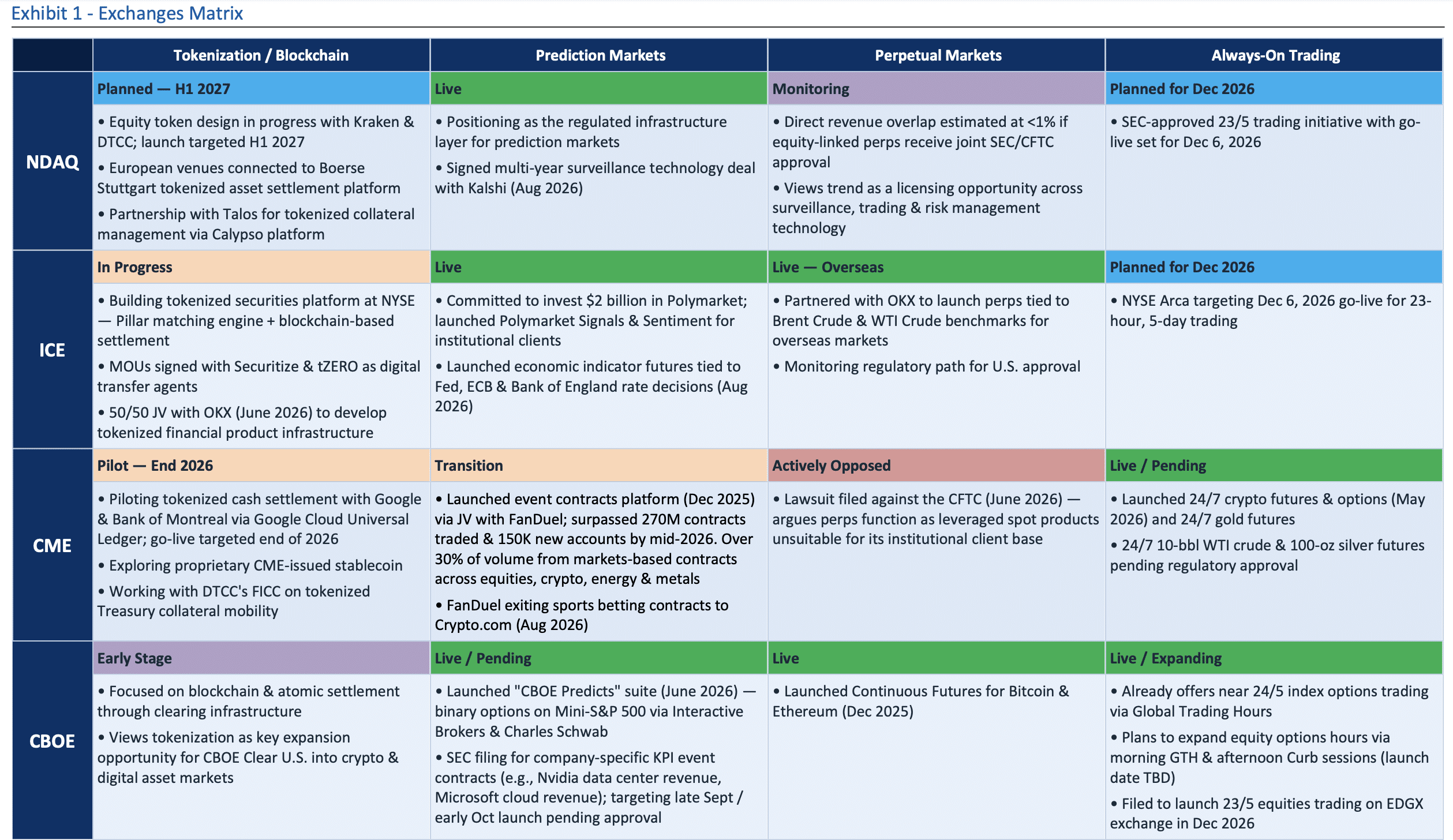
Source: RBC Capital Markets
ICE has been working with the SEC to move NYSE-listed securities onchain within its regulated framework and has announced plans to launch a tokenized securities venue, Digital Trading Platform, at the beginning of 2027.
“Central to this strategy is the development of an NYSE-affiliated digital platform that combines the NYSE’s Pillar matching engine with blockchain-based post-trade systems to facilitate 24/7 trading and onchain settlement for regulated securities,” said Sabadra.
To support this strategy, ICE partnered with tokenization platform Securitize, which owns a digital transfer agent, in March 2026. ICE then partnered with tZERO as the second digital transfer-agent. tZero has a long-standing relationship with ICE, which invested in the firm in 2022 and also joined the latest funding round in September this year.

Alan Konevsky, tZERO
In August 2026 ICE agreed a memorandum of understanding with tZERO, in which the blockchain-powered infrastructure provider will be a design partner in developing a digital transfer agent and a broker-dealer intended to support onchain settlement of tokenized securities. tZERO is expected to be designated as an approved digital transfer agent and subscriber to the Digital Trading Platform, subject to meeting applicable regulatory, technology, and operational requirements.
ICE will also receive a license to tZERO’s blockchain patent portfolio of 23 patent families and 103 patents for use in the Digital Trading Platform and other potential use cases. Konevsky said crypto and digital assets have developed in an open source environment where intellectual property protections have not been an area of focus. He added. “That is changing due to the maturation of the space.”
tZERO has an end-to-end turnkey infrastructure stack for tokenized securities including a digital transfer agent and an SEC-registered broker-dealer custodian of digital assets.
“As ICE is developing its own platform for tokenized securities, they are looking for design partners to assist them in thinking through connectivity with digital transfer agencies, broker-dealer custodians and how they can become interoperable,” Konevsky added.

Michael Blaugrund, ICE
Michael Blaugrund, vice president of strategic initiatives at ICE, said in a statement that tZERO’s experience in regulated onchain infrastructure makes them a valuable partner as the group expands its upcoming digital transfer agent program in support of tokenized securities trading and settlement.
Konevsky added that until recently, tokenization was mostly related to niche, thinly-traded illiquid assets and the industry is now looking to tokenize liquid, disclosure-rich asset classes such as public equities, cash products and money market funds. He argued that once tokenization infrastructure is in place around public equities and cash products, it is then far easier to loop in private assets.
Tokenization is about creating new access points, distribution pathways, use cases and utility functions such as onchain borrowing and lending capabilities, according to Konevsky. In addition, a tokenized security could be paired with another digital asset such as a stablecoin, to create new pairs. He said: “These assets are both onchain and share the same digital language so you can create new products.”
ICE and tZERO will also evaluate potential use of tokenized assets for collateral management purposes at ICE’s clearing houses and other affiliates.
Sabadra added: “Furthermore, ICE had previously commented on collaborating with BNY and Citi to integrate tokenized deposits across its clearinghouses, aiming to optimize collateral movement and capital efficiency by bypassing the constraints of traditional banking hours; which could now potentially be bolstered through the use of tZERO’s tokenized assets for collateral management purposes for ICE’s clearing houses.”
In tokenization, ICE sees a more immediate and practical opportunity in increasing efficiency and utility in collateral movement and settlement, according to Sabadra. Konevsky agreed that a big promise of tokenization is more efficient collateral, as well as increased utility and functionality.
Sabadar said ICE frames this as an additive opportunity rather than a disruptive threat, positioning itself to operate at the center of onchain securities markets as it already operates at the center of traditional markets.
The analyst added: “The company doesn’t see any existing blockchain or second-layer solution that can replicate the transaction volumes processed by the likes of NYSE/traditional exchanges.”

NEWSLETTER SIGN UP
And receive exclusive articles on securities markets

🏆 The 2026 Global Markets Choice Awards are here! 🌍 Nominations are officially OPEN for the celebration of excellence in global capital markets trading & technology. Nominate below:
https://www.jotform.com/form/260086385121150

Delaware Life Insurance Company is becoming the first insurance carrier to offer an index that contains cryptocurrency, adding the BlackRock U.S. Equity Bitcoin Balanced Risk 12% Index to its fixed index annuity (FIA) portfolio.
As the digital assets industry pushes toward
Franklin Templeton is expanding its tokenized fund suite, signaling growing institutional demand for blockchain-based fund infrastructure and regulated investment products moving onchain. Read the full article below:
$50 billion in active ETF inflows helped fuel a record year for @BlackRock 's iShares business, as investors continue to lean into active strategies.
Shanny Basar
Senior writer
A Senior Writer at Markets Media who became a financial journalist in 2000 after working in banking for over a decade....
More about this authorRelated articles
-

Bitnomial, Payward’s CFTC-regulated exchange and clearinghouse, would be the HIP-3 deployer.
-

This builds on recently launched ICE IDs for private credit instruments.
-

The introduction of central clearing will help align Iceland with international standards.
-

This is the first exchange-traded future linked to a transparent leveraged loan benchmark.
-

The EU approval positions Archax to serve growing institutional demand for tokenised RWAs.