





10.09.2026

TP ICAP, the interdealer broker and provider of market infrastructure and data, held its second annual ‘Bridging the Gap’ digital assets conference in September this year in London. Dan Fields, chief executive of global broking at TP ICAP, said in a keynote address at the conference that digital assets have been driven by innovation, but the next phase will be driven by coordination.
Fields argued that innovation often creates fragmentation as liquidity, assets and collateral can become separated across multiple venues and ecosystems.

“The opportunity now is not simply to create more innovation, it is to connect the innovations that already exist,” he added. “Innovation creates new possibilities, infrastructure enables adoption but only co-ordination enables scale.”
Therefore digital asset markets need rules and standards, clearing and settlement, legal frameworks and market supervision. Fields gave the example of foreign exchange becoming the world’s largest financial market after the failure of Bankhaus Herstatt in 1974 led to the formation of CLS (Continuous Linked Settlement), the network that helps participants settle transactions while significantly reducing risk. Fields said the lesson was not that the market had innovated too quickly, but that market infrastructure needed to evolve alongside the market itself.
He said TP ICAP has approached digital assets as a market structure challenge, rather than a technology opportunity. Fields said: “Fusion Digital Assets was built around those principles, helping bridge traditional and digital markets through trusted market structures designed for institutional participation.”
Fusion Digital Assets is TP ICAP’s wholesale, institutional-grade spot cryptoasset exchange.
Nithya Sridharan, director at TP ICAP, Digital Assets, told Markets Media that the focus of the last year’s conference was on bridging the gap between traditional finance and decentralized finance, which often felt like two separate worlds. She agreed that this year, the challenge is less about connectivity and more about scaling adoption and infrastructure. One takeaway that resonated across all three panels, according to Sridharan, was collaboration amongst market participants as partnerships and collaborations across various parts of the financial market infrastructure will be required for tokenization to scale.
“There is increased institutional interest, but everybody is watching the state of play very closely,” she added. “As an industry, we are not focusing on whether tokenization is going to work, as it has moved beyond the experimentation phase to something more concrete.”
Sridharan continued that interoperability is going to be important, and it has matured in the industry. For example, TP ICAP is seeing custodians supporting a greater number of chains and consolidation in assets and chains. She expects that different blockchains, from public to permissioned, will continue to co-exist and grow because each model has different use cases.

“We are seeing several emerging approaches to support 24/7 trading and settlement,“ she added. “In some models, prime brokers and central clearing counterparties play an important role by abstracting the complexities of real-time settlement from end users.”
She said recent events have reinforced the value of markets that can operate beyond traditional trading hours and settle more efficiently.
“Stablecoins have emerged as a clear success story, with the market exceeding $300bn, while the volume of assets moving onchain continues to grow,” Sridharan added. “That said, the market remains in its early stages relative to traditional financial markets.”
The TP ICAP ecosystem on the digital asset side has Bitcoin, Ethereum, and XRP versus the US dollar. She added: “We are looking to expand into stablecoins.’
Asset manager Baillie Gifford and Aave Labs, which is behind the decentralized finance (DeFi) lending and borrowing platform Aave Protocol, said on X putting assets on a blockchain is no longer the hard part and the next opportunity is utility.
They said: “Around 5% of tokenized bonds are currently put to work in decentralized finance; the rest sits on the balance sheet. The efficiency was captured at issuance; using the asset is the part that comes next, and it carries the clearest economic prize.”
They identified six areas which could help progress – native issuance where an asset is intended to be used; clarifying the treatment of tokenized fund units as collateral in securities financing; a common approach to NAV (net asset value) for continuously liquidatable collateral; exploring the benefits of greater rate transparency; clarity on capital treatment for tokenized regulated funds and clarifying how official registers operate on public networks.
“None of this requires tokenized markets to replace conventional ones. The more likely outcome is coexistence, with new rails developing alongside existing market infrastructure,” said Baillie Gifford and Aave.
They added that the opportunity now is to establish the legal, operational and market conventions that allow tokenized assets to become more useful while preserving the protections institutions already rely on.”
Tokenized capital markets could become a core part of finance by the 2030s according to a report from Deutsche Bank Research Institute in September this year. The report agreed that tokenization will modernize financial infrastructure rather than eliminate intermediaries, and the bank expects a gradual transition onto digital rails, with banks retaining key roles across payments, FX, treasury, financing, collateral and trading settlement.
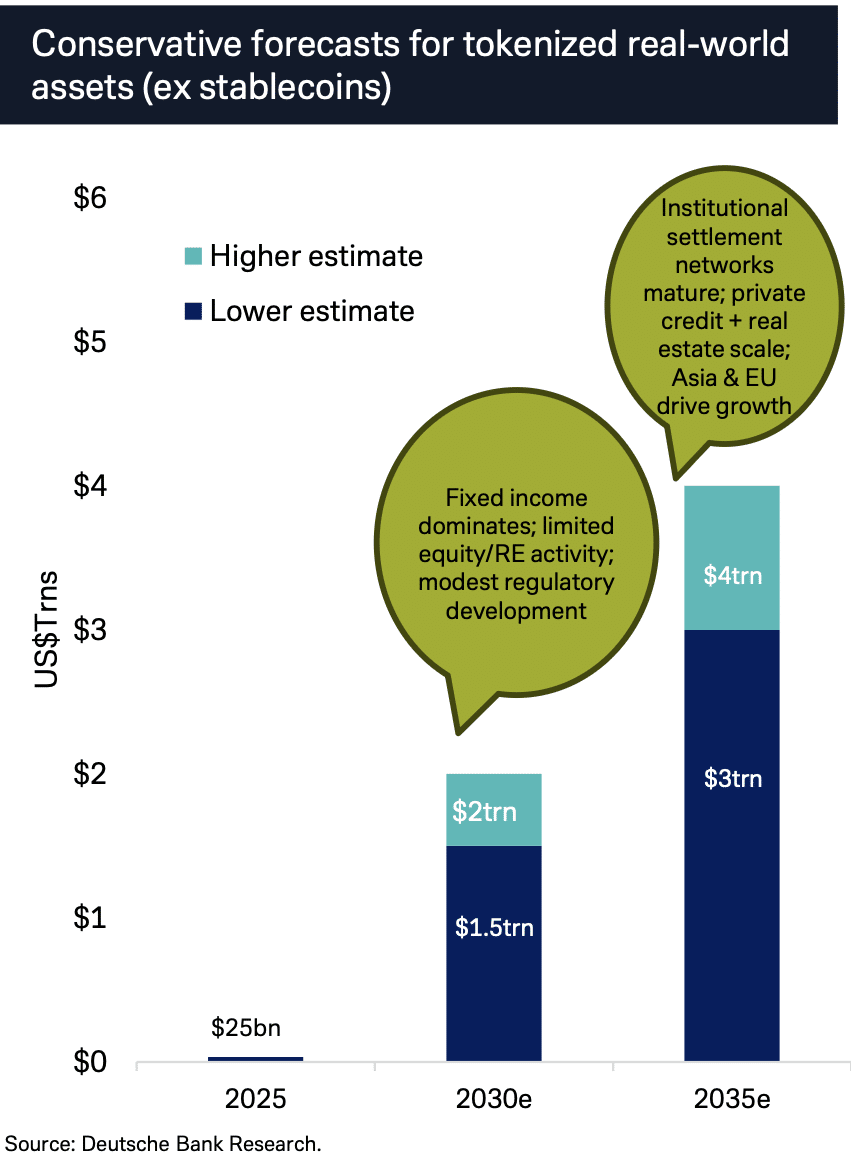
There are three growth catalysts according to the report – financial market infrastructures such as DTCC, NYSE and Nasdaq integrating tokenization into core workflows; the growth of regulated onchain money, such as stablecoins and tokenized deposits, providing a trusted settlement foundation; and regulation.
Deutsche Bank said: “U.S. 2025 GENIUS Act continues to encourage global digital asset adoption, although the failure of the CLARITY act to advance likely rules out progress in this congressional session until Jan 2027. Looking ahead, focus will turn back to the SEC and CFTC for crypto rules.”

NEWSLETTER SIGN UP
And receive exclusive articles on securities markets

🏆 The 2026 Global Markets Choice Awards are here! 🌍 Nominations are officially OPEN for the celebration of excellence in global capital markets trading & technology. Nominate below:
https://www.jotform.com/form/260086385121150

Delaware Life Insurance Company is becoming the first insurance carrier to offer an index that contains cryptocurrency, adding the BlackRock U.S. Equity Bitcoin Balanced Risk 12% Index to its fixed index annuity (FIA) portfolio.
As the digital assets industry pushes toward
Franklin Templeton is expanding its tokenized fund suite, signaling growing institutional demand for blockchain-based fund infrastructure and regulated investment products moving onchain. Read the full article below:
$50 billion in active ETF inflows helped fuel a record year for @BlackRock 's iShares business, as investors continue to lean into active strategies.
Shanny Basar
Senior writer
A Senior Writer at Markets Media who became a financial journalist in 2000 after working in banking for over a decade....
More about this authorRelated articles
-

This is the investor's first allocation to a tokenised financial asset.
-

BNY is one of the first GSIBs to offer regulated digital asset custody in the region.
-

Financial institutions and market infrastructures are moving to always-on operations.
-

This was an extension of the round in the crypto exchange led by ICE.
-

Fund managers want prime brokerage across traditional and digital markets in a regulated framework.