






07.15.2026

BlackRock’s ETF franchise, iShares, crossed $6 trillion in assets under management in the second quarter, roughly doubling in three years.
BlackRock reported financial results for the three and six months ended 30 June 2026 on 15 July 2026.

Larry Fink, chairman and chief executive said on the results call that market fundamentals are strong and well supported, with higher margins and earnings momentum catalyzed by new technology.
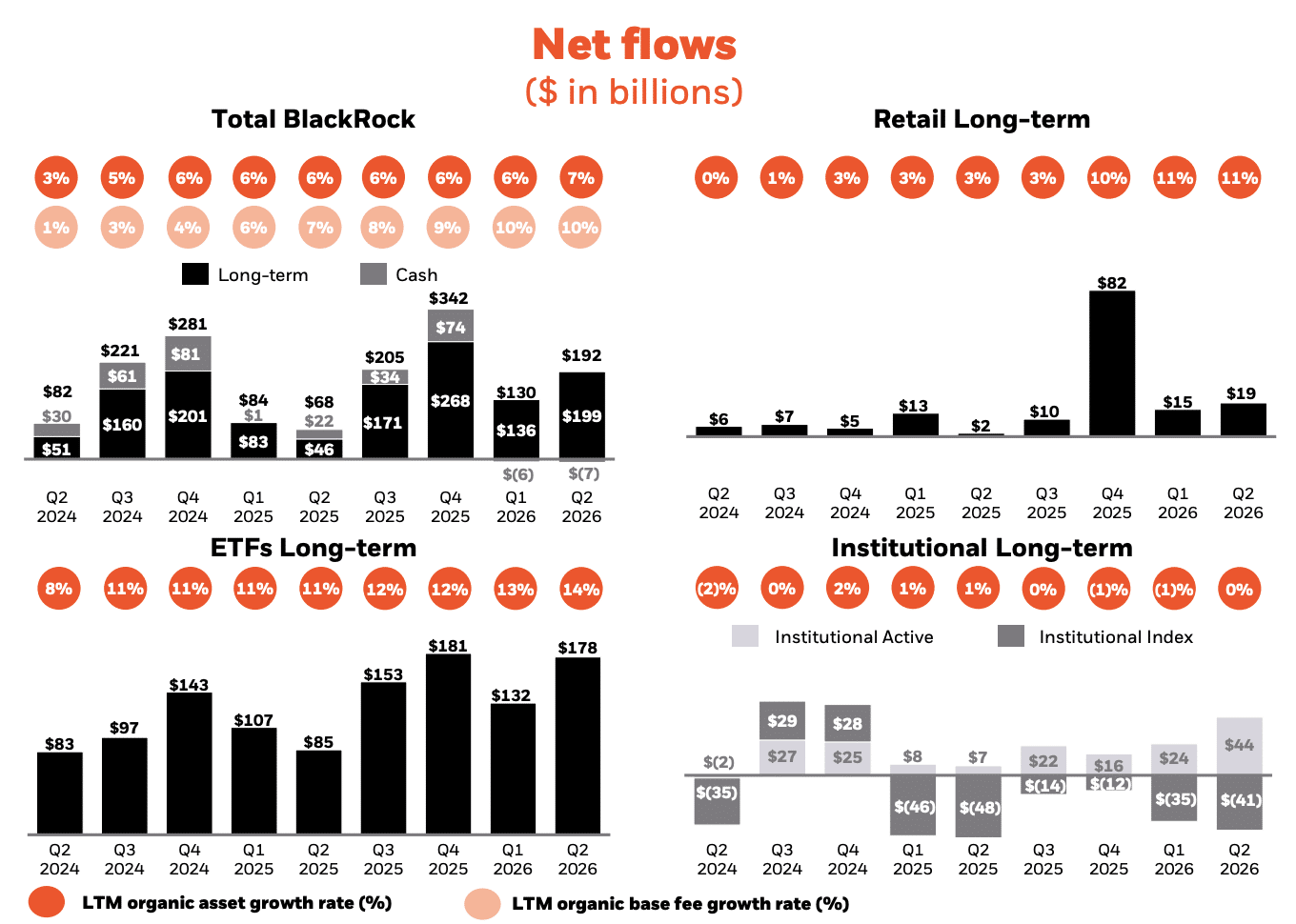
Martin Small, chief financial officer of BlackRock, said on the call that active and index strategies, had $178bn of net inflows in the second quarter. Core equity and bond index ETFs led the way with net inflows of $85bn and $61bn, respectively.
Momentum and active ETFs continued with $20bn of net inflows as Small said clients sought performance through a liquid, tax-efficient wrapper. Precision ETFs added $15bn as clients used iShares international and sector equity ETFs to express tactical views.
“iShares ETFs delivered a fifth consecutive quarter of double-digit organic base fee growth, powered by higher-value ETF categories such as active and precision,” added Small.
In Europe, iShares has raised $80bn so far this year, bringing assets under management to $1.5 trillion, according to Fink. In Asia Pacific locally domiciled iShares crossed $100bn in assets in the second quarter.
Small highlighted the despite declines in crypto by about 30%, BlackRock had “very strong” inflows into the European Bitcoin ETF, and about $650m in international exposures as clients looked to diversify their portfolios using ETFs.
“Active ETFs have gathered more than $70bn in net inflows over the last year, and we are leading the industry in active flows in 2026,” said Fink. “In the last three years, we have gone from the seventh largest active ETF manager to the third largest, and we have ambitions to take our position even higher.”
ETFs boosted the group’s assets under management to a record $15.3 trillion at the end of June this year, following $868bn of net inflows over the last twelve months. Record flows of $321b in the first six months of 2026 more than doubled year-over-year, according to Fink.
Net inflows were $192bn in the second quarter, which Fink said was broad-based across the platform and driven by ETFs, private markets, active fixed income and systematic equity strategies. He said this generated 8% organic base fee growth, well in excess of BlackRock’s target.
Tokenization
Small was asked about tokenization and replied that the firm is focused on scaled, regulated access to digital assets. BlackRock has approximately $110bn in assets under management connected to digital assets, and as part of the 2030 strategic plan it aims to make this a $500m revenue business.
Over the longer term, BlackRock’s products should be accessible natively on chains where many investors already hold digital assets.
“We’re exploring ways to tokenize long-term investment products, like iShares, so investors never need to leave digital wallets to allocate efficiently across crypto, stablecoins, and exposure to long-term stocks and bonds,” added Small.
He continued that BlackRock is working with a wide group of traditional and new players on building access to high-quality long-term investment products that can grow and thrive in digital wallets and has three aims.
The first is to bridge traditional and decentralized finance (DeFI) markets with products such as BUIDL, its tokenized money market fund. Small said: “These products invest in digitally native assets and are the largest in their categories and driving meaningful growth in the traditional capital markets.”
The second aim is to become the stablecoin reserve manager of choice in the industry. BlackRock already manages $60bn of reserves for stablecoin issuer Circle, representing about a quarter of the $300bn stablecoin market, according to Small.

“The third, and I think the most exciting for us, is tokenizing long-term investment products like treasury funds, iShares ETFs, and even private markets in the long term,” said Small.
To progress this aim, BlackRock has recently filed two registration statements with the SEC for tokenized money market funds. One filing is for a tokenized Ethereum share class in an existing fund, and the other is a more digitally native strategy with additional features such as daily dividend reinvestment. BlackRock expects the latter to be accessible through multiple chains and to operate in an ecosystem where third parties support stablecoin-enabled subscription and redemptions, so that the funding mechanism can all happen onchain in the digital wallet.
“As stablecoins and digital wallets grow, clients will need high-quality reserve and liquidity products that can operate natively in that digital ecosystem,” said Small. “These filings are bringing BlackRock’s core cash management capabilities to where digital assets clients are already operating to reinforce our broader ambition to help connect traditional capital markets and tokenized assets.”
Small highlighted that there are five billion digital wallets globally. Therefore tokenized assets are the “spear tip” into an entirely new distribution channel, accessing an entirely new class of investor, which he said is a pure organic growth opportunity for BlackRock.
“These are all potential new investors with iShares and potential new users of model portfolios, SMAs, and managed accounts in tokenized format,” Small added. “We want to build a digital wallet-native asset manager. We’re working with market participants, and regulators to do that that creates growth and resiliency and brings more investors into the markets and more organic growth at BlackRock.”
Private markets
BlackRock has set a strategy built around an integrated public and private market platform, underpinned by Aladdin, its investment technology platform. Fink highlighted that this time last year, BlackRock had just closed its acquisition of HPS and launched its 2030 strategic plan. BlackRock completed its acquisition of private credit manager HPS Investment Partners on 1 July 2025.
“Only four quarters in, our combination of GIP, HPS, and Preqin is already delivering above our expectations and accelerating our 2030 growth trajectory,” said Fink.
In March 2025 BlackRock had completed its purchase of Preqin, a private markets data provider, to serve clients’ whole portfolios across public and private markets by combining investment, technology, and data solutions in one platform. In July this year BlackRock said in a statement that it had expanded its Preqin benchmarks and indices solutions to give investors access to both reporting-grade indices and customizable, transparent peer benchmarks in one place on Aladdin. Private markets benchmarking has historically been fragmented and difficult to compare, with investors relying on disconnected tools across the investment lifecycle and often navigating multiple providers for different types of performance measurement.

Kunal Khara, global head of Aladdin product at BlackRock, said in a statement: “Expanding the breadth and quality of Preqin’s private markets data is central to bringing greater transparency and standardization to private markets, a core tenet of why we brought Preqin into BlackRock.”
In 2024 BlackRock also completed the purchase of Global Infrastructure Partners (GIP), as Fink has said infrastructure is a “generational investment opportunity.”
In private markets the flywheel is in motion, according to Small, as the firm is raising and deploying capital and returning cash to clients. There was an aggregate $15bn of net inflows in the second quarter, led by deployment in private credit, fundraising and infrastructure, and partial onboarding of an outsourcing mandate and private equity solutions. BlackRock is in the market for a number of first-time and successor strategies across infrastructure and credit.
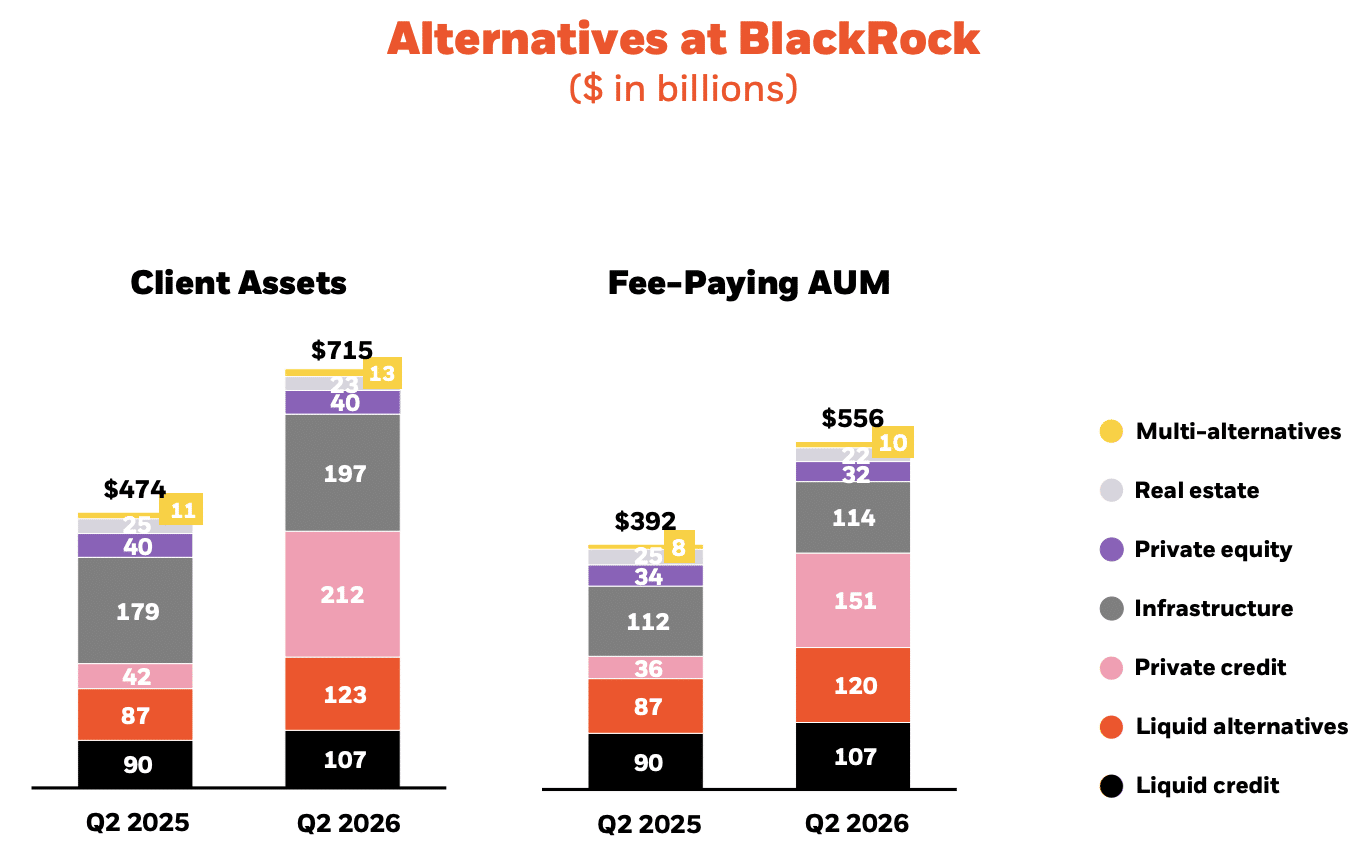
Fink argued that in infrastructure, the reach of BlackRock and GIP has resulted in a faster pace of deployment into premier investment opportunities and a faster pace of fundraising. He gave the example of the $40bn acquisition of Aligned Data Centers from Macquarie Asset Management, which is expected to close in the coming weeks and said BlackRock brought together AI Infrastructure Partnership (AIP), GIP, and MGX in the largest data center infrastructure transaction ever announced. Small said the first half of the year has been one of the busiest on record for the infrastructure platform.
“Institutional demand for private markets continues to grow, including from insurers looking to capture higher yield in their general accounts,” added Fink. “We signed several scaled high-grade investment debt infrastructure mandates in the second quarter.”
GIP and HPS are also coming together on origination, said Fink, and a pipeline of joint opportunities is building in ways that reinforces BlackRock’s conviction in the combined platform, particularly in digital infrastructure. Fink said they are working together on some very large infrastructure financings that involve both equity and debt.
“The J-curve for infrastructure investing is only just starting to accelerate and we are being asked by more technology companies to help them fund their entire investing needs,” Fink added. “Hyperscalers went from being balance sheet light companies to having major balance sheet needs in building out data centers and infrastructure, and they are looking for strategic partners that can provide them the totality of that relationship.”
Financials
Small said that two full years of above-target organic base fee growth underscores that this level of performance is sustainable.
Second quarter revenue of $7.1bn increased 31% year-over-year which the firm said reflects the positive impact of markets, organic base fee growth, fees related to the HPS transaction, higher performance fees, and higher technology services and subscription revenue. Operating income for the quarter was $2.9bn, 39% higher than a year ago.
Fink added that second quarter adjusted operating margin was 45.9%, the highest in almost five years and up 260 basis points from a year ago. He said: “We see it in our results this quarter: 8% organic base fee growth, a nearly 46% adjusted operating margin, double-digit earnings per share growth, and increasing capital return.”
Small argued that record net inflows and organic base fees in the first half of 2026 are “vivid proof points” of a firm at the center of megatrends shaping the investment landscape across public markets, private markets, and technology.
“We see strong momentum,” added Small. “Organic base fees are more than 50% higher compared to this time last year.”
Fink is very optimistic on the outlook for global markets. He said: “We see great market fundamentals with higher corporate margins and earnings momentum catalyzed by new technology. BlackRock is a direct beneficiary of this growth.”

NEWSLETTER SIGN UP
And receive exclusive articles on securities markets

🏆 The 2026 Global Markets Choice Awards are here! 🌍 Nominations are officially OPEN for the celebration of excellence in global capital markets trading & technology. Nominate below:
https://www.jotform.com/form/260086385121150

Delaware Life Insurance Company is becoming the first insurance carrier to offer an index that contains cryptocurrency, adding the BlackRock U.S. Equity Bitcoin Balanced Risk 12% Index to its fixed index annuity (FIA) portfolio.
As the digital assets industry pushes toward
Franklin Templeton is expanding its tokenized fund suite, signaling growing institutional demand for blockchain-based fund infrastructure and regulated investment products moving onchain. Read the full article below:
$50 billion in active ETF inflows helped fuel a record year for @BlackRock 's iShares business, as investors continue to lean into active strategies.
Shanny Basar
Senior writer
A Senior Writer at Markets Media who became a financial journalist in 2000 after working in banking for over a decade....
More about this authorRelated articles
-

Court approval would result in $103m returned to harmed investors.
-

Fund managers want prime brokerage across traditional and digital markets in a regulated framework.
-

The Swiss bank is migrating fund administration services to Northern Trust.
-

Non-bank institutions are taking on a greater role in intermediating capital.
-

Private credit is evolving toward the pricing, data & market making infrastructure in established markets.