





07.24.2026

Members at Eurex Clearing, Deutsche Börse Group’s clearing house, are mobilizing collateral on digital ledger technology (DLT) on a daily basis since the service launched a year ago.
Efthimia Kefalea, head of derivatives clearing development & digital innovation at Eurex Clearing, told Markets Media that the firm was the first central counterparty to enable collateral mobilization using DLT.
“Members use this functionality daily because it is fast and efficient, taking only a couple of minutes to move collateral, compared to hours or even days,” she added.

Anja Kleefsman, PGGM
In July 2025 Eurex Clearing completed the first transaction on its DLT-facilitated collateral mobilization service. J.P. Morgan moved securities collateral for its client PGGM, a Dutch pension fund, from another custody location to Clearstream Banking in Luxembourg for use as margin collateral. The underlying technology is provided by HQLAX, a provider of DLT solutions for collateral management.
Anja Kleefsman, head of treasury and liquidity management at PGGM, said in a statement at the time that optimizing collateral management is a key priority for the pension fund. Kleefsman added: “Instant access to and mobilization of collateral assets provided by this DLT-based technology is a major step forward and we welcome this innovation.”
The ValueExchange consultancy estimated in a report that operational costs make up over half of the total cost of a collateral trade, so the efficiencies of using DLT for counterparties are significant.
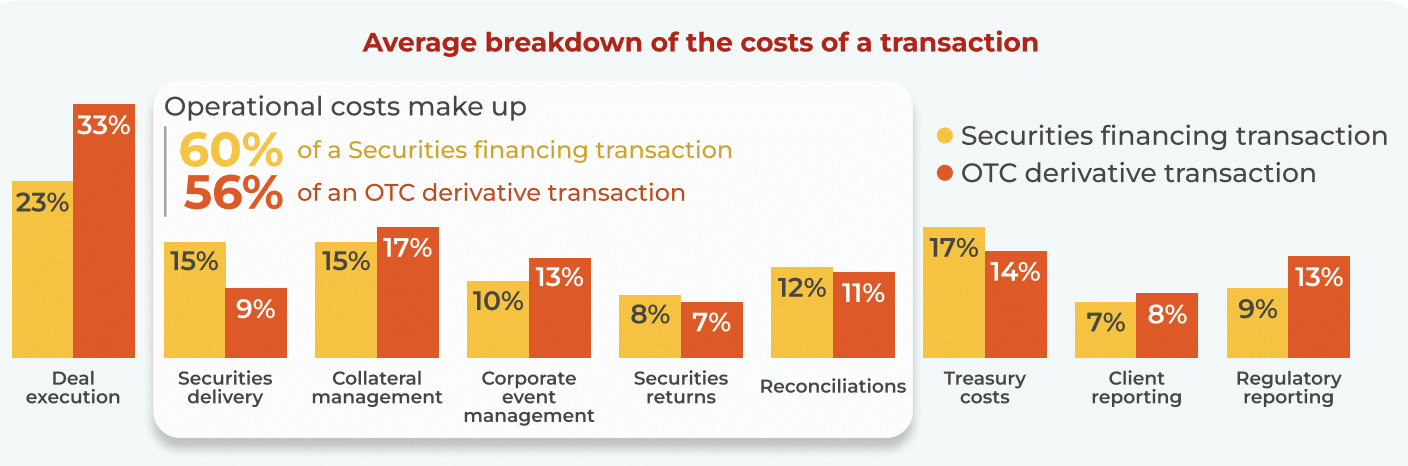
Source: The ValueExchange
Kefalea added that since the end of March this year, the European Central Bank has accepted digital assets issued in central securities depositories using DLT-based services as eligible collateral. She said: “This forward-looking yet prudent decision provides an important foundation for the safe and gradual adoption of digital assets across Europe.”
The European Bank said in a statement that, like other marketable assets, the digital assets must comply with Eurosystem collateral eligibility criteria and collateral management requirements. These criteria include availability for settlement in eligible securities settlement systems, which must be compliant with the CSD Regulation and reachable via the TARGET2-Securities (T2S) platform.
The Eurosystem is also exploring if, how and under what criteria assets issued using DLT and not represented in eligible securities settlement systems could become eligible and be mobilized as Eurosystem collateral in the future. The ECB envisages a staggered approach depending on market, legal and regulatory developments.
“Under this approach, subsets of DLT-based assets could gradually become eligible and be mobilized,” added the ECB.
Stablecoins
Last September Deutsche Börse Group announced a collaboration with Circle, the stablecoin issuer. Kefalea said: “Eurex is assessing the use of stablecoins as cash equivalent and as collateral for the CCP.”

Jeremy Allaire, Circle
Deutsche Börse said in a statement at the time that it aims to deploy Circle’s products, including EURC and USDC stablecoins, within its financial market infrastructure including 360T, the foreign exchange business; Crypto Finance, the cryptocurrency business; and central securities depository Clearstream, which offers settlement and custody of crypto assets to institutional investors.
Jeremy Allaire, co-founder, chairman and chief executive of Circle, said in a statement at the time: “Together with Deutsche Börse Group, we’re planning to advance the use of regulated stablecoins across Europe’s market infrastructure—reducing settlement risk, lowering costs, and improving efficiency for banks, asset managers, and the wider market.”
Tokenized bank money
In traditional finance, Eurex Clearing is part of the European Central Bank’s exploratory work on wholesale central bank digital currency and has integrated technical solutions from Deutsche Bundesbank and Banque de France into its clearing processes. Outside Europe, Eurex Clearing said it is the only CCP participating in Project Agorá, an initiative led by the Bank for International Settlements (BIS) to tokenize central bank and commercial bank money on an interoperable DLT platform and make cross-border payments more efficient.
In March this year the Eurosystem published the roadmap for Appia, an initiative to shape the development of a European tokenized financial ecosystem in which central bank money plays a central role.
The Eurosystem said its strategy for providing tokenized wholesale central bank money rests on two complementary initiatives: Pontes and Appia.
Pontes is the Eurosystem’s DLT solution that will be launched in the third quarter of 2026 to enable central bank money settlement for DLT-based transactions. Appia involves working with the market to explore how a wholesale financial ecosystem based on tokenization and DLT could be designed.

Efthimia Kefalea, Eurex Clearing
Kefalea said in an article in the WFE’s Focus magazine: “Appia aims to create a shared settlement framework for tokenized assets, and Eurex Clearing’s contribution ensures that clearing services remain compatible with emerging digital securities ecosystems.”
The Eurosystem plans to publish a blueprint for this ecosystem in 2028.
Piero Cipollone, member of the ECB’s executive board, said in a statement: “With Appia, we are building a road from today’s financial system to tomorrow’s tokenized markets, firmly grounded in central bank money.”
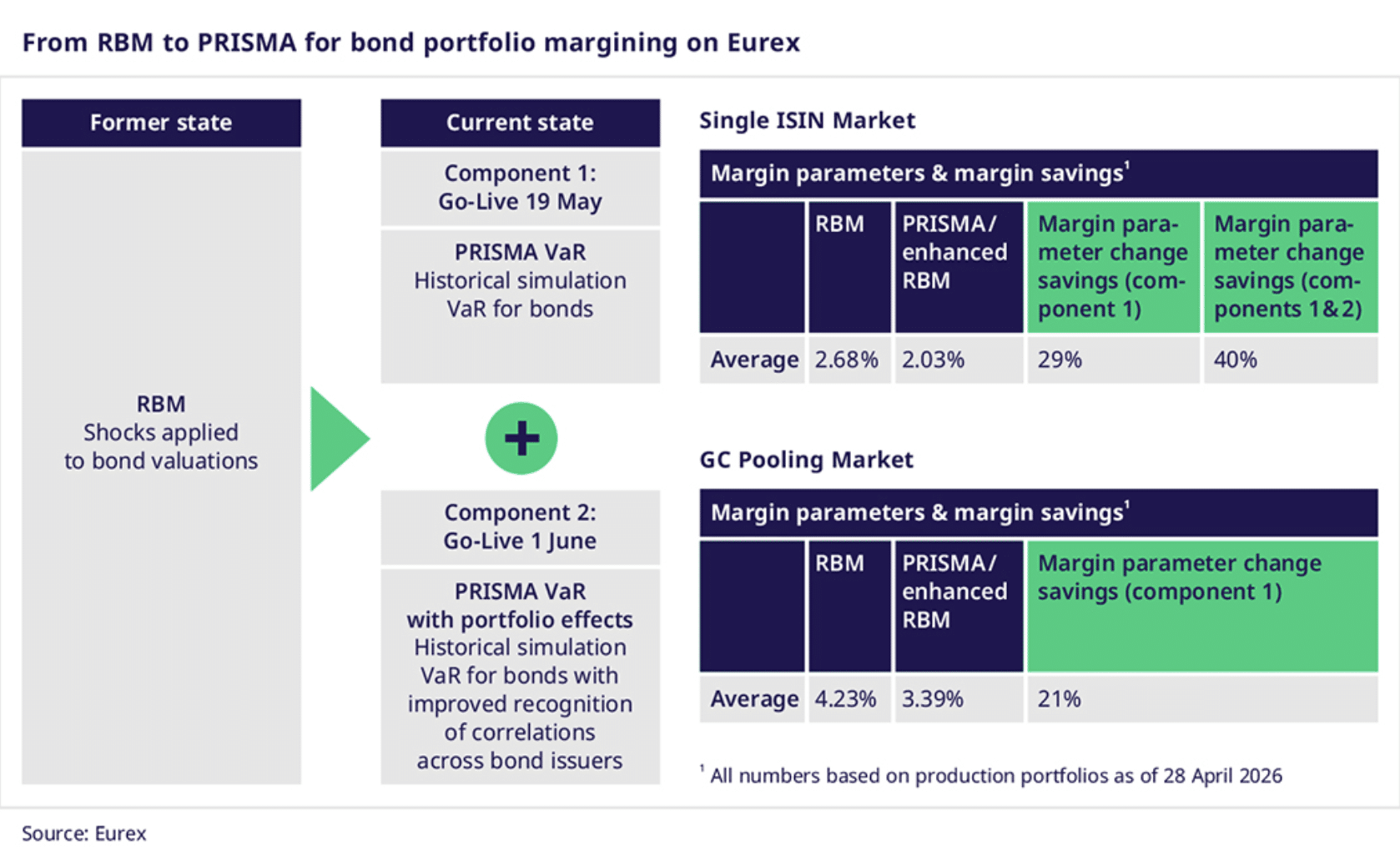
Source: Eurex
In addition to digital assets, Eurex Clearing has also introduced bond portfolio margining for the first time in June this year by extending its established PRISMA risk model, and said this paves the way for future cross-margining between repos and derivatives.
“Capital efficiency remains a key client priority; cross-margining between repos and derivatives is a major enabler of balance sheet and funding efficiency,” added Kefalea.

NEWSLETTER SIGN UP
And receive exclusive articles on securities markets

🏆 The 2026 Global Markets Choice Awards are here! 🌍 Nominations are officially OPEN for the celebration of excellence in global capital markets trading & technology. Nominate below:
https://www.jotform.com/form/260086385121150

Delaware Life Insurance Company is becoming the first insurance carrier to offer an index that contains cryptocurrency, adding the BlackRock U.S. Equity Bitcoin Balanced Risk 12% Index to its fixed index annuity (FIA) portfolio.
As the digital assets industry pushes toward
Franklin Templeton is expanding its tokenized fund suite, signaling growing institutional demand for blockchain-based fund infrastructure and regulated investment products moving onchain. Read the full article below:
$50 billion in active ETF inflows helped fuel a record year for @BlackRock 's iShares business, as investors continue to lean into active strategies.
Shanny Basar
Senior writer
A Senior Writer at Markets Media who became a financial journalist in 2000 after working in banking for over a decade....
More about this authorRelated articles
-

The regulator is reviewing if tokenised collateral could be used safely by EU CCPs.
-

Financial institutions and market infrastructures are moving to always-on operations.
-

Central clearing has been introduced to a securities financing transactions market that operated bilaterally.
-

For the first time, Coinbase can create and settle fully collateralized derivatives directly.
-

MIAX also increased net capital in the FCM, Dorman Trading, by $40m.