






07.01.2026

Flow Traders, a global trading firm based in Amsterdam, said its digital asset revenues increased from €15m in 2019 to €120m this year as it aims to become the 24/7 liquidity provider of choice across both traditional and digital assets.
In June this year Flow Traders presented its strategy update, Horizon 2030, to investors and detailed its plan to become the 24/7 liquidity provider of choice while setting its financial ambitions for 2030. The strategy aims to drive profitable growth across traditional and digital assets, powered by frontier technology, AI and deep learning.
Thomas Spitz, chief executive of Flow Traders, said in a statement that tokenization, infrastructure modernization and investor requirements are removing the boundaries between asset classes and time zones.

Marc Jansen, Flow Traders
Marc Jansen, co-chief trading officer at Flow Traders, told Markets Media that the firm started getting involved in crypto nine years ago based on the thesis that the financial world would eventually move onchain.
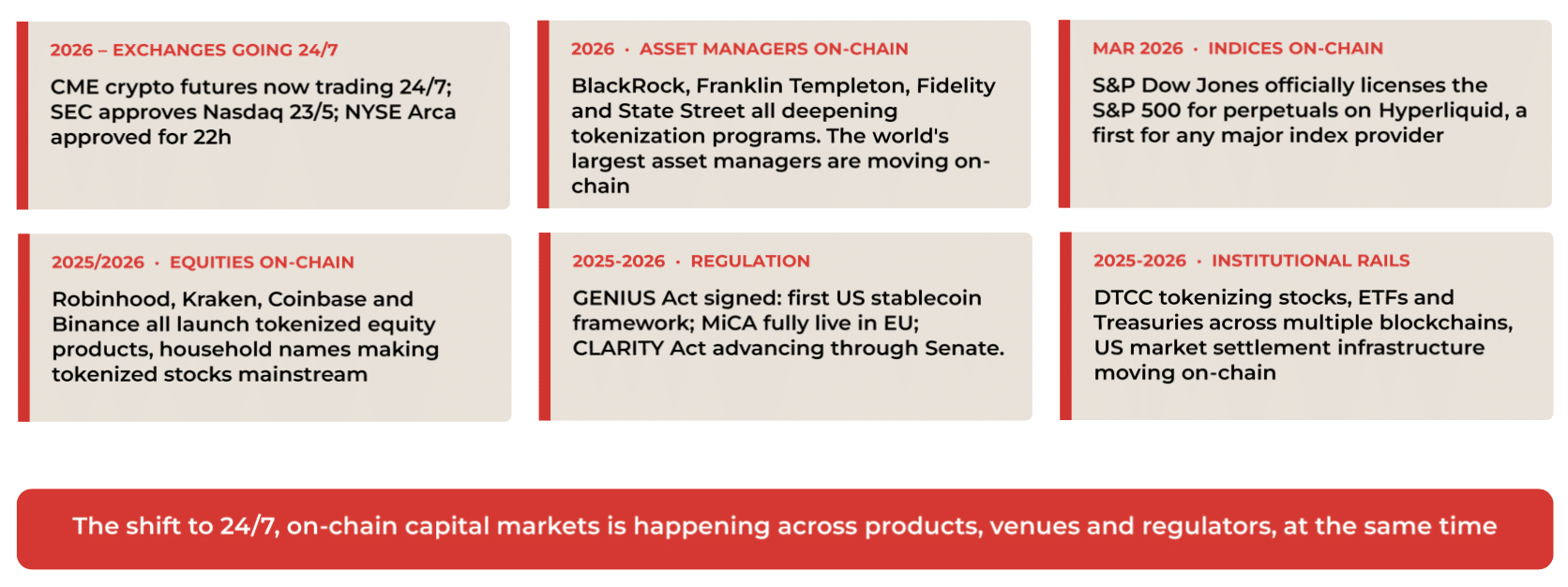
Institutions were then suspicious of digital assets. However, Jansen said there has been a big shift since the U.S. administration passed the GENIUS Act for stablecoins and the DTCC, the U.S post-trade infrastructure, announced that it is launching its tokenization service this year. The service will enable the tokenization of real-world, DTC-custodied assets, that are valued at over $114 trillion,. The tokens will have the same entitlements, investor protections and ownership rights as the assets held in traditional form.
Source: Flow Traders
Jansen said at Flow Traders’ investor day that when the DTCC moves onchain, the rest of the U.S. financial system will follow. He added: “This is not just happening in one corner of the market. The shift to 24/7 onchain markets is no longer theoretical.”
Jansen argued that a differentiator for Flow Traders is that the firm has also been trading ETFs for 23 years. He said: “We are uniquely positioned as the only firm with digital asset and ETF market making under the same roof.”
He compared tokenization to the ETF market structure revolution. For example, minting of tokens onchain is similar to the create/redeem process in ETFs.
The firm is already used to operating 24/7 and used to pricing ETFs when the underlying markets are closed, said Jansen.
“The skills we have built up over more than 20 years of ETF market making map directly onto tokenized assets,” Jansen added. “We are already active in tokenized real world assets, while most firms are still writing internal memos about it.”
Flow Traders is also accustomed to finding liquidity in fragmented markets as there are, for example, more than 40 ETFs on the S&P 500 index.
Jansen believes Flow Traders has an advantage because it already has nine years of proprietary data, hundreds of institutional relationships, and a platform that covers the full digital asset life cycle.
“You can’t build nine years of experience overnight,” Jansen said. “We didn’t wait for the infrastructure, we built alongside it.”
Over-the-counter offering
In March this year Flow Traders expanded its digital assets OTC offering beyond crypto, launching 24/7 proprietary, two-way liquidity for tokenized money-market funds, equities and commodities. Jansen said this was to meet growing demand for reliable access to tokenized assets across extended trading hours, overnights, and weekends. Counterparties can trade and hedge tokenized equity and commodity exposures against fiat or stablecoins.

Thomas Spitz, Flow Traders
Spitz said in a statement that in some large‑cap U.S. stocks, activity across tokenized and synthetic markets has at times reached around 2–3% of the notional trading volume of their primary U.S. listings. He added: “Much of this activity takes place outside traditional U.S. market hours, creating new infrastructure to manage equity risk overnight and across global trading sessions.”
Horizon 2030
At the investor day in June, Jansen presented the strategy for the digital asset business. He said Flow Traders will broaden its product coverage across ETFs, including active and innovative strategies, while expanding its digital asset and tokenized asset capabilities to further grow 24/7 trading and drive convergence between traditional and digital markets.
Jansen said this positions Flow Traders at the epicenter of the fastest-growing segments in capital markets, capturing the tokenized RWA [real world asset] opportunity forecasted at $5.5 trillion by 2030.
Source: Flow Traders
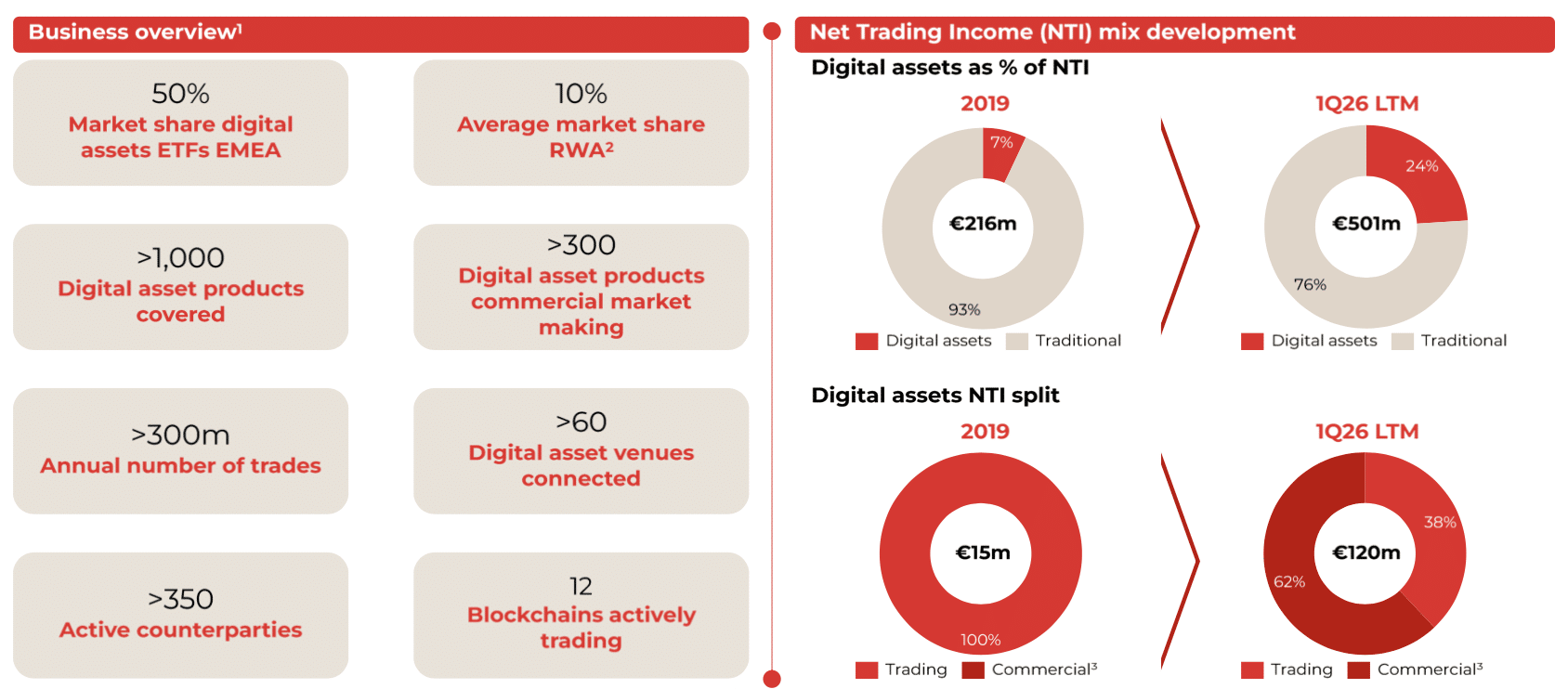
Half of crypto ETF trades in Europe, Middle East and Africa go through Flow Traders and the firm has 10% market share across tokenized real world assets, a market that barely existed three years ago, according to Jansen.
He highlighted the revenue growth in digital asset business. Jansen said: “Digital assets moved from 7% of total group revenue to 24% which is a structural shift in the company.”
In 2019 digital asset revenue was approximately €15m, which has increased to €122m in the first quarter of 2026.
Back in 2019 all the digital asset revenue came from trading. In contrast, this year commercial revenue makes up 62% which Jansen said is contractual and less sensitive to daily market conditions. Commercial revenue is generated from venture capital investments, partnerships, onchain infrastructure, and token market making agreements, and some may be paid in tokens rather than fiat currency.
“The digital asset franchise is large, profitable, diversifying and structurally improving in revenue quality,” said Jansen.
He argued that by investing selectively in digital asset protocols and infrastructure projects Flow Traders gets equity or tokens, and early access before new markets are established.
“That positions us as the preferred liquidity provider as those ecosystems grow, and it funds itself through capital appreciation and token returns,” he added. “We are not just a user of these ecosystems but bear part of their functioning infrastructure.”
Flow Traders set financial ambitions for 2030 which include net trading income of more than €1bn, return on trading capital of more than 50% and an EBITDA margin above 45%

NEWSLETTER SIGN UP
And receive exclusive articles on securities markets

🏆 The 2026 Global Markets Choice Awards are here! 🌍 Nominations are officially OPEN for the celebration of excellence in global capital markets trading & technology. Nominate below:
https://www.jotform.com/form/260086385121150

Delaware Life Insurance Company is becoming the first insurance carrier to offer an index that contains cryptocurrency, adding the BlackRock U.S. Equity Bitcoin Balanced Risk 12% Index to its fixed index annuity (FIA) portfolio.
As the digital assets industry pushes toward
Franklin Templeton is expanding its tokenized fund suite, signaling growing institutional demand for blockchain-based fund infrastructure and regulated investment products moving onchain. Read the full article below:
$50 billion in active ETF inflows helped fuel a record year for @BlackRock 's iShares business, as investors continue to lean into active strategies.
Shanny Basar
Senior writer
A Senior Writer at Markets Media who became a financial journalist in 2000 after working in banking for over a decade....
More about this authorRelated articles
-

A CSD will use a public blockchain to mirror securities ownership records for the first time.
-

21X Group operates the first fully regulated trading and settlement system for tokenized securities in the EU.
-

For the first time, Coinbase can create and settle fully collateralized derivatives directly.
-

London Stock Exchange Group also intends to bring other services into the Canton Network.
-

Pairing Coinbase with Citi’s regulated banking rails gives a direct path between tradFi & digital assets.