






02.17.2026

London Stock Exchange Group is launching LSEG DiSH, a platform for programmable commercial bank money, and Lloyds Banking Group has completed the first gilt purchase using tokenized deposits.
On 15 January 2026 London Stock Exchange Group said in a statement that it is launching an open-access platform, LSEG DiSH, for both onchain and traditional settlements. Commercial bank deposits on the platform’s ledger, DiSH Cash, will enable the 24/7 instantaneous movement of money in multiple currencies and jurisdictions, to provide a real cash leg for settlements. Instantaneous settlement of cash means LSEG DiSH can offer dynamic management of intraday liquidity and funding, as well as 24/7 management of margin which increases capital efficiency.

Dan Maguire, LSEG
Daniel Maguire, group head, LSEG Markets and chief executive at LCH Group, said: “LSEG DiSH expands the tokenized cash and cash-like solutions available to the market, and for the first time, offers a real cash solution tokenized on the blockchain utilising cash in multiple currencies held at commercial banks.”
Bud Novin, head of payment systems, post trade solutions, LSEG Digital Asset, told Markets Media there was a need to enable a fiat cash leg in digital asset transactions, rather than using a central bank digital currency, stablecoin or a bank coin.
Novin explained that coins or deposit tokens issued by banks are great for direct lending, but are limited because they can only be used by that individual bank’s customers. Tokenized money funds and stablecoins are not cash, and Novin said they are not suitable for institutional trades as they cannot be guaranteed to convert to cash in unlimited amounts. As a result, DiSH has been designed to enable dealers to use commercial bank money without having to open a bank account.
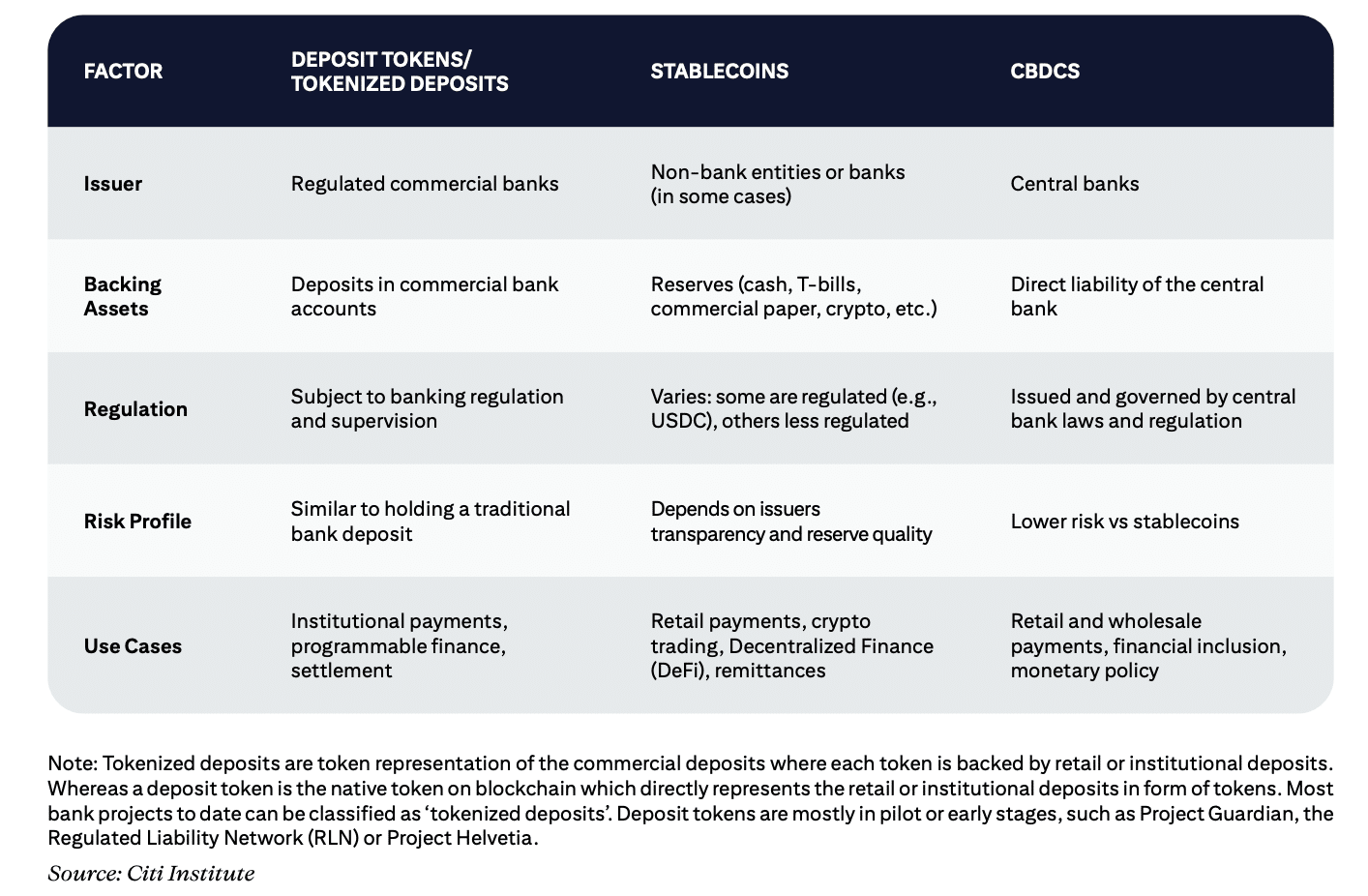
Source: Citi Institute
LSEG owns accounts in each currency at a commercial bank, which are bankruptcy remote from the exchange group, according to Novin. He adds: “We control beneficial ownership of the cash on our ledger, DiSH Cash, which we tokenize for 24/7 trading on the Canton Network.”
When there is a transaction, LSEG DiSH mints a token for party A on the Canton Network, Digital Assets’ blockchain for financial institutions with built-in privacy controls. When that token is transferred to party B, LSEG DiSH instantaneously updates its ledger so party B has beneficial ownership of the commercial bank money. LSEG DiSH is going live with Canton Network but the platform is open access, so it can connect to any blockchain that customers want to use, increasing interoperability.

Bud Novin, LSEG
Novin describes DiSH as a service allowing clients to use previously trapped assets to generate cash 24/7 and synchronise cash movements to activity that is either on- or off-chain. For example, clients could send foreign exchange trades to be settled directly on DiSH’s ledger. DiSH also allows overnight repo borrowing to migrate to intraday repo, which improves capital efficiency and is about one tenth of the cost.
The cash can be used for lending, repos or settling transactions payment-versus-payment (PvP), or delivery-versus-payment (DvP) or with anyone who signs up to LSEG DiSH’s rulebook. The new platform has a rule book and account structure that is similar to LCH SwapAgent, the LSEG business that prices and settles a significant percentage of the cross-currency swap market.
“Transactions are most efficient when both legs are onchain but we can still improve efficiency for transactions that are off chain,” said Novin. “We will be doing more pilots before launching in the summer, including a tokenized gilt, with some new big names.”
LSEG DiSH wants to work with clearing houses to offer solutions for industry pain points such as operating 24/7 and margining over the weekends, and is creating an all-to-all model where people will be able to use tokenized money market funds as collateral. Novin said LSEG DiSH wants to foster liquid secondary markets in tokenized money.
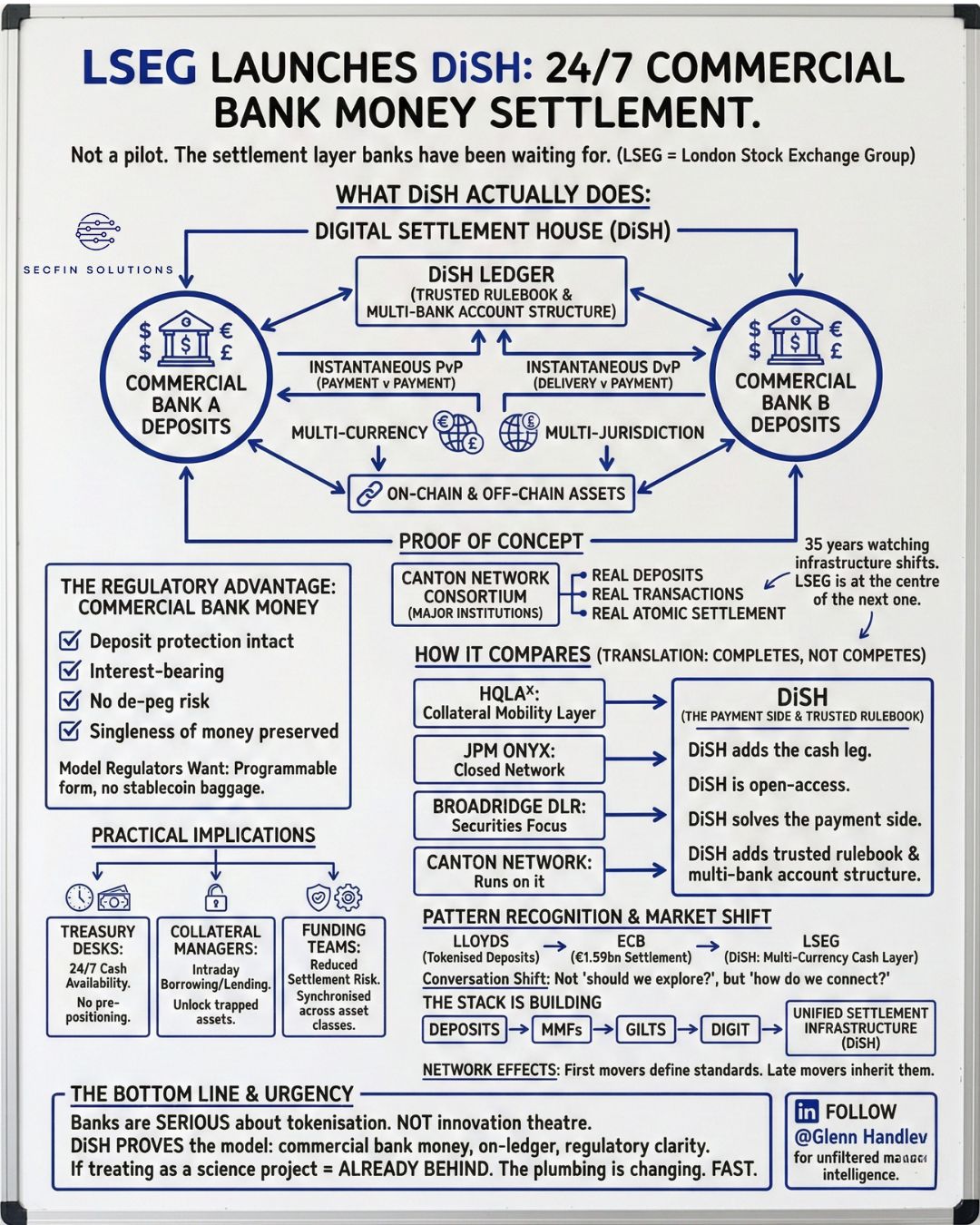
Source: Glenn Handley
Management consultant Glenn Handley said in a LinkedIn post: “This isn’t another pilot. This is the settlement layer banks have been waiting for.”
Handley continued that regulators prefer commercial bank money in programmable form to stablecoins. He added: “35 years watching infrastructure shifts. LSEG just positioned itself at the centre of the next one.”
Tokenized deposits
While LSEG is setting up DiSH, Lloyds Banking Group said in a statement on 7 January 2026 that it had completed the first digital asset transaction using tokenized deposits in the U.K. Sterling tokenized deposits were issued for the first time on a public blockchain, the Canton Network. Lloyds Bank Corporate Markets used the deposits to buy a tokenized gilt from Archax, the FCA-regulated digital asset exchange.
The What’s Drippin newsletter from Security Token Group, said: “Although this isn’t launched to their clients yet, it’s another strong movement forward for the region and those involved. This builds on previous work together around tokenized collateral so naturally we expect this partnership to continue growing and will keep an eye on future rollouts and applications.”

Surath Sengupta, Lloyds
Surath Sengupta, head of transaction banking products at Lloyds, told Markets Media that clients are increasingly looking for transparency, speed and instant settlement and blockchain technology helps the bank fulfil these requirements. For example, in trade finance Lloyds used blockchain to reduce the time it takes for certain trades from months and days to hours and minutes.
“The gilt transaction showcases the ability to move between traditional and digital assets and vice versa which is critical, because our clients demand that ability,” he added.
Sengupta believes that if you look at the future through the lens of this transaction, you can see a treasurer being able to digitize all the traditional assets on the balance sheet. On the other side, they can move from fiat cash into tokenized deposits for instantaneous settlement and smart contracts will be able to automate some decision making.
Lloyds has a runway of use cases for tokenized deposits, according to Sengupta, as they keep the security and features of traditional cash, such as earning interest, while giving all the advantages of digital money, including instantaneous settlement, transparency and programmability.
“We are not saying no to stablecoins, or other forms of digital money, because we will be driven by the customer and the market,” he said. “The security features of tokenized deposits and their linkage back to traditional money make them a really good tool for scaling this market.”
Sengupta believes the regulatory and market environment is coming together to support tokenized deposits, and banks and other financial partners are increasingly getting ready to facilitate these transactions for clients. Therefore, he thinks this will start scaling quite quickly in the near term.
“Tokenization is increasingly coming from the periphery into the centre and we believe there will be more transactions,” he added.
Peter Left, head of digital and market innovation at Lloyds Banking Group, said in a blog that digital assets are moving into the financial mainstream with stablecoins set to transform international payments, digital wallets expected to become a core customer interface and the emergence of digital capital markets. In addition to tokenized deposits and digital gilts, Lloyds is working with other banks on Great British Tokenised Deposits (GBTD), which will enable person-to-person marketplace payments: faster remortgaging and digital asset settlement.
“The financial services industry stands on the brink of a transformation as profound as the arrival of the internet itself,” said Left. “In 2026, digital assets will move from the periphery to the heart of mainstream finance, reshaping how businesses and individuals interact with money, markets, and each other.”
So which forces behind this change should investors be watching most closely?
Senior Research Analyst Martha Reyes breaks down the key dynamics and why they matter for allocators: https://t.co/8WMlA6TiuI
— Fidelity Digital Assets (@DigitalAssets) February 17, 2026
Martha Reyes, senior research analyst at Fidelity Digital Assets, said in a blog that the digital assets market in the UK and Europe is evolving into a more mature and investable ecosystem and regulatory clarity is increasing.
“Looking ahead, the UK plans to bring crypto firms – including exchanges, custodians, and wallet providers – fully under the existing financial services framework by October 2027, overseen by the FCA and Bank of England in the case of systemic stablecoins,” she added. “This new regime will apply the same governance, transparency, and conduct standards as traditional financial services, with detailed rules expected in 2026 following a series of FCA consultations.”

NEWSLETTER SIGN UP
And receive exclusive articles on securities markets

🏆 The 2026 Global Markets Choice Awards are here! 🌍 Nominations are officially OPEN for the celebration of excellence in global capital markets trading & technology. Nominate below:
https://www.jotform.com/form/260086385121150

Delaware Life Insurance Company is becoming the first insurance carrier to offer an index that contains cryptocurrency, adding the BlackRock U.S. Equity Bitcoin Balanced Risk 12% Index to its fixed index annuity (FIA) portfolio.
As the digital assets industry pushes toward
Franklin Templeton is expanding its tokenized fund suite, signaling growing institutional demand for blockchain-based fund infrastructure and regulated investment products moving onchain. Read the full article below:
$50 billion in active ETF inflows helped fuel a record year for @BlackRock 's iShares business, as investors continue to lean into active strategies.
Shanny Basar
Senior writer
A Senior Writer at Markets Media who became a financial journalist in 2000 after working in banking for over a decade....
More about this authorRelated articles
-

This is the investor's first allocation to a tokenised financial asset.
-

BNY is one of the first GSIBs to offer regulated digital asset custody in the region.
-

Bank of America, Nomura, and Tradeweb are new strategic investors.
-

J.P. Morgan provided Solana Foundation with input on institutional settlement practices and requirements.
-

The Swiss bank is migrating fund administration services to Northern Trust.